



 Chat with AI
Exam 8: Inventories and the Cost of Goods Sold

Exam 1: Accounting: Information for Decision Making135 Questions
Exam 2: Basic Financial Statements158 Questions
Exam 3: The Accounting Cycle: Capturing Economic Events161 Questions
Exam 4: The Accounting Cycle: Accruals and Deferrals160 Questions
Exam 5: The Accounting Cycle: Reporting Financial Results136 Questions
Exam 6: Merchandising Activities144 Questions
Exam 7: Financial Assets233 Questions
Exam 8: Inventories and the Cost of Goods Sold169 Questions
Exam 9: Plant and Intangible Assets154 Questions
Exam 10: Liabilities221 Questions
Exam 11: Stockholders Equity: Paid-In Capital166 Questions
Exam 12: Income and Changes in Retained Earnings153 Questions
Exam 13: Statement of Cash Flows181 Questions
Exam 14: Financial Statement Analysis165 Questions
Exam 15: Global Business and Accounting95 Questions
Exam 16: Management Accounting: a Business Partner124 Questions
Exam 17: Job Order Cost Systems and Overhead Allocations116 Questions
Exam 18: Process Costing103 Questions
Exam 19: Costing and the Value Chain89 Questions
Exam 20: Cost-Volume-Profit Analysis147 Questions
Exam 21: Incremental Analysis119 Questions
Exam 22: Responsibility Accounting and Transfer Pricing108 Questions
Exam 23: Operational Budgeting115 Questions
Exam 24: Standard Cost Systems130 Questions
Exam 25: Rewarding Business Performance71 Questions
Exam 26: Capital Budgeting125 Questions
Exam 28: Forms of Business Organization52 Questions
Exam 27: The Time Value of Money: Future Amounts and Present Values Answer Key49 Questions
Select questions type


In a perpetual inventory system, the flow of inventory cost is first through the balance sheet then through the income statement.
(True/False)
4.8/5  (72)
(72) In a periodic inventory system, overstating the amount of ending inventory will cause an understatement of gross profit in the following year.
(True/False)
4.9/5 (87)
(87) The total amount debited to the Inventory account during January was:
(Multiple Choice)
5.0/5 (74)
(74) Sherman Electric uses a periodic inventory system. The beginning inventory of a particular product, and the purchases during the current year, were as follows:
 At December 31, the ending inventory of this product consisted of 65 units.
Using periodic costing procedures, determine (1) cost of the year-end inventory and, (2) cost of goods sold relating to this product under each of the following flow assumptions:
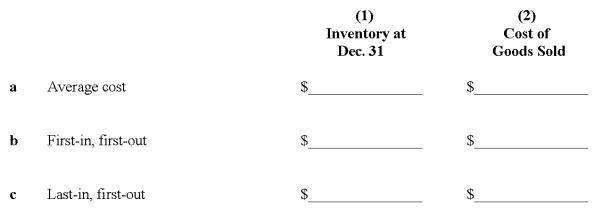
At December 31, the ending inventory of this product consisted of 65 units.
Using periodic costing procedures, determine (1) cost of the year-end inventory and, (2) cost of goods sold relating to this product under each of the following flow assumptions: (Essay)
4.8/5 (72)
(72) Companies with periodic inventory systems often use techniques such as the gross profit method and the retail method to:
(Multiple Choice)
4.9/5 (68)
(68) When goods for sale are not homogeneous in nature, it is not necessary to use the specific identification method of accounting for inventory.
(True/False)
4.9/5 (91)
(91) Salerno Co. has an inventory turnover rate of 7 and an accounts receivable turnover rate of 5. Assuming 365 days in a year, the period of time required for Salerno to convert its inventory into cash through normal business operations is approximately:
(Multiple Choice)
4.8/5 (75)
(75) The primary purpose for using an inventory flow assumption is to:
(Multiple Choice)
4.9/5 (80)
(80) Trent Department Store uses a perpetual inventory system but adjusts its inventory records at year-end to reflect the results of a complete physical inventory. In the physical inventory taken at the ends of 2010 and 2011, Trent's employees failed to count the merchandise in the store's window display. The cost of this merchandise amounted to $13,000 at the end of 2010, and $19,000 at the end of 2011. As a result of these errors, the cost of goods sold for 2005 will be:
(Multiple Choice)
4.9/5 (84)
(84) Many companies state in their annual reports that inventory is shown at the lower of its cost or market value. This means that the inventory:
(Multiple Choice)
4.9/5 (71)
(71) Just-in-time inventory systems cannot be used in conjunction with LIFO.
(True/False)
4.8/5 (96)
(96) Which of the four inventory cost flow assumptions is best suited to inventories of high-priced, low-volume items?
(Multiple Choice)
4.8/5 (86)
(86) If all things are equal, except one company uses LIFO during inflation and the other uses FIFO, then:
(Multiple Choice)
4.9/5 (68)
(68) Because of the consistency principle, inventory should never be written down below cost.
(True/False)
4.7/5 (84)
(84) Assume that the replacement cost of this monitor at year-end is $210 per unit. Using LIFO flow assumption and the lower-of-cost-or-market rule, the ending inventory amounts to:
(Multiple Choice)
5.0/5 (87)
(87) A store that sells expensive custom-made jewelry is most likely to determine its cost of goods sold using:
(Multiple Choice)
4.8/5 (84)
(84) 
Filters
- Essay(0)
- Multiple Choice(0)
- Short Answer(0)
- True False(0)
- Matching(0)