



 Chat with AI
Exam 14: Financial Statement Analysis

Exam 1: Accounting: Information for Decision Making135 Questions
Exam 2: Basic Financial Statements158 Questions
Exam 3: The Accounting Cycle: Capturing Economic Events161 Questions
Exam 4: The Accounting Cycle: Accruals and Deferrals160 Questions
Exam 5: The Accounting Cycle: Reporting Financial Results136 Questions
Exam 6: Merchandising Activities144 Questions
Exam 7: Financial Assets233 Questions
Exam 8: Inventories and the Cost of Goods Sold169 Questions
Exam 9: Plant and Intangible Assets154 Questions
Exam 10: Liabilities221 Questions
Exam 11: Stockholders Equity: Paid-In Capital166 Questions
Exam 12: Income and Changes in Retained Earnings153 Questions
Exam 13: Statement of Cash Flows181 Questions
Exam 14: Financial Statement Analysis165 Questions
Exam 15: Global Business and Accounting95 Questions
Exam 16: Management Accounting: a Business Partner124 Questions
Exam 17: Job Order Cost Systems and Overhead Allocations116 Questions
Exam 18: Process Costing103 Questions
Exam 19: Costing and the Value Chain89 Questions
Exam 20: Cost-Volume-Profit Analysis147 Questions
Exam 21: Incremental Analysis119 Questions
Exam 22: Responsibility Accounting and Transfer Pricing108 Questions
Exam 23: Operational Budgeting115 Questions
Exam 24: Standard Cost Systems130 Questions
Exam 25: Rewarding Business Performance71 Questions
Exam 26: Capital Budgeting125 Questions
Exam 28: Forms of Business Organization52 Questions
Exam 27: The Time Value of Money: Future Amounts and Present Values Answer Key49 Questions
Select questions type


Component percentages indicate the relative size of each item included in a total. Which of the following statements is true?
(Multiple Choice)
4.9/5  (80)
(80) One number expressed as a percentage of another is called:
(Multiple Choice)
4.8/5 (62)
(62) If the return on total assets ratio is substantially below the cost of borrowing, common stockholders will benefit from a high debt ratio.
(True/False)
5.0/5 (80)
(80) From a creditor's point of view, the lower the debt ratio; the safer the creditor's position.
(True/False)
4.8/5 (88)
(88) A transaction that will increase the quick ratio but cause the current ratio to decline is:
(Multiple Choice)
4.9/5 (82)
(82) All of the following ratios are considered measures of profitability except:
(Multiple Choice)
4.7/5 (69)
(69) Below are eight ratios. Match each equation to the correct ratio. If there is no match, use "None" as your response.
Current ratio Working capital A/R turnover rate Debt ratio Earnings per share Return on assets Return on equity Price-earnings ratio
________ (a.) Net income - preferred dividends divided by average number of common shares outstanding.
________ (b.) Net sales divided by average accounts receivable.
________ (c.) Operating income divided by average total assets.
________ (d.) Current assets divided by current liabilities.
________ (e.) Annual dividend divided by current stock price.
________ (f). Current assets minus current liabilities.
________ (g.) Total liabilities divided by total assets.
________ (h.) Net income divided by average total equity.
________ (i.) Common stockholder's equity divided by shares of common stock outstanding.
________ (j ) Current stock price divided by earnings per share.
(Essay)
4.8/5 (80)
(80) ROE - return on equity - is measured by dividing net income by average number of shares outstanding.
(True/False)
4.8/5 (81)
(81) The lower the current ratio, the more liquid the company appears.
(True/False)
4.9/5 (79)
(79) The current ratio may be less than, equal to, or greater than the quick ratio.
(True/False)
4.9/5 (84)
(84) Use and interpretation of financial measurements
Shown below are various financial measurements for two companies which are similar in size and sell similar products:
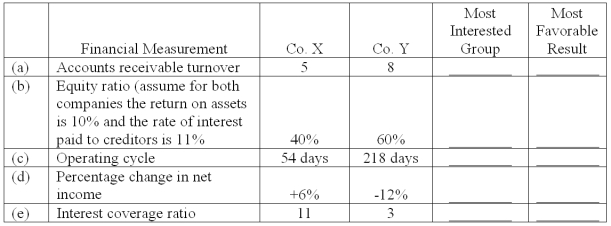 Instructions: You are to enter code letters in the spaces provided in the two right-hand columns.
In the first column, indicate which of the following three groups probably would be most interested in the specified financial measurement. Identify one group, using the following code letters: STC = indicating short-term creditors, LTC = indicating long-term creditors, and S = indicating stockholders.
In the second column, enter an X or a Y to indicate whether your "most interested group" would prefer the measurement results reported by Co. X or Co. Y.
Consider each financial measurement independently of the others.
Instructions: You are to enter code letters in the spaces provided in the two right-hand columns.
In the first column, indicate which of the following three groups probably would be most interested in the specified financial measurement. Identify one group, using the following code letters: STC = indicating short-term creditors, LTC = indicating long-term creditors, and S = indicating stockholders.
In the second column, enter an X or a Y to indicate whether your "most interested group" would prefer the measurement results reported by Co. X or Co. Y.
Consider each financial measurement independently of the others. (Essay)
4.8/5 (87)
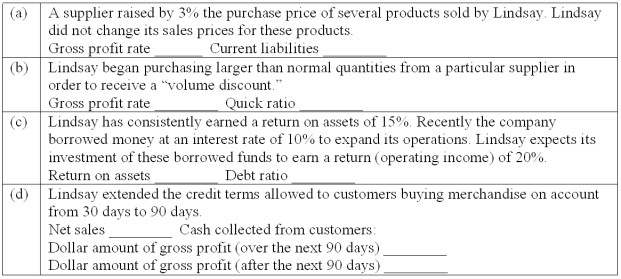
(87) Effects of events on financial measurements
Indicate the probable effects of each of the following strategies or events upon the financial measurements of Lindsay Corp. listed below. Use the code letters I = Increase, D = Decrease, and NE = No Effect.
(Essay)
4.9/5 (90)
(90) 
Filters
- Essay(0)
- Multiple Choice(0)
- Short Answer(0)
- True False(0)
- Matching(0)