



 Chat with AI
Exam 14: Financial Statement Analysis

Exam 1: Accounting: Information for Decision Making135 Questions
Exam 2: Basic Financial Statements158 Questions
Exam 3: The Accounting Cycle: Capturing Economic Events161 Questions
Exam 4: The Accounting Cycle: Accruals and Deferrals160 Questions
Exam 5: The Accounting Cycle: Reporting Financial Results136 Questions
Exam 6: Merchandising Activities144 Questions
Exam 7: Financial Assets233 Questions
Exam 8: Inventories and the Cost of Goods Sold169 Questions
Exam 9: Plant and Intangible Assets154 Questions
Exam 10: Liabilities221 Questions
Exam 11: Stockholders Equity: Paid-In Capital166 Questions
Exam 12: Income and Changes in Retained Earnings153 Questions
Exam 13: Statement of Cash Flows181 Questions
Exam 14: Financial Statement Analysis165 Questions
Exam 15: Global Business and Accounting95 Questions
Exam 16: Management Accounting: a Business Partner124 Questions
Exam 17: Job Order Cost Systems and Overhead Allocations116 Questions
Exam 18: Process Costing103 Questions
Exam 19: Costing and the Value Chain89 Questions
Exam 20: Cost-Volume-Profit Analysis147 Questions
Exam 21: Incremental Analysis119 Questions
Exam 22: Responsibility Accounting and Transfer Pricing108 Questions
Exam 23: Operational Budgeting115 Questions
Exam 24: Standard Cost Systems130 Questions
Exam 25: Rewarding Business Performance71 Questions
Exam 26: Capital Budgeting125 Questions
Exam 28: Forms of Business Organization52 Questions
Exam 27: The Time Value of Money: Future Amounts and Present Values Answer Key49 Questions
Select questions type


Effects of transactions upon analytical measurements
Determine the immediate effect of each of the transactions described below on the ratio listed beside each transaction. In the blank space to the left of each statement, you are to indicate the effect by writing the appropriate code letter. The code letters are as follows: I = increase the ratio, D = decrease the ratio, and NE = no effect on this ratio.
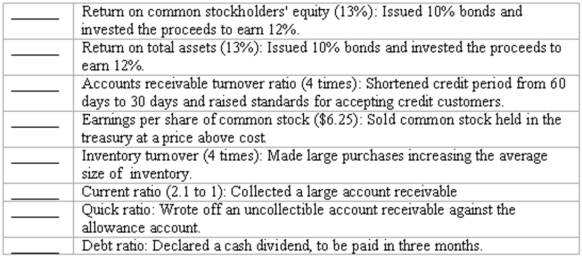
(Essay)
4.9/5  (85)
(85) During the years 2009 through 2011, Powers, Inc., reported the following amounts of net income (dollars in thousands): Relative to the prior year, the percentage change in net income:
(Multiple Choice)
4.8/5 (84)
(84) An organization that provides ratings of corporate governance services is:
(Multiple Choice)
4.7/5 (89)
(89) The return on equity ratio may be either higher or lower than the return on assets ratio.
(True/False)
4.9/5 (87)
(87) The ratio which measures total liabilities as a percentage of total assets is called:
(Multiple Choice)
4.9/5 (87)
(87) The Plaza Company has working capital of $540,000 and a current ratio of 3 to 1. The amount of current assets is:
(Multiple Choice)
4.9/5 (72)
(72) Claret Corporation's return on common stockholders' equity for 2009, rounded to the nearest tenth of a percent, is:
(Multiple Choice)
4.7/5 (77)
(77) Traditionally, stock of financially sound companies with stable earnings usually have a price-earnings ratio of:
(Multiple Choice)
4.8/5 (73)
(73) Hart Corporation's net income was $400,000 in 2010 and $160,000 in 2011. What percentage increase in net income must Hart achieve in 2012 to offset the decline in profits in 2011?
(Multiple Choice)
4.9/5 (82)
(82) In financial statement analysis, the most difficult of the following items to predict is whether:
(Multiple Choice)
4.9/5 (74)
(74) In order for investors and creditors to decide whether to invest in a company or loan a company funds they may:
(Multiple Choice)
4.9/5 (76)
(76) Deducting the cost of goods sold from net income gives us operating income.
(True/False)
4.9/5 (83)
(83) Eleva Corporation's inventory turnover for 2011 is closest to:
(Multiple Choice)
4.7/5 (68)
(68) Comparative financial statements show side-by-side financial data for two or more companies.
(True/False)
4.9/5 (84)
(84) The gross profit rate for the year (rounded to the nearest 1 percent) was:
(Multiple Choice)
4.9/5 (90)
(90) 
Filters
- Essay(0)
- Multiple Choice(0)
- Short Answer(0)
- True False(0)
- Matching(0)