



 Chat with AI
Exam 7: Deductions and Losses: Certain Business Expenses and Losses

Exam 1: An Introduction to Taxation and Understanding the Federal Tax Law211 Questions
Exam 2: Working with the Tax Law102 Questions
Exam 3: Computing the Tax180 Questions
Exam 4: Gross Income: Concepts and Inclusions125 Questions
Exam 5: Gross Income: Exclusions113 Questions
Exam 6: Deductions and Losses: In General156 Questions
Exam 7: Deductions and Losses: Certain Business Expenses and Losses94 Questions
Exam 8: Depreciation, Cost Recovery, Amortization, and Depletion120 Questions
Exam 9: Deductions: Employee and Self-Employed-Related Expenses153 Questions
Exam 10: Deductions and Losses: Certain Itemized Deductions104 Questions
Exam 11: Investor Losses130 Questions
Exam 12: Tax Credits and Payments111 Questions
Exam 13: Property Transactions: Determination of Gain or Loss, Basis Considerations, and Nontaxable Exchanges285 Questions
Exam 14: Property Transactions: Capital Gains and Losses, Section 1231, and Recapture Provisions167 Questions
Exam 15: Taxing Business Income60 Questions
Exam 16: Accounting Periods and Methods88 Questions
Exam 17: Corporations: Introduction and Operating Rules108 Questions
Exam 18: Corporations: Organization and Capital Structure109 Questions
Exam 19: Corporations: Distributions Not in Complete Liquidation185 Questions
Exam 20: Corporations: Distributions in Complete Liquidation and an Overview of Reorganizations71 Questions
Exam 21: Partnerships248 Questions
Exam 22: S Corporations129 Questions
Exam 23: Exempt Entities153 Questions
Exam 24: Multistate Corporate Taxation204 Questions
Exam 25: Taxation of International Transactions146 Questions
Exam 26: Tax Practice and Ethics184 Questions
Exam 27: The Federal Gift and Estate Taxes141 Questions
Exam 28: Income Taxation of Trusts and Estates161 Questions
Select questions type


The amount of a business loss cannot exceed the amount of the taxpayer's NOL for the taxable year.
(True/False)
4.9/5  (81)
(81) Peggy is in the business of factoring accounts receivable. Last year, she purchased a $30,000 account receivable for $25,000. This year, the account was settled for $25,000. How much loss can Peggy deduct and in which year?
(Multiple Choice)
4.8/5 (72)
(72) The purpose of the "excess business loss" rules are to limit the amount of non-business income (e.g., salaries, interest, dividends, etc.) that can be "sheltered" from tax as a result of business losses.
(True/False)
4.7/5 (73)
(73) While Susan was on vacation during the current year, someone broke into her home and stole the following items:
? A computer used 60% in connection with Susan's employment as an employee and 40% for her personal use. The cost of the computer was $8,000. Depreciation of $3,000 had been taken on the computer and it had a fair market value of $4,000 at the time of the theft.
? A painting, which Susan purchased as an investment for $10,000, had a fair market value of $17,000.
? Silverware purchased for $3,000 had a fair market value of $5,000.
? Cash of $30,000.
Susan's adjusted gross income, before considering any of the above items, is $60,000. Determine the total amount of Susan's itemized deductions resulting from the theft.
(Essay)
4.9/5 (80)
(80) In 2018, Morley, a single taxpayer, had an AGI of $30,000 before considering the following items: 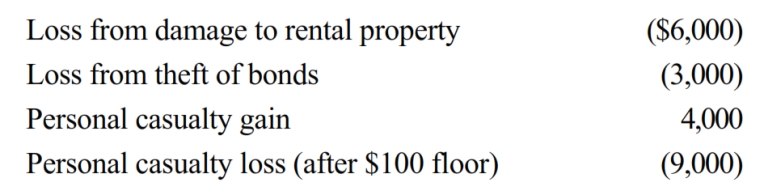 The personal casualties occurred in a Federally-declared disaster area. Determine the amount of Morley's itemized deduction from the losses.
 (Multiple Choice)
4.7/5 (62)
(62) Last year, Lucy purchased a $100,000 account receivable for $90,000. During the current year, Lucy collected $97,000 on the account. What are the tax consequences to Lucy associated with the collection of the account receivable? No subsequent collections are expected.
(Multiple Choice)
4.8/5 (81)
(81) Alicia was involved in an automobile accident in 2018. Her car was used 60% for business and 40% for personal use. The car had originally cost $40,000. At the time of the accident, the car was worth $20,000 and Alicia had taken $8,000 of depreciation. The car was totally destroyed and Alicia had let her car insurance expire. If Alicia's AGI is $50,000 (before considering the loss), determine her AGI and itemized deduction for the casualty loss.
(Multiple Choice)
4.9/5 (85)
(85) In 2017, Amos had AGI of $50,000. Amos also had a diamond ring stolen which cost $20,000 and was worth $17,000 at the time of the theft. He itemized deductions on last year's tax return. In 2018, Amos recovered $17,000 from the insurance company. Therefore, he must include $11,900 in gross income on the tax return for the current year.
(True/False)
4.9/5 (65)
(65) A business bad debt is a debt unrelated to the taxpayer's trade or business either when it was created or when it became worthless.
(True/False)
4.8/5 (76)
(76) The amount of partial worthlessness on a nonbusiness bad debt is deducted in the year partial worthlessness is determined.
(True/False)
4.9/5 (76)
(76) Susan has the following items for 2018:
? Loss on rental property caused by termites-$110,000. Insurance covered 80% of the loss.
? Loss on personal use automobile-$10,000. The insurance policy does not cover the first $3,000 of loss. Susan decided not to file a claim for the loss.
? Loss on a painting stolen from Susan's house. Susan purchased the painting three years ago as an investment. She paid $40,000 for the painting and it was worth $35,000 at the time of the theft. The painting was insured for the fair market value.
? Salary-$40,000.
Determine Susan's AGI and total amount of itemized deductions for 2018.
(Essay)
4.9/5 (79)
(79) A taxpayer can carry back any NOL incurred 2 years and then forward up to 20 years.
(True/False)
4.9/5 (73)
(73) Mike, single, age 31, had the following items for 2018:
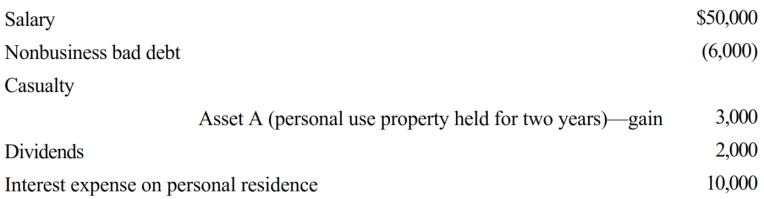 Compute Mike's taxable income for 2018.
 (Essay)
4.9/5 (82)
(82) 
Filters
- Essay(0)
- Multiple Choice(0)
- Short Answer(0)
- True False(0)
- Matching(0)