



 Chat with AI
Exam 2: Economic Models

Exam 1: First Principles233 Questions
Exam 2: Economic Models319 Questions
Exam 3: Supply and Demand292 Questions
Exam 5: International Trade 5274 Questions
Exam 6: Macroeconomics: the Big Picture168 Questions
Exam 7: Gdp and Cpi: Tracking the Macroeconomy434 Questions
Exam 8: Unemployment and Inflation354 Questions
Exam 9: Long-Run Economic Growth316 Questions
Exam 10: Savings, Investment Spending, and the Financial System402 Questions
Exam 13: Fiscal Policy Appendix Taxes and the Multiplier382 Questions
Exam 14: Money, Banking, and the Federal Reserve System468 Questions
Exam 15: Monetary Policy359 Questions
Exam 16: Inflation, Disinflation, and Deflation240 Questions
Exam 17: Crises and Consequences214 Questions
Exam 18: Events and Ideas322 Questions
Exam 19: Open-Economy Macroeconomics467 Questions
Exam 20: Graphs in Economics75 Questions
Exam 21: toward a Fuller Understanding of Present Value36 Questions
Select questions type


Mark and Julie are going to sell brownies and cookies for their third annual fundraiser bake sale. In one day, Mark can make 40 brownies or 20 cookies, and Julie can make 15 brownies or 15 cookies. Based on this information, _____ has the comparative advantage in making brownies and _____ has the comparative advantage in making cookies.
(Multiple Choice)
4.8/5  (88)
(88) Greta starts using a new baking technique, and she can now do twice as much of everything. In a single day Greta can now make 10 cakes or 8 pies, rather than the 5 cakes and 4 pies she could previously bake. Greta's production possibility frontier has _____, but her opportunity costs of making pies _____.
(Multiple Choice)
4.8/5 (72)
(72) Roommates Sarah and Zoe are hosting a Halloween party and have to make food for their guests and costumes for themselves. To finish both tasks as quickly as possible, Sarah and Zoe know that each of them should focus on just one task, but they don't know who should do what. Sarah and Zoe should determine which roommate:
(Multiple Choice)
4.8/5 (74)
(74) All points inside the production possibility frontier represent:
(Multiple Choice)
4.9/5 (88)
(88) Use the following to answer questions :
Figure: Production Possibilities and Circular-Flow Diagram  -(Figure: Production Possibilities and Circular-Flow Diagram) Look at the figure Production Possibilities and Circular-Flow Diagram. Assume the two figures represent the same economy. Suppose that in the circular-flow diagram most firms undergo a significant increase in productivity. This results in a significant increase in the output of both coconuts and fish. If all other variables remain unchanged, then the adjustment in this economy would be best represented in the production possibilities figure by a movement from point A toward:
 (Multiple Choice)
4.9/5 (80)
(80) Use the following to answer questions:
Figure: Consumer and Capital Goods 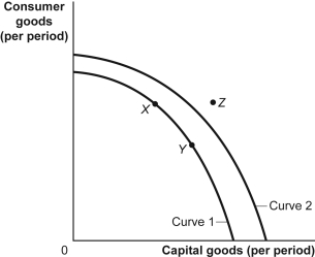 -(Figure: Consumer and Capital Goods) Look at the figure Consumer and Capital Goods. The movement from curve 1 to curve 2 indicates:
 (Multiple Choice)
4.8/5 (87)
(87) The _____ illustrates the trade-offs facing an economy that produces only two goods.
(Multiple Choice)
4.7/5 (76)
(76) In building models, economists avoid making any assumptions that might leave out any aspect of reality.
(True/False)
4.7/5 (85)
(85) Use the following to answer questions:
Figure: Tom's Production Possibilities 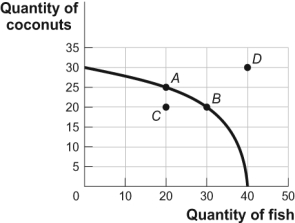 -(Figure: Tom's Production Possibilities) Look at the figure Tom's Production Possibilities. Which point or points represent(s) an inefficient combination of coconuts and fish?
 (Multiple Choice)
5.0/5 (88)
(88) Trade takes the form of _____ when people directly exchange goods they have for goods they want.
(Multiple Choice)
4.8/5 (74)
(74) Consider a point within a production possibility frontier for a simple economy that produces only two goods, X and Y. Why is this point described as feasible but not efficient?
(Essay)
4.7/5 (70)
(70) Which of the following offices of the U.S. government is a major employer of economists?
(Multiple Choice)
4.9/5 (81)
(81) Use the following to answer questions :
Figure: Comparative Advantage
Eastland and Westland produce only two goods, boxes of peaches and boxes of oranges, and this figure shows each nation's production possibility frontier for the two goods.  -(Figure: Comparative Advantage) Look at the figure Comparative Advantage. Eastland has an absolute advantage in producing:
 (Multiple Choice)
4.9/5 (82)
(82) Use the following to answer questions :  -(Table: Comparative Advantage I) Look at the table Comparative Advantage I. The opportunity cost of producing 1 box of cell phones for Sweden is _____ box(es) of herring.
 (Multiple Choice)
4.8/5 (92)
(92) Because Casey can type reports faster and more accurately than Ahmet, Casey has a(n) _____ in typing reports.
(Multiple Choice)
5.0/5 (83)
(83) All points outside the production possibility frontier are:
(Multiple Choice)
4.9/5 (73)
(73) 
Filters
- Essay(0)
- Multiple Choice(0)
- Short Answer(0)
- True False(0)
- Matching(0)