



 Chat with AI
Exam 2: Economic Models

Exam 1: First Principles233 Questions
Exam 2: Economic Models319 Questions
Exam 3: Supply and Demand292 Questions
Exam 5: International Trade 5274 Questions
Exam 6: Macroeconomics: the Big Picture168 Questions
Exam 7: Gdp and Cpi: Tracking the Macroeconomy434 Questions
Exam 8: Unemployment and Inflation354 Questions
Exam 9: Long-Run Economic Growth316 Questions
Exam 10: Savings, Investment Spending, and the Financial System402 Questions
Exam 13: Fiscal Policy Appendix Taxes and the Multiplier382 Questions
Exam 14: Money, Banking, and the Federal Reserve System468 Questions
Exam 15: Monetary Policy359 Questions
Exam 16: Inflation, Disinflation, and Deflation240 Questions
Exam 17: Crises and Consequences214 Questions
Exam 18: Events and Ideas322 Questions
Exam 19: Open-Economy Macroeconomics467 Questions
Exam 20: Graphs in Economics75 Questions
Exam 21: toward a Fuller Understanding of Present Value36 Questions
Select questions type


Because models make simplifying assumptions, they are of very little use in the real world.
(True/False)
5.0/5  (84)
(84) "Teachers in northern New Hampshire should earn more money" is a normative statement.
(True/False)
4.9/5 (90)
(90) Use the following to answer questions : 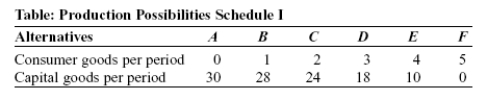 -(Table: Production Possibilities Schedule I) Look at the table Production Possibilities Schedule I. The opportunity cost of producing the third unit of consumer goods is _____ units of capital goods.
 (Multiple Choice)
4.9/5 (65)
(65) Use the following to answer questions :  -(Table: Comparative Advantage I) Look at the table Comparative Advantage I. The opportunity cost of producing 1 box of herring for Sweden is _____ box(es) of cell phones.
 (Multiple Choice)
4.9/5 (73)
(73) Abe starts exercising regularly, and after a few months he can do twice as much of everything. In a single day Abe can now make 10 hamburgers or 8 milkshakes rather than the 5 hamburgers and 4 milkshakes he made in the past. We now know that Abe's production possibility frontier has _____, but his opportunity costs of making milkshakes _____.
(Multiple Choice)
5.0/5 (93)
(93) Use the following to answer questions :  -(Figure: Wine and Wheat) Look at the figure Wine and Wheat. If this economy is producing 12 tons of wheat and 9,000 bottles of wine, we know the economy:
 (Multiple Choice)
4.9/5 (80)
(80) Use the following to answer questions :  -(Table: Coffee and Salmon Production Possibilities II) Look at the table Coffee and Salmon Production Possibilities II. This table shows the maximum amounts of coffee and salmon, both measured in pounds, that Brazil and Alaska can produce if they just produce one good. Alaska has an absolute advantage in producing:
 (Multiple Choice)
4.9/5 (74)
(74) If they produce only hamburgers, in a single day Sarah can produce 10 hamburgers, and Abe can produce 5 hamburgers. If they make milkshakes only, in a single day Sarah can produce 10 milkshakes, and Abe can produce 4 milkshakes. Therefore, _____ has an absolute advantage and a comparative advantage in making _____.
(Multiple Choice)
4.8/5 (75)
(75) Use the following to answer questions:
Figure: Tom's Production Possibilities  -(Figure: Tom's Production Possibilities) Look at the figure Tom's Production Possibilities. The opportunity cost for Tom to move from point C on the curve to point A is:
 (Multiple Choice)
4.7/5 (71)
(71) Use the following to answer question: 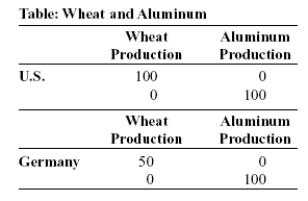 -(Table: Wheat and Aluminum) Look at the table Wheat and Aluminum. The table shows the maximum possible production of wheat and aluminum for both the United States and Germany. Are gains from trade possible between these nations? Explain.
 (Essay)
4.9/5 (75)
(75) In the circular-flow diagram households receive money for _____ in the _____ market.
(Multiple Choice)
4.7/5 (87)
(87) If LeRoyce trades two cookies for one of Amir's brownies, we say that they are engaging in:
(Multiple Choice)
4.7/5 (85)
(85) Assume an economy is operating on its production possibility frontier, which shows the production of military and civilian goods. If the output of military goods is increased, the output of civilian goods:
(Multiple Choice)
5.0/5 (76)
(76) Use the following to answer questions :  -(Table: Trade-off of Study Time and Leisure Time) Look at the table Trade-off of Study Time and Leisure Time. A student sleeps 8 hours per day and divides the remaining time between study time and leisure time. The table shows the combinations of study and leisure time that can be produced in the 16 waking hours of each day. If a student decides to consume one additional hour of leisure time, how many hours of study time must she give up?
 (Multiple Choice)
4.8/5 (79)
(79) In a single day, George can bake 10 cakes and Greta can bake 5 cakes. We know that _____ has a(n) _____ advantage in baking cakes.
(Multiple Choice)
4.8/5 (70)
(70) The effect of an increase in productive inputs such as labor and capital can be shown by:
(Multiple Choice)
4.8/5 (66)
(66) The fact that a society's production possibility frontier is bowed out, or concave to the origin of a graph, demonstrates the law of _____ opportunity cost.
(Multiple Choice)
4.9/5 (86)
(86) 
Filters
- Essay(0)
- Multiple Choice(0)
- Short Answer(0)
- True False(0)
- Matching(0)