



 Chat with AI
Exam 2: Economic Models

Exam 1: First Principles233 Questions
Exam 2: Economic Models319 Questions
Exam 3: Supply and Demand292 Questions
Exam 5: International Trade 5274 Questions
Exam 6: Macroeconomics: the Big Picture168 Questions
Exam 7: Gdp and Cpi: Tracking the Macroeconomy434 Questions
Exam 8: Unemployment and Inflation354 Questions
Exam 9: Long-Run Economic Growth316 Questions
Exam 10: Savings, Investment Spending, and the Financial System402 Questions
Exam 13: Fiscal Policy Appendix Taxes and the Multiplier382 Questions
Exam 14: Money, Banking, and the Federal Reserve System468 Questions
Exam 15: Monetary Policy359 Questions
Exam 16: Inflation, Disinflation, and Deflation240 Questions
Exam 17: Crises and Consequences214 Questions
Exam 18: Events and Ideas322 Questions
Exam 19: Open-Economy Macroeconomics467 Questions
Exam 20: Graphs in Economics75 Questions
Exam 21: toward a Fuller Understanding of Present Value36 Questions
Select questions type


The principle of comparative advantage suggests that if New York and Florida exchange taxi parts for oranges, each state will be made worse off.
(True/False)
4.9/5  (78)
(78) Use the following to answer questions :
Figure: Comparative Advantage
Eastland and Westland produce only two goods, boxes of peaches and boxes of oranges, and this figure shows each nation's production possibility frontier for the two goods.  -(Figure: Comparative Advantage) Look at the figure Comparative Advantage. Eastland has a comparative advantage in producing:
 (Multiple Choice)
5.0/5 (75)
(75) In the simplest circular-flow model, households supply _____ and demand _____.
(Multiple Choice)
4.8/5 (78)
(78) "Steel tariffs will prevent job losses in the steel industry" is a positive statement.
(True/False)
4.9/5 (82)
(82) Use the following to answer questions :  -(Figure: Wine and Wheat) Look at the figure Wine and Wheat. The opportunity cost of moving from producing ONLY wheat to producing ONLY wine is _____ tons of wheat.
 (Multiple Choice)
4.9/5 (89)
(89) If Brazil gives up three automobiles for each ton of coffee it produces, while Peru gives up seven automobiles for each ton of coffee it produces, then Brazil has a comparative advantage in _____ production and should specialize in _____.
(Multiple Choice)
4.8/5 (73)
(73) In movement along a production possibility frontier, the opportunity cost to society of getting more of one good:
(Multiple Choice)
4.7/5 (73)
(73) Use the following to answer questions :  -(Table: Trade-off of Study Time and Leisure Time) Look at the table Trade-off of Study Time and Leisure Time. A student sleeps 8 hours per day and divides the remaining time between study time and leisure time. The table shows the combinations of study and leisure time that can be produced in the 16 waking hours of each day. Suppose the student completes a speed-reading course that allows him to do the same amount of studying in half as many hours. His opportunity cost:
 (Multiple Choice)
4.9/5 (79)
(79) Use the following to answer questions : 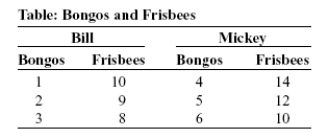 -(Table: Bongos and Frisbees) Look at the table Bongos and Frisbees. Bill and Mickey make bongos and Frisbees. Who should specialize in the production of bongos?
 (Multiple Choice)
5.0/5 (70)
(70) Use the following to answer questions:
Figure: Tom's Production Possibilities  -(Figure: Tom's Production Possibilities) Look at the figure Tom's Production Possibilities. Which point or points represent(s) a feasible combination of coconuts and fish?
 (Multiple Choice)
4.7/5 (67)
(67) Smallville has a linear production possibility frontier in the production of good X and good Y. It can produce 6 of X per hour or 8 of Y per hour. Suppose it has 240 hours of labor and divides labor hours equally between production of good X and good Y. What is the MAXIMUM amount of good Y it can produce?
(Multiple Choice)
4.9/5 (65)
(65) Use the following to answer questions :
-(Table: Trade-off of Study Time and Leisure Time) Look at the table Trade-off of Study Time and Leisure Time. A student sleeps 8 hours per day and divides the remaining time between study and leisure time. Suppose this student is studying 4 hours and spending 10 hours doing leisure activities. This point is:
-(Table: Trade-off of Study Time and Leisure Time) Look at the table Trade-off of Study Time and Leisure Time. A student sleeps 8 hours per day and divides the remaining time between study and leisure time. Suppose this student is studying 4 hours and spending 10 hours doing leisure activities. This point is: (Multiple Choice)
4.9/5 (79)
(79) In Kessy's old kitchen, he could bake 10 cookies or mix 15 glasses of lemonade in one day. Now Kessy has a larger oven and refrigerator. How does this affect his production possibility frontier?
(Multiple Choice)
5.0/5 (72)
(72) In the circular-flow diagram households buy _____ in the _____ market.
(Multiple Choice)
4.8/5 (91)
(91) 
Filters
- Essay(0)
- Multiple Choice(0)
- Short Answer(0)
- True False(0)
- Matching(0)