



 Chat with AI
Exam 2: Economic Models

Exam 1: First Principles233 Questions
Exam 2: Economic Models319 Questions
Exam 3: Supply and Demand292 Questions
Exam 5: International Trade 5274 Questions
Exam 6: Macroeconomics: the Big Picture168 Questions
Exam 7: Gdp and Cpi: Tracking the Macroeconomy434 Questions
Exam 8: Unemployment and Inflation354 Questions
Exam 9: Long-Run Economic Growth316 Questions
Exam 10: Savings, Investment Spending, and the Financial System402 Questions
Exam 13: Fiscal Policy Appendix Taxes and the Multiplier382 Questions
Exam 14: Money, Banking, and the Federal Reserve System468 Questions
Exam 15: Monetary Policy359 Questions
Exam 16: Inflation, Disinflation, and Deflation240 Questions
Exam 17: Crises and Consequences214 Questions
Exam 18: Events and Ideas322 Questions
Exam 19: Open-Economy Macroeconomics467 Questions
Exam 20: Graphs in Economics75 Questions
Exam 21: toward a Fuller Understanding of Present Value36 Questions
Select questions type


Assume that Colombia gives up three motorcycles for each ton of coffee it produces, while Bolivia gives up seven motorcycles for each ton of coffee it produces. Colombia has a comparative advantage in _____ production and should specialize in _____.
(Multiple Choice)
4.9/5  (88)
(88) As long as people have different _____, everyone has a comparative advantage in something.
(Multiple Choice)
4.9/5 (90)
(90) Of the following statements, which reflect(s) a normative view?
I. The United States should increase the minimum wage to $10 per hour.
II. There is a federal minimum wage in the United States.
III. The federal minimum wage in the United States is less than $10 per hour.
(Multiple Choice)
4.7/5 (80)
(80) "The unemployment rate should be higher" is a normative statement.
(True/False)
4.8/5 (88)
(88) Use the following to answer questions:
Scenario: Countries A and B
Two countries, A and B, produce two goods, wheat (W) and steel (S). Each has a linear production possibility frontier in both goods. If country A spends all of its available resources to produce wheat, it can produce 500 tons of wheat and no steel. If it uses all of its resources to produce steel, it can produce 250 tons of steel and no wheat. If country B spends all of its available resources producing wheat, it can produce 400 tons of wheat, and if it spends all of its resources on the production of steel, it can produce 400 tons of steel.
-(Scenario: Countries A and B) Look at the scenario Countries A and B. If each country devotes half of its resources to the production of wheat and half to the production of steel, then their combined total production of wheat will be _____ tons and their combined total production of steel will be _____ tons.
(Multiple Choice)
4.8/5 (78)
(78) Use the following to answer questions:
Scenario: Countries A and B
Two countries, A and B, produce two goods, wheat (W) and steel (S). Each has a linear production possibility frontier in both goods. If country A spends all of its available resources to produce wheat, it can produce 500 tons of wheat and no steel. If it uses all of its resources to produce steel, it can produce 250 tons of steel and no wheat. If country B spends all of its available resources producing wheat, it can produce 400 tons of wheat, and if it spends all of its resources on the production of steel, it can produce 400 tons of steel.
-(Scenario: Countries A and B) Look at the scenario Countries A and B. If countries A and B both specialize and trade:
(Multiple Choice)
4.9/5 (81)
(81) If an economy is producing at a point on its production possibilities frontier, it is:
(Multiple Choice)
4.7/5 (74)
(74) Suppose residents of Montana operate on their production possibility frontier, and they want to increase production of both wheat and fly-fishing rods. According to the production possibility frontier, this cannot happen without new resources or technological improvement.
(True/False)
4.9/5 (80)
(80) Investors will lose money on mortgage-backed securities if:
(Multiple Choice)
4.7/5 (63)
(63) Use the following to answer questions :
Figure: Consumer and Capital Goods 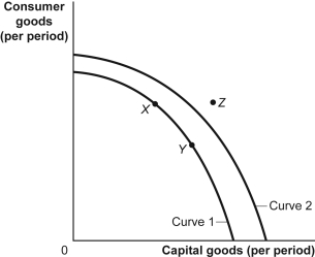 -(Figure: Consumer and Capital Goods) Look at the figure Consumer and Capital Goods. The movement from curve 1 to curve 2 indicates:
 (Multiple Choice)
4.9/5 (81)
(81) The financial meltdown in 2008-2009 was partially the result of a faulty economic model that underestimated the risk of mortgage-backed securities.
(True/False)
4.9/5 (81)
(81) Use the following to answer questions:
Scenario: Linear Production Possibility Frontier
Largetown has a linear production possibility frontier, and it produces socks and shirts with 80 hours of labor. The table shows the number of hours of labor necessary to produce one pair of socks or one shirt. 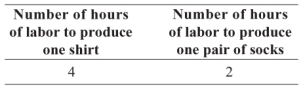 -(Scenario: Linear Production Possibility Frontier) Look at the scenario Linear Production Possibility Frontier. What is the maximum number of pairs of socks Largetown can produce?
 (Multiple Choice)
4.9/5 (84)
(84) Use the following to answer questions : 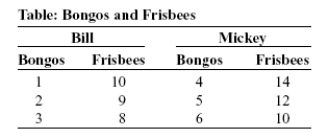 -(Table: Bongos and Frisbees) Look at the table Bongos and Frisbees. Bill and Mickey make bongos and Frisbees. Who has the comparative advantage in producing Frisbees?
 (Multiple Choice)
4.7/5 (84)
(84) If a production possibility frontier is a straight line, it tells us that the opportunity cost of producing one more unit of good X:
(Multiple Choice)
4.9/5 (87)
(87) Use the following to answer questions : 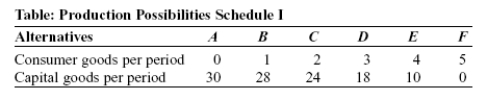 -(Table: Production Possibilities Schedule I) Look at the table Production Possibilities Schedule I. If the economy produces 4 units of consumer goods per period, it also can produce at most _____ units of capital goods per period.
 (Multiple Choice)
4.7/5 (75)
(75) 
Filters
- Essay(0)
- Multiple Choice(0)
- Short Answer(0)
- True False(0)
- Matching(0)