



 Chat with AI
Exam 15: Monetary Policy

Exam 1: First Principles233 Questions
Exam 2: Economic Models319 Questions
Exam 3: Supply and Demand292 Questions
Exam 5: International Trade 5274 Questions
Exam 6: Macroeconomics: the Big Picture168 Questions
Exam 7: Gdp and Cpi: Tracking the Macroeconomy434 Questions
Exam 8: Unemployment and Inflation354 Questions
Exam 9: Long-Run Economic Growth316 Questions
Exam 10: Savings, Investment Spending, and the Financial System402 Questions
Exam 13: Fiscal Policy Appendix Taxes and the Multiplier382 Questions
Exam 14: Money, Banking, and the Federal Reserve System468 Questions
Exam 15: Monetary Policy359 Questions
Exam 16: Inflation, Disinflation, and Deflation240 Questions
Exam 17: Crises and Consequences214 Questions
Exam 18: Events and Ideas322 Questions
Exam 19: Open-Economy Macroeconomics467 Questions
Exam 20: Graphs in Economics75 Questions
Exam 21: toward a Fuller Understanding of Present Value36 Questions
Select questions type


Other things equal, if there is an excess demand for money, the interest rate may rise.
(True/False)
4.8/5  (56)
(56) To decrease interest rates, the Fed should increase the money supply.
(True/False)
4.9/5 (84)
(84) The chair of the Board of Governors during the 2008 financial crisis was:
(Multiple Choice)
4.9/5 (92)
(92) Use the following to answer questions :
Figure: Monetary Policy I  -(Figure: Monetary Policy I) Look at the figure Monetary Policy I. If the economy is initially in equilibrium at E1 and the central bank chooses to buy Treasury bills, _____ shift to _____ a(n) _____ gap.
 (Multiple Choice)
4.8/5 (76)
(76) The theory of monetary neutrality means that monetary policy is completely irrelevant.
(True/False)
4.8/5 (75)
(75) When the central bank announces the desired inflation rate and sets policy to reach that rate, it is using:
(Multiple Choice)
4.7/5 (90)
(90) Use the following to answer questions :
Figure: Monetary Policy III 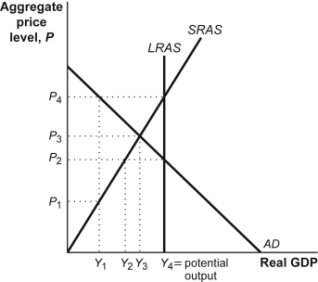 -(Figure: Monetary Policy III) Look at the figure Monetary Policy III. The central bank should adopt policies to move the economy to:
 (Multiple Choice)
4.8/5 (95)
(95) If the economy is at potential output and the Fed increases the money supply, in the short run interest rates will likely increase.
(True/False)
4.8/5 (81)
(81) If the economy is at potential output and the Fed decreases the money supply, in the SHORT run the price level will likely_____ and real GDP will likely_____ .
(Multiple Choice)
4.8/5 (89)
(89) Use the following to answer questions :
Figure: Monetary Policy and the AD-SRAS Model  -(Figure: Monetary Policy and the AD-SRAS Model) Look at the figure Monetary Policy and the AD-SRAS Model. If the economy is in a recessionary gap at point f, it could move to point g as a result of:
 (Multiple Choice)
4.9/5 (83)
(83) An increase in the supply of money will lead to a(n) _____ in the equilibrium interest rate and a(n) _____ in real GDP.
(Multiple Choice)
4.7/5 (76)
(76) If the Federal Reserve sets the federal funds rate on the basis of inflation and the output gap, then the Federal Reserve is following:
(Multiple Choice)
4.8/5 (77)
(77) Which of the following describes the difference between the Taylor rule and inflation targeting?
(Multiple Choice)
4.8/5 (80)
(80) The difference between the interest rate on assets that are not money and the interest rate on assets that are money is:
(Multiple Choice)
4.9/5 (81)
(81) Every year more and more purchases are made with credit cards on the Internet. Given this trend, all else equal, we would expect:
(Multiple Choice)
4.9/5 (83)
(83) 
Filters
- Essay(0)
- Multiple Choice(0)
- Short Answer(0)
- True False(0)
- Matching(0)