



 Chat with AI
Exam 15: Monetary Policy

Exam 1: First Principles233 Questions
Exam 2: Economic Models319 Questions
Exam 3: Supply and Demand292 Questions
Exam 5: International Trade 5274 Questions
Exam 6: Macroeconomics: the Big Picture168 Questions
Exam 7: Gdp and Cpi: Tracking the Macroeconomy434 Questions
Exam 8: Unemployment and Inflation354 Questions
Exam 9: Long-Run Economic Growth316 Questions
Exam 10: Savings, Investment Spending, and the Financial System402 Questions
Exam 13: Fiscal Policy Appendix Taxes and the Multiplier382 Questions
Exam 14: Money, Banking, and the Federal Reserve System468 Questions
Exam 15: Monetary Policy359 Questions
Exam 16: Inflation, Disinflation, and Deflation240 Questions
Exam 17: Crises and Consequences214 Questions
Exam 18: Events and Ideas322 Questions
Exam 19: Open-Economy Macroeconomics467 Questions
Exam 20: Graphs in Economics75 Questions
Exam 21: toward a Fuller Understanding of Present Value36 Questions
Select questions type


The Federal Open Market Committee does NOT directly control the _____ with monetary policy.
(Multiple Choice)
4.7/5  (86)
(86) Use the following to answer questions :
Figure: Monetary Policy II 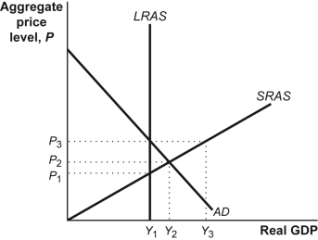 -(Figure: Monetary Policy II) Look at the figure Monetary Policy II. To eliminate the inflationary gap from the short-run equilibrium at Y2, monetary policy should be:
 (Multiple Choice)
4.8/5 (75)
(75) Use the following to answer questions:
Figure: Short-Run Determination of the Interest Rate  -(Figure: Short-Run Determination of the Interest Rate) Look at the figure Short-Run Determination of the Interest Rate. If the money supply is at MS1 and the Fed conducts expansionary monetary policy, in the short run the interest rate drops to r2. In the long run the demand for money will _____, and the interest rate will_____.
 (Multiple Choice)
4.8/5 (80)
(80) Contractionary monetary policy causes _____ in the price level in the short run and _____ in the price level in the long run.
(Multiple Choice)
4.9/5 (78)
(78) If the economy is at potential output and the Fed decreases the money supply, in the SHORT run the likely result will be a(n) _____ in investment and a(n) _____ in consumption.
(Multiple Choice)
5.0/5 (91)
(91) The Fed prints money not only when it is conducting monetary policy but also when it is paying bills as the fiscal agent for the federal government.
(True/False)
4.9/5 (73)
(73) In September 2007, reversing its course, the Federal Reserve began a series of:
(Multiple Choice)
4.8/5 (86)
(86) If the equilibrium interest rate in the money market is 5%, then at an interest rate of 2%, money demanded is _____ than money supplied.
(Multiple Choice)
4.9/5 (77)
(77) If the Federal Reserve uses expansionary monetary policy there is a _____ short-run effect on _____, but_____.
(Multiple Choice)
4.9/5 (77)
(77) In the short run changes in the money supply change the interest rate, but in the long run changes in the money supply have no effect on interest rates.
(True/False)
4.7/5 (75)
(75) When long-term rates are lower than short-term rates, the market is signaling that it expects short-term rates to fall.
(True/False)
4.8/5 (80)
(80) Use the following to answer question 177:
Figure: Short-Run and Long-Run Effects of Monetary Policy 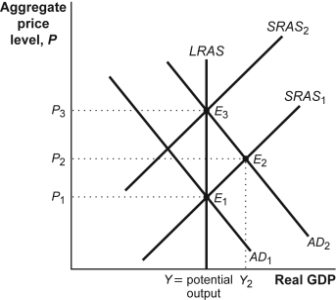 -(Figure: Short-Run and Long-Run Effects of Monetary Policy) Look at the figure Short-Run and Long-Run Effects of Monetary Policy. If the economy is initially at E2 and the central bank makes no change in its monetary policy:
 (Multiple Choice)
4.9/5 (77)
(77) Use the following to answer questions :
Figure: Money Market I 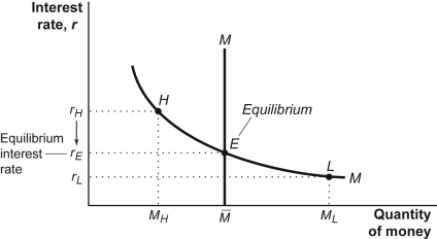 -(Figure: Money Market I) Look at the figure Money Market I. If the interest rate is at rL and the central bank neither buys nor sells Treasury bills, then the interest rate will:
 (Multiple Choice)
4.9/5 (62)
(62) Suppose that the economy is operating at potential output and the money supply increases. Aggregate output will _____ potential output, nominal wages will _____, and the SRAS will shift _____.
(Multiple Choice)
4.8/5 (91)
(91) 
Filters
- Essay(0)
- Multiple Choice(0)
- Short Answer(0)
- True False(0)
- Matching(0)