



 Chat with AI
Exam 15: Monetary Policy

Exam 1: First Principles233 Questions
Exam 2: Economic Models319 Questions
Exam 3: Supply and Demand292 Questions
Exam 5: International Trade 5274 Questions
Exam 6: Macroeconomics: the Big Picture168 Questions
Exam 7: Gdp and Cpi: Tracking the Macroeconomy434 Questions
Exam 8: Unemployment and Inflation354 Questions
Exam 9: Long-Run Economic Growth316 Questions
Exam 10: Savings, Investment Spending, and the Financial System402 Questions
Exam 13: Fiscal Policy Appendix Taxes and the Multiplier382 Questions
Exam 14: Money, Banking, and the Federal Reserve System468 Questions
Exam 15: Monetary Policy359 Questions
Exam 16: Inflation, Disinflation, and Deflation240 Questions
Exam 17: Crises and Consequences214 Questions
Exam 18: Events and Ideas322 Questions
Exam 19: Open-Economy Macroeconomics467 Questions
Exam 20: Graphs in Economics75 Questions
Exam 21: toward a Fuller Understanding of Present Value36 Questions
Select questions type


In the long run, changes in the money supply _____ the aggregate price level and _____ aggregate output.
(Multiple Choice)
4.9/5  (85)
(85) Available international evidence for the period 1970-2010 shows that the:
(Multiple Choice)
4.8/5 (84)
(84) An increase in the money supply _____ the interest rate in the short run but _____ the interest rate in the long run.
(Multiple Choice)
4.8/5 (67)
(67) If the interest rate is below equilibrium, then the quantity of money demanded is more than the quantity of money supplied, and the quantity of interest-bearing financial assets demanded is also more than the quantity supplied.
(True/False)
4.8/5 (81)
(81) Use the following to answer questions :
Figure: The Money Supply and Aggregate Demand  -(Figure: The Money Supply and Aggregate Demand) Look at the figure The Money Supply and Aggregate Demand. If the economy is in an inflationary gap, the Federal Reserve will _____ Treasury bills, which will _____ the money supply and _____ interest rates. This is shown in panel _____.
 (Multiple Choice)
4.8/5 (75)
(75) In the long run a change in the money supply will affect:
I. the interest rate.
II. real GDP.
III. prices.
(Multiple Choice)
4.8/5 (92)
(92) The short-run aggregate supply curve is _____, and the long-run aggregate supply curve is _____.
(Multiple Choice)
4.7/5 (89)
(89) Use the following to answer questions :
Figure: Monetary Policy II 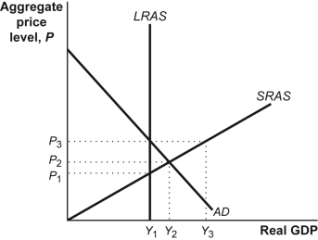 -(Figure: Monetary Policy II) Look at the figure Monetary Policy II. If the short-run equilibrium is at Y2, appropriate central bank policy is:
 (Multiple Choice)
4.8/5 (75)
(75) Suppose the Federal Reserve is conducting an expansionary monetary policy. It will _____ Treasury bills on the open market, so that the money supply will _____, interest rates will _____, planned investment spending will _____, and the AD curve will shift to the _____.
(Multiple Choice)
4.8/5 (92)
(92) If the Federal Reserve wants to lower the interest rate, it will:
(Multiple Choice)
4.7/5 (92)
(92) The quantity demanded of money is negatively related to _____, and the demand for money is positively related to _____.
(Multiple Choice)
5.0/5 (78)
(78) If the economy is at potential output and the Fed increases the money supply, in the SHORT run the aggregate demand will likely:
(Multiple Choice)
4.9/5 (87)
(87) Use the following to answer questions :
Figure: Monetary Policy III 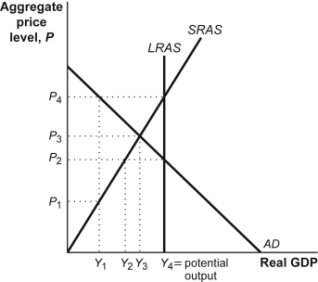 -(Figure: Monetary Policy III) Look at the figure Monetary Policy III. Expansionary economic policy will lead to an equilibrium GDP of:
 (Multiple Choice)
5.0/5 (73)
(73) An increase in the money supply will decrease interest rates in the short run but will not affect interest rates in the long run because an increase in the money supply will eventually _____ prices and _____ money demand.
(Multiple Choice)
4.8/5 (81)
(81) Suppose the Federal Reserve has set a target for the federal funds rate. If initially the equilibrium interest rate happens to be higher than the target interest rate, then the Federal Reserve should _____ Treasury bills in the open market, _____ the money supply, shift the supply of money curve to the _____, and _____ the interest rate to the target rate.
(Multiple Choice)
4.9/5 (58)
(58) In the income-expenditure model, contractionary monetary policy leads to _____ interest rates, a(n) _____ in planned investment spending, and a(n) _____ in equilibrium GDP.
(Multiple Choice)
4.9/5 (85)
(85) If an economy is in long-run equilibrium at its potential output level, this also means:
(Multiple Choice)
4.8/5 (64)
(64) Use the following to answer questions :
Figure: Equilibrium in the Money Market  -(Figure: Equilibrium in the Money Market) Look at the figure Equilibrium in the Money Market. If the rate of interest is below equilibrium, there will be an excess _____ money and the interest rate will _____.
 (Multiple Choice)
5.0/5 (94)
(94) 
Filters
- Essay(0)
- Multiple Choice(0)
- Short Answer(0)
- True False(0)
- Matching(0)