



 Chat with AI
Exam 15: Monetary Policy

Exam 1: First Principles233 Questions
Exam 2: Economic Models319 Questions
Exam 3: Supply and Demand292 Questions
Exam 5: International Trade 5274 Questions
Exam 6: Macroeconomics: the Big Picture168 Questions
Exam 7: Gdp and Cpi: Tracking the Macroeconomy434 Questions
Exam 8: Unemployment and Inflation354 Questions
Exam 9: Long-Run Economic Growth316 Questions
Exam 10: Savings, Investment Spending, and the Financial System402 Questions
Exam 13: Fiscal Policy Appendix Taxes and the Multiplier382 Questions
Exam 14: Money, Banking, and the Federal Reserve System468 Questions
Exam 15: Monetary Policy359 Questions
Exam 16: Inflation, Disinflation, and Deflation240 Questions
Exam 17: Crises and Consequences214 Questions
Exam 18: Events and Ideas322 Questions
Exam 19: Open-Economy Macroeconomics467 Questions
Exam 20: Graphs in Economics75 Questions
Exam 21: toward a Fuller Understanding of Present Value36 Questions
Select questions type


Suppose the economy is in long-run equilibrium at full employment levels of real GDP. In the long run, if the money supply increases, we would expect _____ in the price level and _____ in real GDP.
(Multiple Choice)
4.7/5  (78)
(78) Use the following to answer questions :
Figure: Money Market I 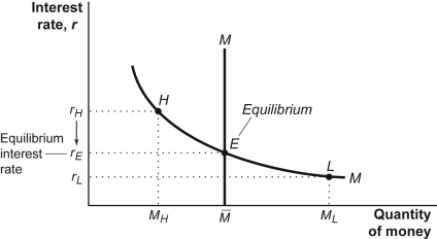 -(Figure: Money Market I) Look at the figure Money Market I. If the money market is initially in equilibrium at point E and the central bank sells Treasury bills, then the interest rate will:
 (Multiple Choice)
5.0/5 (85)
(85) Use the following to answer questions:
Figure: Short-Run Determination of the Interest Rate  -(Figure: Short-Run Determination of the Interest Rate) Look at the figure Short-Run Determination of the Interest Rate. If the money supply is at MS1 and the central bank buys Treasury bills, then the resulting short-run shift in the supply of savings (loanable funds) may be represented by a shift of the:
 (Multiple Choice)
4.9/5 (82)
(82) If the actual interest rate is 6% and the target rate is 4%, the Fed should sell Treasury bills.
(True/False)
5.0/5 (88)
(88) Suppose the Federal Reserve buys Treasury bills. We can expect this transaction to _____ the money supply, _____ Treasury bill prices, and _____ interest rates.
(Multiple Choice)
4.9/5 (85)
(85) In the long run, the interest rate is determined in the _____ market.
(Multiple Choice)
4.7/5 (73)
(73) Use the following to answer questions :
Figure: The Money Supply and Aggregate Demand  -(Figure: The Money Supply and Aggregate Demand) Look at the figure The Money Supply and Aggregate Demand. If the Federal Reserve intended to encourage investment and expand the economy, it would _____ Treasury bills, _____ the money supply, and _____ interest rates. This is shown in panel _____.
 (Multiple Choice)
4.8/5 (94)
(94) The money demand curve is _____ because a lower interest rate _____ the opportunity cost of holding money.
(Multiple Choice)
4.9/5 (75)
(75) Quantitative easing occurs when instead of purchasing only short-term government debt, the Fed buys long-term government debt as well.
(True/False)
4.7/5 (64)
(64) The Fed prints money only when it is conducting monetary policy.
(True/False)
4.7/5 (76)
(76) Use the following to answer questions :
Figure: Output Gap  -(Figure: Output Gap) Look at the figure Output Gap. If the economy is at Y1 as a result of expansionary monetary policy and no further policy is implemented, in the long run nominal wages will _____ and shift the short-run aggregate supply curve to the _____, which will _____ real output.
 (Multiple Choice)
4.8/5 (86)
(86) A 20% increase in the aggregate price level will increase the quantity of money demanded by:
(Multiple Choice)
4.8/5 (76)
(76) Given an inflationary gap, the Federal Reserve will use monetary policy to _____ real GDP and _____ the interest rate.
(Multiple Choice)
5.0/5 (89)
(89) One advantage of inflation targeting over the Taylor rule is that the central bank's policy can be evaluated by seeing how close to the target actual inflation rates are.
(True/False)
4.8/5 (74)
(74) Given an inflationary gap, the Federal Reserve will use monetary policy to _____ interest rates and _____ aggregate demand.
(Multiple Choice)
4.9/5 (73)
(73) Monetary policy that lowers the interest rate is called _____ because it _____.
(Multiple Choice)
4.8/5 (79)
(79) Use the following to answer questions :
Figure: Economic Adjustments 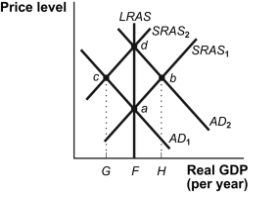 -(Figure: Economic Adjustments) Look at the figure Economic Adjustments. Assume that the economy is at point c. The effect of an increase in the money supply is represented by a shift of the _____ curve to _____.
 (Multiple Choice)
4.9/5 (64)
(64) Use the following to answer questions :
Figure: The Money Supply and Aggregate Demand
-(Figure: The Money Supply and Aggregate Demand) Look at the figure The Money Supply and Aggregate Demand. Panel (a) illustrates what happens when the Federal Reserve decides to _____ the money supply and _____ interest rates.
-(Figure: The Money Supply and Aggregate Demand) Look at the figure The Money Supply and Aggregate Demand. Panel (a) illustrates what happens when the Federal Reserve decides to _____ the money supply and _____ interest rates. (Multiple Choice)
4.8/5 (79)
(79) Other things equal, rising interest rates lead to a _____ in investment spending and a _____ in _____ spending.
(Multiple Choice)
4.8/5 (77)
(77) 
Filters
- Essay(0)
- Multiple Choice(0)
- Short Answer(0)
- True False(0)
- Matching(0)