



 Chat with AI
Exam 9: Firms in Perfectly Competitive Markets

Exam 1: Economics: Foundations and Models160 Questions
Exam 2: Trade-Offs, comparative Advantage, and the Market System191 Questions
Exam 3: Where Prices Come From: the Interaction of Demand and Supply241 Questions
Exam 4: Market Efficiency and Market Failure226 Questions
Exam 5: The Economics of Healthcare169 Questions
Exam 6: Firms,the Stock Market,and Corporate Governance255 Questions
Exam 7: Consumer Choice and Elasticity270 Questions
Exam 8: Technology, production, and Costs277 Questions
Exam 9: Firms in Perfectly Competitive Markets351 Questions
Exam 10: Monopoly and Antitrust253 Questions
Exam 11: Monopolistic Competition and Oligopoly304 Questions
Exam 12: GDP: Measuring Total Production and Income200 Questions
Exam 13: Unemployment and Inflation207 Questions
Exam 14: Economic Growth, the Financial System and Business Cycles172 Questions
Exam 15: Aggregate Demand and Aggregate Supply Analysis120 Questions
Exam 16: Money, banks, and the Federal Reserve System139 Questions
Exam 17: Monetary Policy180 Questions
Exam 18: Fiscal Policy131 Questions
Exam 19: Comparative Advantage, international Trade, and Exchange Rates247 Questions
Select questions type


A profit-maximising monopolistically competitive firm produces and sells an allocatively efficient quantity of output.
(True/False)
4.7/5  (82)
(82) How does the demand curve for an oligopoly firm differ from the demand curves for firms in competitive market structures?
(Essay)
4.7/5 (88)
(88) For a profit-maximising monopolistically competitive firm,for the last unit sold,the marginal cost of production is less than the marginal benefit received by a customer from the purchase of that unit.
(True/False)
4.9/5 (90)
(90) Figure 9-4  Figure 9-4 shows short-run cost and demand curves for a monopolistically competitive firm in the market for designer watches.
-Refer to Figure 9-4.What is the area that represents the total fixed cost of production?
Figure 9-4 shows short-run cost and demand curves for a monopolistically competitive firm in the market for designer watches.
-Refer to Figure 9-4.What is the area that represents the total fixed cost of production? (Multiple Choice)
4.9/5 (70)
(70) A fundamental assumption in game theory is that players do not interact with each other.
(True/False)
4.9/5 (82)
(82) If firms in a monopolistically competitive industry are making profits in the short run,
(Multiple Choice)
4.8/5 (84)
(84) Figure 9-5 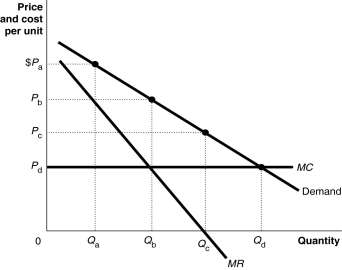 -Refer to Figure 9-5.The chocolate store represented in the diagram is currently selling Qa units of chocolate at a price of Pa.Is this chocolate store maximising its profit and,if it is not,what would you recommend to the firm?
 (Multiple Choice)
4.9/5 (82)
(82) An entry barrier exists when firms in an industry charge the lowest price possible for their products.
(True/False)
4.8/5 (79)
(79) The approach economists use to analyse competition among oligopolists is called
(Multiple Choice)
4.8/5 (79)
(79) A monopolistically competitive industry that earns economic profits in the short run will face a more elastic demand curve in the long run.
(True/False)
5.0/5 (79)
(79) A set of actions that a firm takes to achieve a goal is the definition of a
(Multiple Choice)
5.0/5 (95)
(95) Both the perfectly competitive firm and the monopolistically competitive firm produce at the output where marginal revenue equals marginal cost (MR = MC)but only the perfectly competitive firm achieves allocative efficiency.Explain why this is the case.
(Essay)
4.7/5 (81)
(81) Which of the following is not a reason why government officials are willing to impose entry barriers?
(Multiple Choice)
4.9/5 (78)
(78) For a monopolistically competitive firm,price equals average revenue.
(True/False)
4.9/5 (73)
(73) In long-run equilibrium,compared to a perfectly competitive market,a monopolistically competitive industry produces a ________ level of output and charges a ________ price.
(Multiple Choice)
4.9/5 (85)
(85) The barrier to entry that allowed Alcoa to make persistent economic profits was ownership of an essential input.
(True/False)
4.8/5 (78)
(78) 
Filters
- Essay(0)
- Multiple Choice(0)
- Short Answer(0)
- True False(0)
- Matching(0)