



 Chat with AI
Exam 9: Firms in Perfectly Competitive Markets

Exam 1: Economics: Foundations and Models160 Questions
Exam 2: Trade-Offs, comparative Advantage, and the Market System191 Questions
Exam 3: Where Prices Come From: the Interaction of Demand and Supply241 Questions
Exam 4: Market Efficiency and Market Failure226 Questions
Exam 5: The Economics of Healthcare169 Questions
Exam 6: Firms,the Stock Market,and Corporate Governance255 Questions
Exam 7: Consumer Choice and Elasticity270 Questions
Exam 8: Technology, production, and Costs277 Questions
Exam 9: Firms in Perfectly Competitive Markets351 Questions
Exam 10: Monopoly and Antitrust253 Questions
Exam 11: Monopolistic Competition and Oligopoly304 Questions
Exam 12: GDP: Measuring Total Production and Income200 Questions
Exam 13: Unemployment and Inflation207 Questions
Exam 14: Economic Growth, the Financial System and Business Cycles172 Questions
Exam 15: Aggregate Demand and Aggregate Supply Analysis120 Questions
Exam 16: Money, banks, and the Federal Reserve System139 Questions
Exam 17: Monetary Policy180 Questions
Exam 18: Fiscal Policy131 Questions
Exam 19: Comparative Advantage, international Trade, and Exchange Rates247 Questions
Select questions type


Table 9-1
 -Refer to Table 9-1.What is the marginal revenue of the 3rd unit?
 (Multiple Choice)
4.9/5  (74)
(74) Excess capacity is a characteristic of monopolistically competitive firms.What does excess capacity mean?
(Multiple Choice)
4.8/5 (84)
(84) A monopolistically competitive firm is producing an output level where marginal revenue is greater than marginal cost.What should this firm do to increase its profit or reduce its losses?
(Multiple Choice)
4.8/5 (79)
(79) Prisoner's dilemma games imply that cooperative behaviour between two people or two firms always breaks down.But reality teaches us that people and firms often cooperate successfully to achieve their goals.Why do the results from prisoner's dilemma games fail to predict real-world results?
(Multiple Choice)
4.9/5 (69)
(69) Figure 9-3 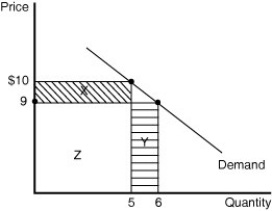 -Refer to Figure 9-3.What is the marginal revenue of the 6th unit of output?
 (Multiple Choice)
4.8/5 (86)
(86) In the long-run equilibrium,a monopolistically competitive firm earning normal profit produces the allocatively efficient output level.
(True/False)
4.8/5 (89)
(89) Consider a U-shaped long-run average cost curve that has a minimum efficient scale at 6000 units of output.In this case,this industry would be
(Multiple Choice)
4.8/5 (89)
(89) When a firm faces a downward-sloping demand curve,marginal revenue
(Multiple Choice)
4.7/5 (75)
(75) Which of the following is true for a monopolistically competitive firm in long-run equilibrium?
(Multiple Choice)
4.7/5 (77)
(77) In the long-run equilibrium,both the perfectly competitive firm and the monopolistically competitive firm produce the output at which MR = MC and charge a price equal to the average total cost of production.
(True/False)
4.8/5 (65)
(65) If marginal revenue is negative,then the revenue lost from receiving a lower price on all the units that could have been sold at the original price is smaller than the additional revenue from selling one more unit of the good.
(True/False)
4.7/5 (69)
(69) Economists agree that a monopolistically competitive market structure
(Multiple Choice)
4.8/5 (95)
(95) All of the following are examples of oligopolistic markets except
(Multiple Choice)
4.9/5 (82)
(82) Figure 9-17  -Refer to Figure 9-17.In the long run,why will the firm produce Qf units and not Qg units,which has a lower average cost of production?
 (Multiple Choice)
4.7/5 (83)
(83) 
Filters
- Essay(0)
- Multiple Choice(0)
- Short Answer(0)
- True False(0)
- Matching(0)