



 Chat with AI
Exam 9: Firms in Perfectly Competitive Markets

Exam 1: Economics: Foundations and Models160 Questions
Exam 2: Trade-Offs, comparative Advantage, and the Market System191 Questions
Exam 3: Where Prices Come From: the Interaction of Demand and Supply241 Questions
Exam 4: Market Efficiency and Market Failure226 Questions
Exam 5: The Economics of Healthcare169 Questions
Exam 6: Firms,the Stock Market,and Corporate Governance255 Questions
Exam 7: Consumer Choice and Elasticity270 Questions
Exam 8: Technology, production, and Costs277 Questions
Exam 9: Firms in Perfectly Competitive Markets351 Questions
Exam 10: Monopoly and Antitrust253 Questions
Exam 11: Monopolistic Competition and Oligopoly304 Questions
Exam 12: GDP: Measuring Total Production and Income200 Questions
Exam 13: Unemployment and Inflation207 Questions
Exam 14: Economic Growth, the Financial System and Business Cycles172 Questions
Exam 15: Aggregate Demand and Aggregate Supply Analysis120 Questions
Exam 16: Money, banks, and the Federal Reserve System139 Questions
Exam 17: Monetary Policy180 Questions
Exam 18: Fiscal Policy131 Questions
Exam 19: Comparative Advantage, international Trade, and Exchange Rates247 Questions
Select questions type


Which of the following will not happen as a consequence of a monopolistically competitive firm suffering economic losses in the short run?
(Multiple Choice)
4.9/5  (78)
(78) If a monopolistically competitive firm has excess capacity,
(Multiple Choice)
4.8/5 (62)
(62) The Table below shows the demand and cost data facing 'Velvet Touches,' a monopolistically competitive producer of velvet throw pillows.
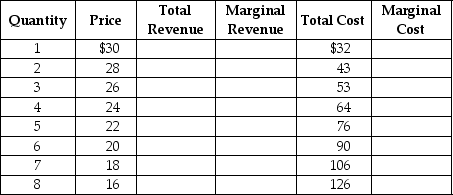 Use the data to answer the following questions.
a.Complete the Total Revenue (TR),Marginal Revenue (MR)and Marginal Cost (MC)columns above.
b.What are the profit-maximising price and quantity for Velvet Touches?
c.Is the firm making a profit or a loss? How much is the profit or loss? Show your work.
d.Is this firm operating in the long run or in the short run? Explain your answer.
e.If the firm's profit or loss is typical of all firms in the market for throw pillows,what is likely to happen in the future? Will there be more firms or will some existing firms leave the industry? Explain your answer.
f.What will happen to the typical firm's profit or loss after all entry/exit adjustments?
Use the data to answer the following questions.
a.Complete the Total Revenue (TR),Marginal Revenue (MR)and Marginal Cost (MC)columns above.
b.What are the profit-maximising price and quantity for Velvet Touches?
c.Is the firm making a profit or a loss? How much is the profit or loss? Show your work.
d.Is this firm operating in the long run or in the short run? Explain your answer.
e.If the firm's profit or loss is typical of all firms in the market for throw pillows,what is likely to happen in the future? Will there be more firms or will some existing firms leave the industry? Explain your answer.
f.What will happen to the typical firm's profit or loss after all entry/exit adjustments? (Essay)
4.8/5 (85)
(85) What are the most important differences between perfectly competitive markets and monopolistically competitive markets?
(Essay)
4.8/5 (76)
(76) Economies of scale can lead to an oligopolistic market structure because
(Multiple Choice)
4.8/5 (72)
(72) If a perfectly competitive firm maximises short-run profits,its marginal revenue will be positive and less than its price.
(True/False)
4.8/5 (65)
(65) The reason that the coffeehouse market is monopolistically competitive rather than perfectly competitive is because
(Multiple Choice)
4.7/5 (74)
(74) Figure 9-7 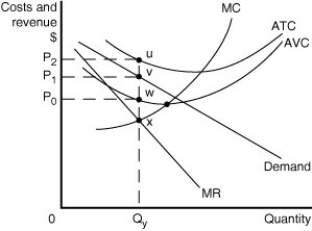 Figure 9-7 shows short-run cost and demand curves for a monopolistically competitive firm in the footwear market.
-Refer to Figure 9-7.Which of the following statements describes the best course of action for the firm depicted in the diagram?
Figure 9-7 shows short-run cost and demand curves for a monopolistically competitive firm in the footwear market.
-Refer to Figure 9-7.Which of the following statements describes the best course of action for the firm depicted in the diagram? (Multiple Choice)
4.8/5 (79)
(79) What is meant by the term 'government-imposed barrier to entry'? Why would a government be willing to impose barriers to entering an industry?
(Essay)
4.8/5 (76)
(76) Figure 9-12  -Refer to Figure 9-12.The firm represented in the diagram
 (Multiple Choice)
4.7/5 (79)
(79) New firms are able to enter monopolistically competitive markets because there are low barriers to entry.
(True/False)
4.9/5 (88)
(88) An equilibrium in a game in which players pursue their own self-interest is called
(Multiple Choice)
4.9/5 (87)
(87) A monopolistically competitive firm that is earning profits will,in the long run,experience all of the following except
(Multiple Choice)
5.0/5 (69)
(69) What is meant by 'excess capacity'? How does it relate to consumer utility?
(Essay)
4.8/5 (75)
(75) Figure 9-10 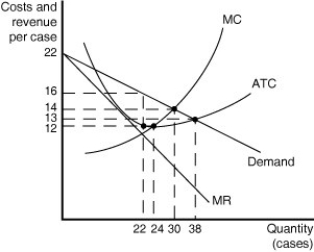 Figure 9-10 shows cost and demand curves for a monopolistically competitive producer of iced tea.
-Refer to Figure 9-10 to answer the following questions.
a.What is the profit-maximising output level?
b.What is the profit-maximising price?
c.At the profit-maximising output level,how much profit will be realised?
d.Does this graph most likely represent the long run or the short run? Why?
Figure 9-10 shows cost and demand curves for a monopolistically competitive producer of iced tea.
-Refer to Figure 9-10 to answer the following questions.
a.What is the profit-maximising output level?
b.What is the profit-maximising price?
c.At the profit-maximising output level,how much profit will be realised?
d.Does this graph most likely represent the long run or the short run? Why? (Essay)
4.9/5 (83)
(83) Economists have long debated whether there is a significant loss of wellbeing to society in markets that are monopolistically competitive rather than perfectly competitive.Which of the following offers the best reason why some economists believe that monopolistically competitive markets benefit consumers despite any loss of wellbeing?
(Multiple Choice)
4.8/5 (70)
(70) 
Filters
- Essay(0)
- Multiple Choice(0)
- Short Answer(0)
- True False(0)
- Matching(0)