



 Chat with AI
Exam 6: Bones and Skeletal Tissue

Exam 1: The Human Body: an Orientation118 Questions
Exam 2: Chemistry Comes Alive137 Questions
Exam 3: Cells: the Living Units131 Questions
Exam 4: Tissue: the Living Fabric109 Questions
Exam 5: The Integumentary System112 Questions
Exam 6: Bones and Skeletal Tissue106 Questions
Exam 7: The Skeleton125 Questions
Exam 8: Joints103 Questions
Exam 9: Muscles and Muscle Tissue129 Questions
Exam 10: The Muscular System100 Questions
Exam 11: Fundamentals of the Nervous System and Nervous Tissue95 Questions
Exam 12: The Central Nervous System138 Questions
Exam 13: The Peripheral Nervous System and Reflex Activity103 Questions
Exam 14: The Autonomic Nervous System103 Questions
Exam 15: The Special Senses147 Questions
Exam 16: The Endocrine System129 Questions
Exam 17: Blood126 Questions
Exam 18: The Cardiovascular System: the Heart107 Questions
Exam 19: The Cardiovascular System: Blood Vessels133 Questions
Exam 20: The Lymphatic System and Lymphoid Organs and Tissues88 Questions
Exam 21: The Immune System: Innate and Adaptive Body Defenses124 Questions
Exam 22: The Respiratory System123 Questions
Exam 23: The Digestive System148 Questions
Exam 24: Nutrition,metabolism,and Body Temperature Regulation123 Questions
Exam 25: The Urinary System129 Questions
Exam 26: Fluid,electrolyte,and Acid-Base Balance110 Questions
Exam 27: The Reproductive System131 Questions
Exam 28: Pregnancy and Human Development99 Questions
Exam 29: Heredity120 Questions
Select questions type


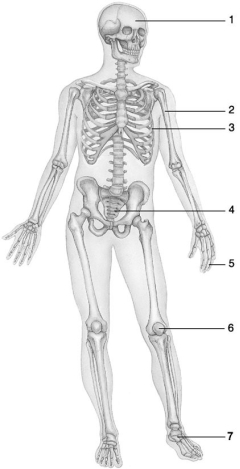 Figure 6.1
Using Figure 6.1, match the following bone types with the numbered structure:
-Bone 3.
Figure 6.1
Using Figure 6.1, match the following bone types with the numbered structure:
-Bone 3. (Multiple Choice)
4.9/5  (74)
(74) Short,irregular,and flat bones have medullary cavities in order to keep the weight of the bones light.
(True/False)
4.8/5 (86)
(86) When an osteoblast becomes completely surrounded by its own matrix secretions it is referred to as an ________.
(Multiple Choice)
4.8/5 (70)
(70) 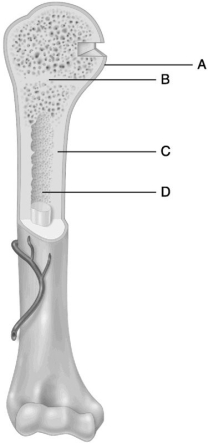 Figure 6.2
Using Figure 6.2, match the following:
-Location of the epiphyseal line.
Figure 6.2
Using Figure 6.2, match the following:
-Location of the epiphyseal line. (Multiple Choice)
4.9/5 (89)
(89) Why are the bones of young children much more flexible than those of the elderly?
(Essay)
4.8/5 (84)
(84)
Figure 6.1
Using Figure 6.1, match the following bone types with the numbered structure:
-Bone 7.
Figure 6.1
Using Figure 6.1, match the following bone types with the numbered structure:
-Bone 7. (Multiple Choice)
4.9/5 (89)
(89) The term osteoid refers to the organic part of the matrix of compact bones.
(True/False)
4.8/5 (80)
(80) Proper blood calcium levels are required for muscle contraction,nerve function,and other critical activities in the body.How does the body maintain homeostasis in response to decreased blood calcium levels? Discuss the main gland,hormone,and target of the hormone.
(Essay)
4.8/5 (80)
(80) Skeletal remains are discovered at an archeological site.X-rays of the femur show evidence of a thin epiphyseal plate.This bone likely belonged to which of the following?
(Multiple Choice)
4.8/5 (70)
(70) How can a tooth be moved in a bony socket during orthodontic treatment?
(Essay)
4.9/5 (65)
(65) Match the following:
-Round or oval opening through a bone.
(Multiple Choice)
4.9/5 (94)
(94)
Figure 6.1
Using Figure 6.1, match the following bone types with the numbered structure:
-Bone 5.
Figure 6.1
Using Figure 6.1, match the following bone types with the numbered structure:
-Bone 5. (Multiple Choice)
4.8/5 (73)
(73) If your doctor notices a marked decrease in calcium ion levels in your blood,what gland might he suspect is not functioning properly and why?
(Essay)
5.0/5 (75)
(75) Match the following:
-Very large,blunt,irregularly shaped process.
(Multiple Choice)
4.9/5 (71)
(71) Match the following:
-An incomplete fracture or cracking of the bone without actual separation of the parts.Common in children.
(Multiple Choice)
4.9/5 (85)
(85) Alice and James adopted a 3-year-old child from a developing country.They noticed that her legs were bowed and there were some deformities in her cranial and pelvic bones.They brought her to a physician for a diagnosis.What was the likely diagnosis,and what was the treatment for the disorder?
(Essay)
4.9/5 (82)
(82) Which of the following statements best describes interstitial growth of cartilage?
(Multiple Choice)
4.8/5 (68)
(68) 
Filters
- Essay(0)
- Multiple Choice(0)
- Short Answer(0)
- True False(0)
- Matching(0)