



 Chat with AI
Exam 6: Bones and Skeletal Tissue

Exam 1: The Human Body: an Orientation118 Questions
Exam 2: Chemistry Comes Alive137 Questions
Exam 3: Cells: the Living Units131 Questions
Exam 4: Tissue: the Living Fabric109 Questions
Exam 5: The Integumentary System112 Questions
Exam 6: Bones and Skeletal Tissue106 Questions
Exam 7: The Skeleton125 Questions
Exam 8: Joints103 Questions
Exam 9: Muscles and Muscle Tissue129 Questions
Exam 10: The Muscular System100 Questions
Exam 11: Fundamentals of the Nervous System and Nervous Tissue95 Questions
Exam 12: The Central Nervous System138 Questions
Exam 13: The Peripheral Nervous System and Reflex Activity103 Questions
Exam 14: The Autonomic Nervous System103 Questions
Exam 15: The Special Senses147 Questions
Exam 16: The Endocrine System129 Questions
Exam 17: Blood126 Questions
Exam 18: The Cardiovascular System: the Heart107 Questions
Exam 19: The Cardiovascular System: Blood Vessels133 Questions
Exam 20: The Lymphatic System and Lymphoid Organs and Tissues88 Questions
Exam 21: The Immune System: Innate and Adaptive Body Defenses124 Questions
Exam 22: The Respiratory System123 Questions
Exam 23: The Digestive System148 Questions
Exam 24: Nutrition,metabolism,and Body Temperature Regulation123 Questions
Exam 25: The Urinary System129 Questions
Exam 26: Fluid,electrolyte,and Acid-Base Balance110 Questions
Exam 27: The Reproductive System131 Questions
Exam 28: Pregnancy and Human Development99 Questions
Exam 29: Heredity120 Questions
Select questions type


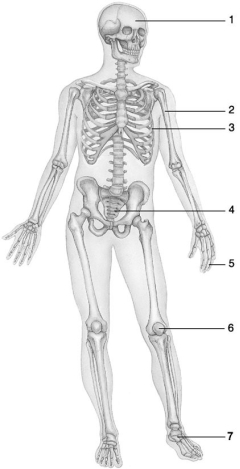 Figure 6.1
Using Figure 6.1, match the following bone types with the numbered structure:
-Bone 6.
Figure 6.1
Using Figure 6.1, match the following bone types with the numbered structure:
-Bone 6. (Multiple Choice)
4.8/5  (73)
(73) Johnny fractured the lower third of his right tibia in a skiing accident.The soft tissues in the area were severely damaged and their surgical removal was necessary.After prolonged immobilization,it was found that Johnny was healing very poorly.The explanation offered by the orthopedic surgeon was that vascularization of the fracture site was still inadequate and good healing was absolutely dependent upon an adequate blood supply.Describe how a long bone receives its blood supply and trace the path of nutrient delivery to the osteocytes.
(Essay)
4.7/5 (69)
(69) Bones are constantly undergoing resorption (breaking bone down)for various reasons.Which of the following cells accomplishes this process?
(Multiple Choice)
4.8/5 (68)
(68) 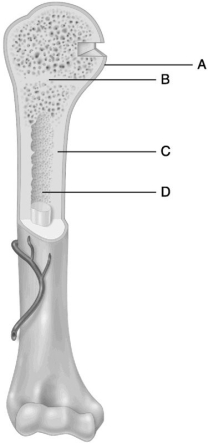 Figure 6.2
Using Figure 6.2, match the following:
-Area where yellow marrow is found.
Figure 6.2
Using Figure 6.2, match the following:
-Area where yellow marrow is found. (Multiple Choice)
4.8/5 (92)
(92) The trabeculae of spongy bone are oriented toward lines of stress.
(True/False)
4.9/5 (81)
(81) Match the following:
-The cells responsible for the early stages of endochondral ossification.
(Multiple Choice)
4.8/5 (91)
(91) Match the following:
-Excessive and haphazard bone deposit and resorption.
(Multiple Choice)
4.9/5 (65)
(65) Match the following:
-Cells that can dissolve the bony matrix.
(Multiple Choice)
4.8/5 (81)
(81) What can a deficiency of growth hormone during bone formation cause?
(Multiple Choice)
4.8/5 (71)
(71) The cell responsible for secreting the matrix of bone is the ________.
(Multiple Choice)
4.8/5 (92)
(92) If your elderly patient's blood calcium level is normal,does that mean the patient does not have osteoporosis? Explain.
(Essay)
4.9/5 (79)
(79) People who live in northern latitudes may require supplemental calcium with vitamin D.Explain why.
(Essay)
4.8/5 (81)
(81) The structural unit of compact bone (osteon)resembles the growth rings of a tree trunk.
(True/False)
4.8/5 (79)
(79) Match the following:
-The appearance of this structure signals the end of bone growth.
(Multiple Choice)
4.8/5 (79)
(79) The structure of bone tissue suits the function.Which of the following bone tissues is adapted to support weight and withstand torsion stresses?
(Multiple Choice)
4.9/5 (68)
(68) 
Filters
- Essay(0)
- Multiple Choice(0)
- Short Answer(0)
- True False(0)
- Matching(0)