



 Chat with AI
Exam 10: Radical Reactions

Exam 1: A Review of General Chemistry: Electrons, Bonds, and Molecular Properties191 Questions
Exam 2: Molecular Representations168 Questions
Exam 3: Acids and Bases127 Questions
Exam 4: Alkanes and Cycloalkanes116 Questions
Exam 5: Stereoisomerism141 Questions
Exam 6: Chemical Reactivity and Mechanisms96 Questions
Exam 7: Alkyl Halides: Nucleophilic Substitution and Elimination Reactions224 Questions
Exam 8: Addition Reactions of Alkenes153 Questions
Exam 9: Alkynes177 Questions
Exam 10: Radical Reactions102 Questions
Exam 11: Synthesis106 Questions
Exam 12: Alcohols and Phenols147 Questions
Exam 13: Ethers and Epoxides; Thiols and Sulfides139 Questions
Exam 14: Infrared Spectroscopy and Mass Spectrometry135 Questions
Exam 15: Nuclear Magnetic Resonance Spectroscopy140 Questions
Exam 16: Conjugated Pi Systems and Pericyclic Reactions140 Questions
Exam 17: Aromatic Compounds118 Questions
Exam 18: Aromatic Substitution Reactions122 Questions
Exam 19: Aldehydes and Ketones169 Questions
Exam 20: Carboxylic Acids and Their Derivatives144 Questions
Exam 21: Alpha Carbon Chemistry: Enols and Enolates147 Questions
Exam 22: Amines112 Questions
Exam 23: Introduction to Organometallic Compounds118 Questions
Exam 24: Carbohydrates144 Questions
Exam 25: Amino Acids, Peptides, and Proteins133 Questions
Exam 26: Lipids123 Questions
Exam 27: Synthetic Polymers119 Questions
Select questions type


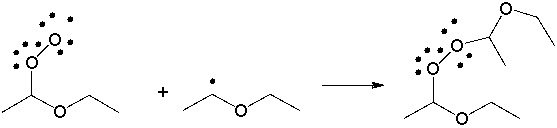

One possible product of thermal cracking of hexane is 1-butene. Draw arrows to suggest a possible mechanism for this process starting from an alkyl radical.
(Essay)
4.8/5  (82)
(82) Determine the repeat unit for the polymer produced in the following reaction. 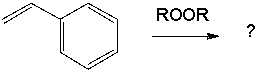
(Multiple Choice)
4.8/5 (89)
(89) Draw the major product(s) of the following reaction. Is the product optically active? Explain. 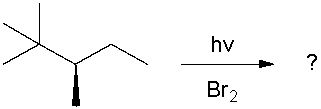
(Essay)
4.8/5 (82)
(82) 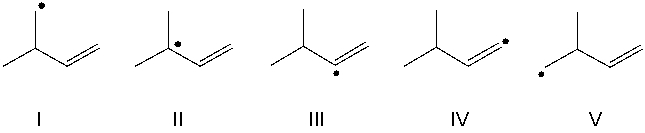

Which of the following are possible product(s) of the reaction shown? 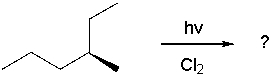
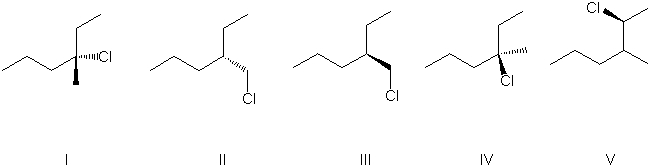
(Multiple Choice)
4.8/5 (75)
(75) Upon treatment with NBS and irradiation with UV light, 2-isopropyl-3-methyl-1-butene reacts to produce exactly two monobrominated compounds. Draw the products of this reaction.
(Essay)
4.9/5 (86)
(86) Propose a sequence of reactions to accomplish the following synthesis. 
(Essay)
4.8/5 (74)
(74) Which of the following compounds would be expected to be least destructive to the ozone layer?
(Multiple Choice)
4.9/5 (98)
(98) Give the arrows to show the mechanism of the following radical process. 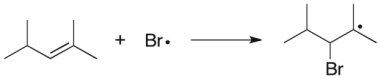
(Essay)
4.8/5 (84)
(84) 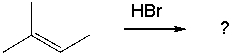
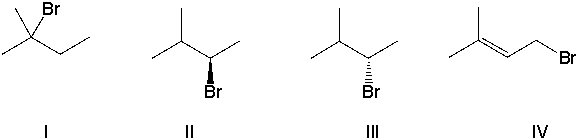
Which of the following are major products of the reaction shown? 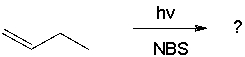

(Multiple Choice)
4.8/5 (81)
(81) 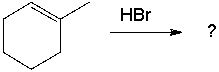
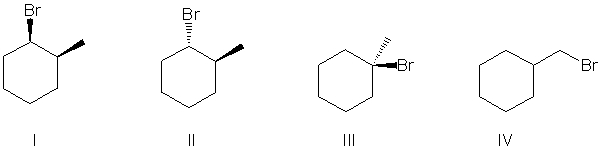
Which term most accurately describes the process shown below? 
(Multiple Choice)
4.8/5 (89)
(89) Free radical chlorination of ethane can produce higher halogenation products such as dichloroethane, trichloroethane, tetrachloroethane, pentachloroethane, and hexachloroethane. How could the production of higher halogenated products be minimized?
(Multiple Choice)
4.9/5 (77)
(77) Upon treatment with NBS and irradiation with UV light, 1-ethyl-4-methylbenzene produces exactly three monobrominated compounds (including stereoisomers). Draw the products of this reaction.
(Essay)
4.9/5 (69)
(69) Give the arrows to show the mechanism of the following radical process. 
(Essay)
4.8/5 (75)
(75) 
Filters
- Essay(0)
- Multiple Choice(0)
- Short Answer(0)
- True False(0)
- Matching(0)