



 Chat with AI
Exam 20: Carboxylic Acids and Their Derivatives

Exam 1: A Review of General Chemistry: Electrons, Bonds, and Molecular Properties191 Questions
Exam 2: Molecular Representations168 Questions
Exam 3: Acids and Bases127 Questions
Exam 4: Alkanes and Cycloalkanes116 Questions
Exam 5: Stereoisomerism141 Questions
Exam 6: Chemical Reactivity and Mechanisms96 Questions
Exam 7: Alkyl Halides: Nucleophilic Substitution and Elimination Reactions224 Questions
Exam 8: Addition Reactions of Alkenes153 Questions
Exam 9: Alkynes177 Questions
Exam 10: Radical Reactions102 Questions
Exam 11: Synthesis106 Questions
Exam 12: Alcohols and Phenols147 Questions
Exam 13: Ethers and Epoxides; Thiols and Sulfides139 Questions
Exam 14: Infrared Spectroscopy and Mass Spectrometry135 Questions
Exam 15: Nuclear Magnetic Resonance Spectroscopy140 Questions
Exam 16: Conjugated Pi Systems and Pericyclic Reactions140 Questions
Exam 17: Aromatic Compounds118 Questions
Exam 18: Aromatic Substitution Reactions122 Questions
Exam 19: Aldehydes and Ketones169 Questions
Exam 20: Carboxylic Acids and Their Derivatives144 Questions
Exam 21: Alpha Carbon Chemistry: Enols and Enolates147 Questions
Exam 22: Amines112 Questions
Exam 23: Introduction to Organometallic Compounds118 Questions
Exam 24: Carbohydrates144 Questions
Exam 25: Amino Acids, Peptides, and Proteins133 Questions
Exam 26: Lipids123 Questions
Exam 27: Synthetic Polymers119 Questions
Select questions type


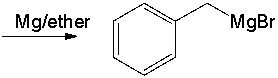
Provide a stepwise synthesis for the following compound using benzyl alcohol as your only source of carbon and using any other reagents necessary. 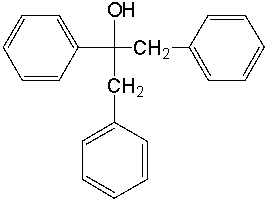

Free
(Essay)
4.7/5  (71)
(71) Correct Answer: Verified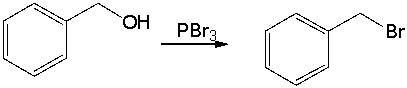
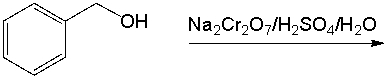
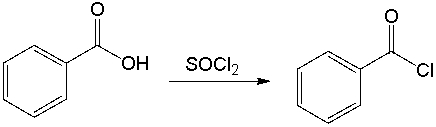
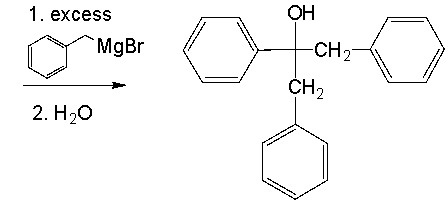
Predict the product for the following reaction. 
Free
(Essay)
5.0/5 (84)
(84) Correct Answer:Verified
Verified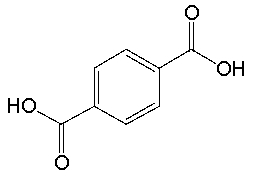
Barbital, used as a sedative, is synthesized from diethyl 2,2-diethyl malonate (A) and urea (B). Provide the structure for barbital. 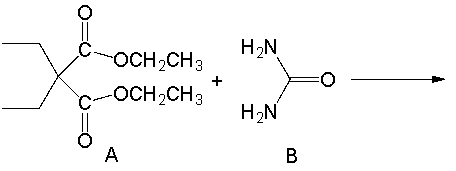
Free
(Essay)
4.8/5 (80)
(80) Correct Answer:Verified
Verified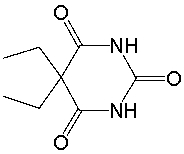

A compound with molecular formula C8H14O3 exhibits a triplet at 1.0 (6H), a sextet at 1.6 (4H) and a triplet at 2.2 (4H) in its 1H NMR spectrum. Its IR spectrum shows two strong absorption bands near 1850 and 1750 cm-1. What is the structure for this compound?
(Essay)
4.8/5 (77)
(77) 

Rank the following acids in decreasing (strongest to weakest) order of acidity. Explain your choice. 
(Essay)
5.0/5 (82)
(82) 
Provide the reagents necessary to carry out the following conversion. 
(Multiple Choice)
4.9/5 (75)
(75) Provide the reagents necessary to carry out the following conversion. 
(Multiple Choice)
4.8/5 (89)
(89) 
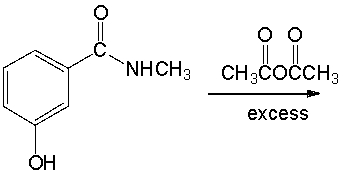
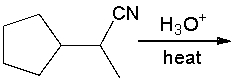
Provide the reagents necessary to carry out the following conversion. 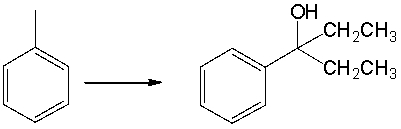
(Essay)
4.9/5 (87)
(87) Provide the reagents necessary to carry out the following conversion. 
(Multiple Choice)
4.9/5 (77)
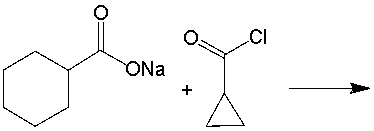
(77) Predict the product for the following reaction and provide a stepwise, curved arrow, mechanism for the formation of the product. 
(Essay)
4.9/5 (86)
(86) 

Filters
- Essay(0)
- Multiple Choice(0)
- Short Answer(0)
- True False(0)
- Matching(0)