



 Chat with AI
Exam 6: Chemical Reactivity and Mechanisms

Exam 1: A Review of General Chemistry: Electrons, Bonds, and Molecular Properties191 Questions
Exam 2: Molecular Representations168 Questions
Exam 3: Acids and Bases127 Questions
Exam 4: Alkanes and Cycloalkanes116 Questions
Exam 5: Stereoisomerism141 Questions
Exam 6: Chemical Reactivity and Mechanisms96 Questions
Exam 7: Alkyl Halides: Nucleophilic Substitution and Elimination Reactions224 Questions
Exam 8: Addition Reactions of Alkenes153 Questions
Exam 9: Alkynes177 Questions
Exam 10: Radical Reactions102 Questions
Exam 11: Synthesis106 Questions
Exam 12: Alcohols and Phenols147 Questions
Exam 13: Ethers and Epoxides; Thiols and Sulfides139 Questions
Exam 14: Infrared Spectroscopy and Mass Spectrometry135 Questions
Exam 15: Nuclear Magnetic Resonance Spectroscopy140 Questions
Exam 16: Conjugated Pi Systems and Pericyclic Reactions140 Questions
Exam 17: Aromatic Compounds118 Questions
Exam 18: Aromatic Substitution Reactions122 Questions
Exam 19: Aldehydes and Ketones169 Questions
Exam 20: Carboxylic Acids and Their Derivatives144 Questions
Exam 21: Alpha Carbon Chemistry: Enols and Enolates147 Questions
Exam 22: Amines112 Questions
Exam 23: Introduction to Organometallic Compounds118 Questions
Exam 24: Carbohydrates144 Questions
Exam 25: Amino Acids, Peptides, and Proteins133 Questions
Exam 26: Lipids123 Questions
Exam 27: Synthetic Polymers119 Questions
Select questions type


For the following reaction step, indicate which pattern of arrow pushing it represents. 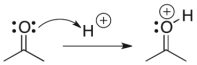
(Multiple Choice)
4.9/5  (74)
(74) 

For the following reaction step, indicate which pattern of arrow pushing it represents. 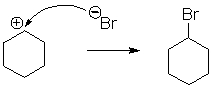
(Multiple Choice)
4.9/5 (86)
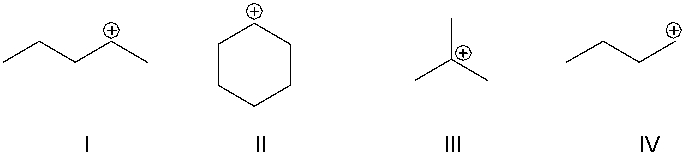
(86) Draw the mechanism and most likely product for the following cation rearrangement. 
(Essay)
4.9/5 (68)
(68) 

Which of the following is the most likely structure of the following cation after rearrangement? 
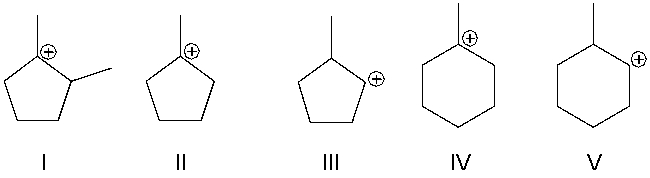
(Multiple Choice)
4.9/5 (73)
(73) Does a reaction with a value of 0 for ∆G favor reactants or products?
(Short Answer)
4.8/5 (71)
(71) Will the following cation undergo rearrangement?
SHAPE \* MERGEFORMAT 

(Short Answer)
4.8/5 (87)
(87) Does a reaction with a positive ∆S and a positive ∆H favor reactants or products?
(Essay)
4.9/5 (78)
(78) Given the following rate law, what is the order of the reaction with respect to tert-butyl iodide? 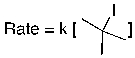
(Short Answer)
4.8/5 (71)
(71) Later in the course, we will compare the halogenation of differently substituted carbons, comparing reactions like the ones below. Which of the following statements is true about reactions I and II? 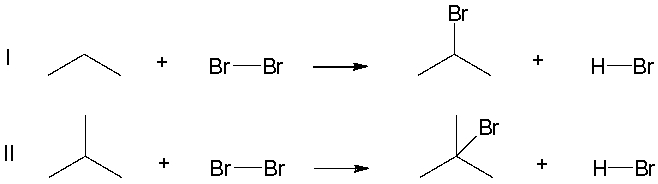
(Multiple Choice)
4.8/5 (72)
(72) Which of the following is an energy diagram for a three-step reaction?
(Multiple Choice)
4.8/5 (91)
(91) 

What type of bond cleavage does the following reaction involve? 
(Short Answer)
4.7/5 (93)
(93) Identify the sequence of curved arrows (electron movement) in the steps of the following reaction. 
(Multiple Choice)
4.9/5 (68)
(68) 
Filters
- Essay(0)
- Multiple Choice(0)
- Short Answer(0)
- True False(0)
- Matching(0)