



 Chat with AI
Exam 5: Developmental Disorders

Exam 1: Introduction to Preliminary Diagnosis of Oral Lesions50 Questions
Exam 2: Inflammation and Repair59 Questions
Exam 3: Immunity and Immunologic Oral Lesions60 Questions
Exam 4: Infectious Diseases64 Questions
Exam 5: Developmental Disorders60 Questions
Exam 6: Genetics87 Questions
Exam 7: Neoplasia99 Questions
Exam 8: Nonneoplastic Diseases of Bone28 Questions
Exam 9: Oral Manifestations of Systemic Diseases72 Questions
Exam 10: Diseases Affecting the Temporomandibular Joint38 Questions
Select questions type


Radiographically, this radiolucent cyst is often heart shaped, caused by the anatomic Y shape of the area. It is called the _____ cyst.
(Multiple Choice)
4.8/5  (84)
(84) What is the name of the pseudocyst filled with salivary gland tissue that may be an extension of the sublingual gland?
(Multiple Choice)
4.7/5 (90)
(90) The radiograph of this patient exhibits a biloculated, well-defined radiolucency lateral to the tooth root. It is asymptomatic. 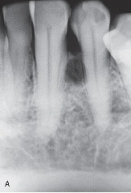 This is a _____ cyst.
 (Multiple Choice)
4.8/5 (80)
(80) Enamel hypoplasia is the result of a disturbance of or damage to ameloblasts during enamel matrix formation. Which one of the following would not be a factor?
(Multiple Choice)
4.8/5 (77)
(77) When two or more teeth are joined by cementum, as shown in this picture, it is known as: 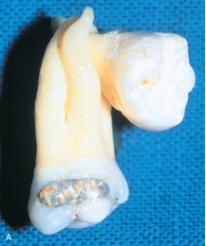
(Multiple Choice)
4.9/5 (79)
(79) During tooth development, ectoderm and ectomesenchymal cells give rise to each of the following except one. Which one is the exception?
(Multiple Choice)
4.8/5 (83)
(83) Total anodontia is often associated with a hereditary disturbance called:
(Multiple Choice)
4.8/5 (86)
(86) Clinically, the lingual thyroid nodule appears as a smooth nodular mass:
(Multiple Choice)
5.0/5 (95)
(95) The most common cyst observed in the oral cavity is caused by pulpal inflammation and is called a(n) _____ cyst.
(Multiple Choice)
4.9/5 (71)
(71) The pseudocyst seen in this radiograph is surrounded by salivary gland tissue. 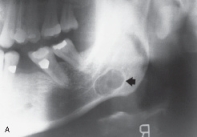 It is a(n) _____ bone cyst.
 (Multiple Choice)
4.8/5 (77)
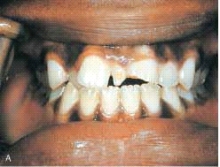
(77) 

Filters
- Essay(0)
- Multiple Choice(0)
- Short Answer(0)
- True False(0)
- Matching(0)