



 Chat with AI
Exam 3: Immunity and Immunologic Oral Lesions

Exam 1: Introduction to Preliminary Diagnosis of Oral Lesions50 Questions
Exam 2: Inflammation and Repair59 Questions
Exam 3: Immunity and Immunologic Oral Lesions60 Questions
Exam 4: Infectious Diseases64 Questions
Exam 5: Developmental Disorders60 Questions
Exam 6: Genetics87 Questions
Exam 7: Neoplasia99 Questions
Exam 8: Nonneoplastic Diseases of Bone28 Questions
Exam 9: Oral Manifestations of Systemic Diseases72 Questions
Exam 10: Diseases Affecting the Temporomandibular Joint38 Questions
Select questions type


Which form of Langerhans cell disease resembles lymphoma, affects children younger than 3 years, and has a rapidly fatal course?
(Multiple Choice)
4.9/5  (84)
(84) The onset of this condition is explosive. It is characterized by skin and mucosal lesions. The skin lesions are referred to as target, iris, or bull's eye lesions. The mucosal lesions affect the buccal mucosa, lips, and tongue and appear as superficial ulcerations. The lip lesions are ulcerated, encrusted, and bloody. 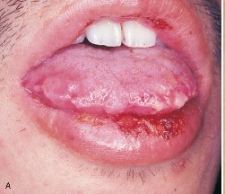 On the basis of this description, you suspect:
 (Multiple Choice)
4.7/5 (79)
(79) This patient presents with an intraepithelial bulla from breakdown of the cellular adhesion between epithelial cells. The bulla ruptured, resulting in a painful ulcer with itching. 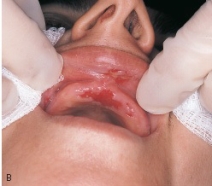 The correct diagnosis for this progressive autoimmune disease is:
 (Multiple Choice)
4.7/5 (81)
(81) The breakdown of cellular adhesion between epithelial cells is called:
(Multiple Choice)
4.8/5 (94)
(94) Pemphigus vulgaris differs histologically from cicatricial pemphigoid in that pemphigus vulgaris involves:
(Multiple Choice)
4.9/5 (83)
(83) The most characteristic skin lesion in SLE is described as:
(Multiple Choice)
4.8/5 (89)
(89) In which one of the following is the Langerhans cell not the proliferating cell?
(Multiple Choice)
4.8/5 (72)
(72) Anaphylaxis occurs as a result of what type of hypersensitivity?
(Multiple Choice)
4.8/5 (77)
(77) When antibodies pass through the placenta to a developing fetus and protect the newborn infant from disease, this is referred to as _____ immunity.
(Multiple Choice)
4.8/5 (92)
(92) Which one of the following is an example of type I hypersensitivity?
(Multiple Choice)
5.0/5 (87)
(87) A patient presents with a diffuse swelling of the upper lip caused by permeability of deeper blood vessels. The skin covering the swelling appears normal and not accompanied by itching. This is characteristic of what pathological condition?
(Multiple Choice)
4.9/5 (79)
(79) In the mildest form of this autoimmune disease, oral lesions appear as erythematous plaques or erosions. White striae radiating from the center of the lesion are also commonly present. These oral lesions are indicative of what autoimmune disease?
(Multiple Choice)
4.7/5 (61)
(61) This patient has Sjögren syndrome and severe xerostomia. 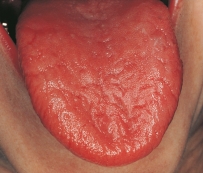 Which clinical feature most appropriately describes the changes on the tongue in this patient?
 (Multiple Choice)
4.7/5 (72)
(72) The major divisions of the immune response are the cell-mediated and humoral responses. Both of these responses originate from what type of cell?
(Multiple Choice)
4.8/5 (67)
(67) The classic triad of symptoms seen in 25% of patients with Hand-Schüller-Christian disease includes all of the following except:
(Multiple Choice)
4.8/5 (88)
(88) Which one of the following routes of drug administration can cause the most significant hypersensitivity reaction?
(Multiple Choice)
4.9/5 (77)
(77) In which type of immune response do B-lymphocytes and antibodies play the predominant role?
(Multiple Choice)
4.8/5 (80)
(80) 
Filters
- Essay(0)
- Multiple Choice(0)
- Short Answer(0)
- True False(0)
- Matching(0)