



 Chat with AI
Exam 15: Resource Markets

Exam 1: The Wealth of Nations: Ownership and Economic Freedom87 Questions
Exam 2: Scarcity and Opportunity Costs87 Questions
Exam 3: Markets and the Price System96 Questions
Exam 4: The Aggregate Economy61 Questions
Exam 5: Using Economics to Understand the World Around You68 Questions
Exam 6: Elasticity: Demand and Supply133 Questions
Exam 7: Demand: Consumer Choice142 Questions
Exam 8: Supply: the Costs of Doing Business105 Questions
Exam 9: Profit Maximization121 Questions
Exam 10: Perfect Competition135 Questions
Exam 11: Monopoly118 Questions
Exam 12: Monopolistic Competition and Oligopoly114 Questions
Exam 13: Markets and Government113 Questions
Exam 14: Antitrust and Regulation88 Questions
Exam 15: Resource Markets110 Questions
Exam 16: The Labor Market116 Questions
Exam 17: The Capital Market110 Questions
Exam 18: The Land Market and Natural Resources55 Questions
Exam 19: Current Issues: Income, Income Distribution, Poverty, and Government Policy85 Questions
Exam 20: World Trade Equilibrium112 Questions
Exam 21: International Trade Restrictions109 Questions
Exam 22: Exchange Rates and Financial Links Between Countries130 Questions
Select questions type


The following table shows the marginal revenue of a firm and the marginal physical product of different units of labor in a perfectly competitive labor market.Table 14.5
Note: Marginal revenue product of a resource is the product of MPP and MR.  -In Table 14.5, if the wage rate is $10, how many workers will be employed by a profit-maximizing firm ?
 (Multiple Choice)
4.8/5  (82)
(82) The following table shows the marginal productivity of different units of labor for producing a product.Table 14.4
In the table,
MR: Marginal Revenue
MPP: Marginal Physical Product
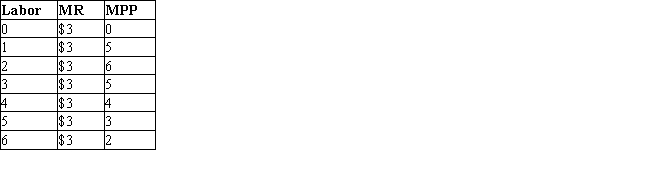 -In Table 14.4, if marginal revenue product is equal to the product of MPP and MR, what wage rate would be consistent with a profit-maximizing firm hiring six laborers?
 (Multiple Choice)
4.9/5 (76)
(76) In the following figure, the first panel shows a market situation prior to regulation and the second panel shows the effects of regulation.Figure 14.2
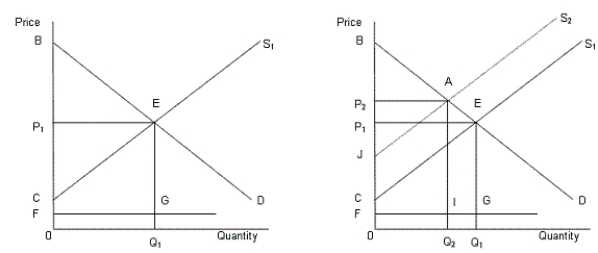 In the figure,
D: Demand curve for automobiles
S1: Supply curve of automobiles prior to regulation
S2: Supply curve of automobiles after regulation
FG: Clean up cost per unit
-The marginal revenue product (MRP) is the:
In the figure,
D: Demand curve for automobiles
S1: Supply curve of automobiles prior to regulation
S2: Supply curve of automobiles after regulation
FG: Clean up cost per unit
-The marginal revenue product (MRP) is the: (Multiple Choice)
4.9/5 (84)
(84) The following table shows output per hour produced by the different units of labor.Table 14.1
The marginal revenue product of a resource is equal to the product of the marginal product of an input and marginal revenue. 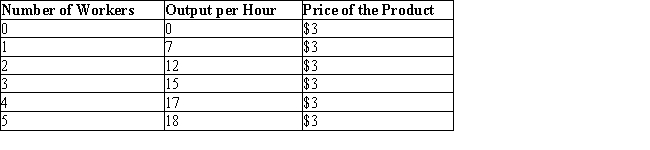 -Refer to Table 14.1. If both the wage rate and the price of the good falls to $2, how many workers would the firm hire?
 (Multiple Choice)
4.8/5 (87)
(87) The following table shows the marginal revenue of a firm and the marginal physical product of different units of labor in a perfectly competitive labor market.Table 14.5
Note: Marginal revenue product of a resource is the product of MPP and MR.
-In Table 14.5, at what wage rate would one worker be hired by a profit-maximizing firm?
-In Table 14.5, at what wage rate would one worker be hired by a profit-maximizing firm? (Multiple Choice)
4.8/5 (86)
(86) The table below shows the total output produced by different units of a resource. Assume that the resource and output markets are both perfectly competitive. The equilibrium price of the resource is $15.00, and the equilibrium price of the product is $0.50.Table 14.2
Marginal revenue product (MRP) of a resource is the product of the marginal product of the resource and the marginal revenue. 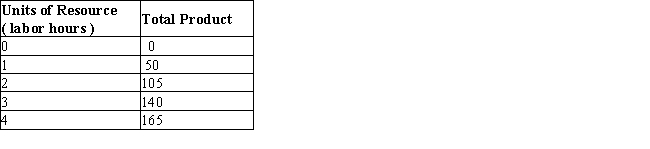 -If a resource is purchased and sold in a perfectly competitive market:
 (Multiple Choice)
4.9/5 (82)
(82) The following table shows output per hour produced by the different units of labor.Table 14.1
The marginal revenue product of a resource is equal to the product of the marginal product of an input and marginal revenue.
-According to Table 14.1, the marginal revenue product of the:
-According to Table 14.1, the marginal revenue product of the: (Multiple Choice)
4.8/5 (76)
(76) Scenario 14.1
A worker in Firm A earns an income of $5,000 per month. He has been offered a job in Firm B where he will be paid a salary of $7,000 per month.
-The profit-maximizing number of workers for a monopsony to employ is derived at the point where the marginal revenue product of labor is equal to the marginal factor cost of labor.
(True/False)
4.7/5 (76)
(76) Scenario 14.1
A worker in Firm A earns an income of $5,000 per month. He has been offered a job in Firm B where he will be paid a salary of $7,000 per month.
-Households' expenditure on goods and services are sources of revenue for the firms.
(True/False)
4.7/5 (79)
(79) The table below shows the total output produced by different units of a resource. Assume that the resource and output markets are both perfectly competitive. The equilibrium price of the resource is $15.00, and the equilibrium price of the product is $0.50.Table 14.2
Marginal revenue product (MRP) of a resource is the product of the marginal product of the resource and the marginal revenue.
-Refer to Table 14.2. What is the marginal factor cost for the third unit of the resource?
-Refer to Table 14.2. What is the marginal factor cost for the third unit of the resource? (Multiple Choice)
5.0/5 (74)
(74) 
Filters
- Essay(0)
- Multiple Choice(0)
- Short Answer(0)
- True False(0)
- Matching(0)