



 Chat with AI
Exam 13: Markets and Government

Exam 1: The Wealth of Nations: Ownership and Economic Freedom87 Questions
Exam 2: Scarcity and Opportunity Costs87 Questions
Exam 3: Markets and the Price System96 Questions
Exam 4: The Aggregate Economy61 Questions
Exam 5: Using Economics to Understand the World Around You68 Questions
Exam 6: Elasticity: Demand and Supply133 Questions
Exam 7: Demand: Consumer Choice142 Questions
Exam 8: Supply: the Costs of Doing Business105 Questions
Exam 9: Profit Maximization121 Questions
Exam 10: Perfect Competition135 Questions
Exam 11: Monopoly118 Questions
Exam 12: Monopolistic Competition and Oligopoly114 Questions
Exam 13: Markets and Government113 Questions
Exam 14: Antitrust and Regulation88 Questions
Exam 15: Resource Markets110 Questions
Exam 16: The Labor Market116 Questions
Exam 17: The Capital Market110 Questions
Exam 18: The Land Market and Natural Resources55 Questions
Exam 19: Current Issues: Income, Income Distribution, Poverty, and Government Policy85 Questions
Exam 20: World Trade Equilibrium112 Questions
Exam 21: International Trade Restrictions109 Questions
Exam 22: Exchange Rates and Financial Links Between Countries130 Questions
Select questions type


The figure given below shows the demand and supply curves of automobiles.Figure 13.3
In the figure,
D: Demand curve of automobiles
S: Supply of automobiles prior to the tax
S+t: Supply of automobiles after the tax
 -In Figure 13.3, the amount of tax levied by the government is equal to:
 (Multiple Choice)
4.8/5  (85)
(85) Overfishing along the coastline of Helsking village led the government to impose a fee on the boats used for fishing. The fishermen were charged $50 on each boat they sent out for fishing. The following table shows the total pounds of fish caught per hour and the number of boats used for fishing.Table 13.2
 -Refer to Table 13.2. Suppose fish sells for $1 per pound. If each fisherman decides whether or not to fish based on the average catch, how many boats per hour will go out to fish?
 (Multiple Choice)
5.0/5 (80)
(80) 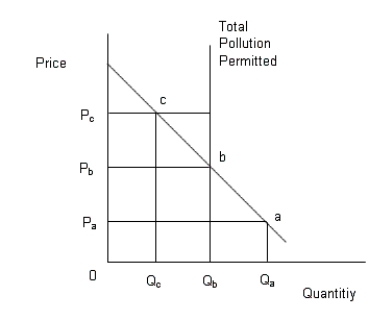 -A market failure occurs when the market outcome is not the socially efficient outcome.
 (True/False)
4.9/5 (81)
(81)
-In the case of positive externalities, too many people consume and produce the good compared to what is desired by society.
-In the case of positive externalities, too many people consume and produce the good compared to what is desired by society. (True/False)
4.9/5 (84)
(84)
-Why does an existing less efficient technology drive out a new, more efficient technology?
-Why does an existing less efficient technology drive out a new, more efficient technology? (Multiple Choice)
4.7/5 (84)
(84) The table below shows the payoff (profit) matrix of Firm A and Firm B indicating the profit outcome that corresponds to each firm's pricing strategy (where $500 and $200 are the pricing strategies of two firms).Table 12.2
 -Which of the following is true of an externality?
 (Multiple Choice)
4.8/5 (87)
(87)
-James insured his car with a renowned insurance company that checked his driving skills and verified his accident records before insuring his car. After paying two premiums for this insurance, James took to drinking and driving. This action of James is likely to create:
-James insured his car with a renowned insurance company that checked his driving skills and verified his accident records before insuring his car. After paying two premiums for this insurance, James took to drinking and driving. This action of James is likely to create: (Multiple Choice)
4.9/5 (81)
(81)
-Mary is a low-risk applicant for a loan at a bank, while John is a high-risk applicant. If the bank increases the interest rates it charges on loans, _____.
-Mary is a low-risk applicant for a loan at a bank, while John is a high-risk applicant. If the bank increases the interest rates it charges on loans, _____. (Multiple Choice)
4.8/5 (93)
(93)
-_____ occurs when unobservable qualities are valued incorrectly because of a lack of information.
-_____ occurs when unobservable qualities are valued incorrectly because of a lack of information. (Multiple Choice)
4.8/5 (81)
(81)
-Suppose that if there are n users of a network, the value of the membership is proportional to n(n − 1). If the value of a network to a single user is $1 for each other user on the network, then a network of size 100 has a value of:
-Suppose that if there are n users of a network, the value of the membership is proportional to n(n − 1). If the value of a network to a single user is $1 for each other user on the network, then a network of size 100 has a value of: (Multiple Choice)
4.7/5 (96)
(96) The table below shows the payoff (profit) matrix of Firm A and Firm B indicating the profit outcome that corresponds to each firm's pricing strategy (where $500 and $200 are the pricing strategies of two firms).Table 12.2
-In the case of public goods, _____.
-In the case of public goods, _____. (Multiple Choice)
4.9/5 (84)
(84)
-The government should subsidize the production of goods which generate a positive externality.
-The government should subsidize the production of goods which generate a positive externality. (True/False)
4.9/5 (92)
(92)
-Private costs of an economic activity exceed social cost when external benefits are created.
-Private costs of an economic activity exceed social cost when external benefits are created. (True/False)
4.9/5 (84)
(84) 
Filters
- Essay(0)
- Multiple Choice(0)
- Short Answer(0)
- True False(0)
- Matching(0)