



 Chat with AI
Exam 13: Markets and Government

Exam 1: The Wealth of Nations: Ownership and Economic Freedom87 Questions
Exam 2: Scarcity and Opportunity Costs87 Questions
Exam 3: Markets and the Price System96 Questions
Exam 4: The Aggregate Economy61 Questions
Exam 5: Using Economics to Understand the World Around You68 Questions
Exam 6: Elasticity: Demand and Supply133 Questions
Exam 7: Demand: Consumer Choice142 Questions
Exam 8: Supply: the Costs of Doing Business105 Questions
Exam 9: Profit Maximization121 Questions
Exam 10: Perfect Competition135 Questions
Exam 11: Monopoly118 Questions
Exam 12: Monopolistic Competition and Oligopoly114 Questions
Exam 13: Markets and Government113 Questions
Exam 14: Antitrust and Regulation88 Questions
Exam 15: Resource Markets110 Questions
Exam 16: The Labor Market116 Questions
Exam 17: The Capital Market110 Questions
Exam 18: The Land Market and Natural Resources55 Questions
Exam 19: Current Issues: Income, Income Distribution, Poverty, and Government Policy85 Questions
Exam 20: World Trade Equilibrium112 Questions
Exam 21: International Trade Restrictions109 Questions
Exam 22: Exchange Rates and Financial Links Between Countries130 Questions
Select questions type


The table below shows the payoff (profit) matrix of Firm A and Firm B indicating the profit outcome that corresponds to each firm's pricing strategy (where $500 and $200 are the pricing strategies of two firms).Table 12.2
 -When the benefits of an activity are received by those who are not directly involved in it, _____.
 (Multiple Choice)
4.8/5  (71)
(71) The following table shows the costs and benefit of producing a commodity.Table 13.1
 -According to Table 13.1, at the social equilibrium:
 (Multiple Choice)
4.7/5 (66)
(66)  -When a particular resource is commonly used, it tends to get underutilized.
 (True/False)
4.8/5 (69)
(69)
-Which of the following may be explained by adverse selection?
-Which of the following may be explained by adverse selection? (Multiple Choice)
4.9/5 (78)
(78)
-A possible solution to the network externality problem is the government limiting the size of networks.
-A possible solution to the network externality problem is the government limiting the size of networks. (True/False)
4.8/5 (73)
(73)
-Private property rights help to ensure an efficient use of resources, because owners of the resources must bear the costs of inefficient use.
-Private property rights help to ensure an efficient use of resources, because owners of the resources must bear the costs of inefficient use. (True/False)
4.7/5 (88)
(88)
-The major problem with common ownership is that too much of the commonly owned resource is consumed, and not enough is produced.
-The major problem with common ownership is that too much of the commonly owned resource is consumed, and not enough is produced. (True/False)
4.9/5 (84)
(84)
-Consumers in used car markets can very easily differentiate between high-quality and low-quality cars.
-Consumers in used car markets can very easily differentiate between high-quality and low-quality cars. (True/False)
4.9/5 (71)
(71) The figure below shows the demand and supply curves in the market for elementary education.Figure 13.1
In the figure,
D: Private demand curve for elementary education
D + s: Demand curve which includes public benefits
S: Supply curve of education
Price and Quantity have been taken on vertical and horizontal axes respectively.  -According to Figure 13.1, the outcome of an unregulated, unsubsidized market would be:
 (Multiple Choice)
4.8/5 (99)
(99)
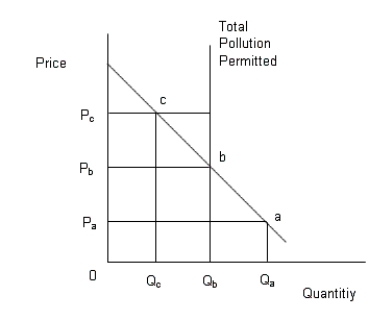
-In Figure 13.4, if the government sells Qb permits to pollute at a price of Pb each, then:
-In Figure 13.4, if the government sells Qb permits to pollute at a price of Pb each, then: (Multiple Choice)
4.8/5 (75)
(75) The table below shows the payoff (profit) matrix of Firm A and Firm B indicating the profit outcome that corresponds to each firm's pricing strategy (where $500 and $200 are the pricing strategies of two firms).Table 12.2
-When a negative externality exists in the case of a particular good, and if that is not reflected in the price, _____.
-When a negative externality exists in the case of a particular good, and if that is not reflected in the price, _____. (Multiple Choice)
4.9/5 (81)
(81) The table below shows the payoff (profit) matrix of Firm A and Firm B indicating the profit outcome that corresponds to each firm's pricing strategy (where $500 and $200 are the pricing strategies of two firms).Table 12.2
-When negative externalities exist in production, _____.
-When negative externalities exist in production, _____. (Multiple Choice)
4.9/5 (69)
(69)
-When some benefits are received by those who are not involved in a private transaction, a negative externality occurs.
-When some benefits are received by those who are not involved in a private transaction, a negative externality occurs. (True/False)
4.9/5 (85)
(85) The figure below shows the demand and supply curves in the market for elementary education.Figure 13.1
In the figure,
D: Private demand curve for elementary education
D + s: Demand curve which includes public benefits
S: Supply curve of education
Price and Quantity have been taken on vertical and horizontal axes respectively.
-Figure 13.1 represents a situation of:
-Figure 13.1 represents a situation of: (Multiple Choice)
4.9/5 (89)
(89) The figure given below shows the demand and supply curves of steel. Sp is the private supply curve, and Ss is the social supply curve that includes both private costs and external costs.Figure 13.2
 -According to Figure 13.2:
 (Multiple Choice)
4.8/5 (83)
(83)
-Problems of moral hazard and adverse selection occur most frequently when excessive information exists in markets.
-Problems of moral hazard and adverse selection occur most frequently when excessive information exists in markets. (True/False)
4.7/5 (79)
(79)
-The Austrian school of economists stressed on the efficiency of the markets on the pretext that:
-The Austrian school of economists stressed on the efficiency of the markets on the pretext that: (Multiple Choice)
5.0/5 (80)
(80) The following table shows the costs and benefit of producing a commodity.Table 13.1
-In China prior to 1990, most residential buildings were dilapidated because:
-In China prior to 1990, most residential buildings were dilapidated because: (Multiple Choice)
4.9/5 (76)
(76)
-Production becomes more efficient if a common property is turned into a private property.
-Production becomes more efficient if a common property is turned into a private property. (True/False)
4.8/5 (75)
(75) The following table shows the costs and benefit of producing a commodity.Table 13.1
-Why are cows and chickens less prone to becoming extinct?
-Why are cows and chickens less prone to becoming extinct? (Multiple Choice)
4.7/5 (62)
(62) 
Filters
- Essay(0)
- Multiple Choice(0)
- Short Answer(0)
- True False(0)
- Matching(0)