



 Chat with AI
Exam 13: Markets and Government

Exam 1: The Wealth of Nations: Ownership and Economic Freedom87 Questions
Exam 2: Scarcity and Opportunity Costs87 Questions
Exam 3: Markets and the Price System96 Questions
Exam 4: The Aggregate Economy61 Questions
Exam 5: Using Economics to Understand the World Around You68 Questions
Exam 6: Elasticity: Demand and Supply133 Questions
Exam 7: Demand: Consumer Choice142 Questions
Exam 8: Supply: the Costs of Doing Business105 Questions
Exam 9: Profit Maximization121 Questions
Exam 10: Perfect Competition135 Questions
Exam 11: Monopoly118 Questions
Exam 12: Monopolistic Competition and Oligopoly114 Questions
Exam 13: Markets and Government113 Questions
Exam 14: Antitrust and Regulation88 Questions
Exam 15: Resource Markets110 Questions
Exam 16: The Labor Market116 Questions
Exam 17: The Capital Market110 Questions
Exam 18: The Land Market and Natural Resources55 Questions
Exam 19: Current Issues: Income, Income Distribution, Poverty, and Government Policy85 Questions
Exam 20: World Trade Equilibrium112 Questions
Exam 21: International Trade Restrictions109 Questions
Exam 22: Exchange Rates and Financial Links Between Countries130 Questions
Select questions type


The figure given below shows the demand and supply curves of automobiles.Figure 13.3
In the figure,
D: Demand curve of automobiles
S: Supply of automobiles prior to the tax
S+t: Supply of automobiles after the tax
 -The Clean Air Act of 1972 required some companies to install the "best available" pollution control technologies. This is an example of:
 (Multiple Choice)
4.8/5  (73)
(73)  -In order to reduce the possibility of adverse selection, banks should raise the interest rates charged on loans.
 (True/False)
4.7/5 (87)
(87)
-A pollution tax has the effect of reducing the costs of production for a firm, leading to a rightward shift of the supply curve.
-A pollution tax has the effect of reducing the costs of production for a firm, leading to a rightward shift of the supply curve. (True/False)
4.8/5 (66)
(66) The table below shows the payoff (profit) matrix of Firm A and Firm B indicating the profit outcome that corresponds to each firm's pricing strategy (where $500 and $200 are the pricing strategies of two firms).Table 12.2
 -Which of the following is an example of a positive externality?
 (Multiple Choice)
4.8/5 (81)
(81) Overfishing along the coastline of Helsking village led the government to impose a fee on the boats used for fishing. The fishermen were charged $50 on each boat they sent out for fishing. The following table shows the total pounds of fish caught per hour and the number of boats used for fishing.Table 13.2
 -If education has positive externalities, _____.
 (Multiple Choice)
5.0/5 (89)
(89) Overfishing along the coastline of Helsking village led the government to impose a fee on the boats used for fishing. The fishermen were charged $50 on each boat they sent out for fishing. The following table shows the total pounds of fish caught per hour and the number of boats used for fishing.Table 13.2
-Refer to Table 13.2. Suppose fish sells for $1 per pound. What is the amount of total profit earned when the fishermen use the socially optimal number of boats?
-Refer to Table 13.2. Suppose fish sells for $1 per pound. What is the amount of total profit earned when the fishermen use the socially optimal number of boats? (Multiple Choice)
4.8/5 (65)
(65) The table below shows the payoff (profit) matrix of Firm A and Firm B indicating the profit outcome that corresponds to each firm's pricing strategy (where $500 and $200 are the pricing strategies of two firms).Table 12.2
-When all the costs and benefits of a transaction are borne by the participants of that transaction, _____.
-When all the costs and benefits of a transaction are borne by the participants of that transaction, _____. (Multiple Choice)
4.8/5 (81)
(81) The following table shows the costs and benefit of producing a commodity.Table 13.1
 -According to Table 13.1, the external cost of producing 5 units of output is:
 (Multiple Choice)
4.8/5 (81)
(81) The following table shows the costs and benefit of producing a commodity.Table 13.1
-According to Table 13.1, at the free market equilibrium:
-According to Table 13.1, at the free market equilibrium: (Multiple Choice)
4.8/5 (65)
(65) The following table shows the costs and benefit of producing a commodity.Table 13.1
-One reason that some whales were hunted close to extinction is that no one can claim ownership of a whale until it is killed. If property rights to the whale population were established:
-One reason that some whales were hunted close to extinction is that no one can claim ownership of a whale until it is killed. If property rights to the whale population were established: (Multiple Choice)
4.8/5 (87)
(87)
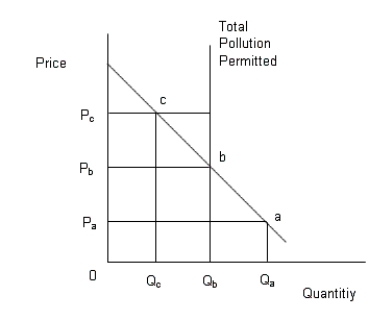
-Refer to Figure 13.4. Suppose the government wishes to reduce pollution to a quantity of Qb. If it sells marketable pollution permits for a pollution quantity of Qb, then:
-Refer to Figure 13.4. Suppose the government wishes to reduce pollution to a quantity of Qb. If it sells marketable pollution permits for a pollution quantity of Qb, then: (Multiple Choice)
4.8/5 (77)
(77) The figure given below shows the demand and supply curves of automobiles.Figure 13.3
In the figure,
D: Demand curve of automobiles
S: Supply of automobiles prior to the tax
S+t: Supply of automobiles after the tax
-When the government tries to control pollution through cap and trade, it _____.
-When the government tries to control pollution through cap and trade, it _____. (Multiple Choice)
4.8/5 (73)
(73)
-When consumers or producers do not bear the full cost of their economic decisions, they tend to produce or consume more than they otherwise would.
-When consumers or producers do not bear the full cost of their economic decisions, they tend to produce or consume more than they otherwise would. (True/False)
4.8/5 (72)
(72)
-It is often impossible for a business firm to determine its private costs of production.
-It is often impossible for a business firm to determine its private costs of production. (True/False)
4.8/5 (82)
(82)
-Which of the following is a measure taken by the government to internalize externalities?
-Which of the following is a measure taken by the government to internalize externalities? (Multiple Choice)
4.8/5 (76)
(76)
-To minimize the asymmetric information problem, the government is called on to require and enforce full disclosure of information.
-To minimize the asymmetric information problem, the government is called on to require and enforce full disclosure of information. (True/False)
4.9/5 (66)
(66)
-When a good is subsidized by the government, the amount of the good produced or consumed declines.
-When a good is subsidized by the government, the amount of the good produced or consumed declines. (True/False)
4.8/5 (76)
(76)
-Moral hazard is the term used to describe the situation in which:
-Moral hazard is the term used to describe the situation in which: (Multiple Choice)
4.7/5 (90)
(90) Overfishing along the coastline of Helsking village led the government to impose a fee on the boats used for fishing. The fishermen were charged $50 on each boat they sent out for fishing. The following table shows the total pounds of fish caught per hour and the number of boats used for fishing.Table 13.2
-The commons problem refers to:
-The commons problem refers to: (Multiple Choice)
4.8/5 (82)
(82) 
Filters
- Essay(0)
- Multiple Choice(0)
- Short Answer(0)
- True False(0)
- Matching(0)