



 Chat with AI
Exam 14: Cost Management

Exam 1: Introduction to Management Accounting78 Questions
Exam 2: An Introduction to Cost Terms and Concepts79 Questions
Exam 3: Cost-Volume-Profit Analysis121 Questions
Exam 4: Measuring Relevant Costs and Revenues for Decision-Making82 Questions
Exam 5: Pricing Decisions and Profitability Analysis62 Questions
Exam 6: Capital Investment Decisions110 Questions
Exam 7: Cost Assignment81 Questions
Exam 8: Activity-Based Costing108 Questions
Exam 9: The Budgeting Process120 Questions
Exam 10: Management Control Systems83 Questions
Exam 11: Standard Costing and Variance Analysis95 Questions
Exam 12: Divisional Financial Performance Measurement86 Questions
Exam 13: Transfer Pricing in Divisionalized Companies63 Questions
Exam 14: Cost Management156 Questions
Exam 15: Strategic Performance Management49 Questions
Select questions type


Using the abbreviations listed below, indicate for each of the costs whether the cost should be classified as:

(Essay)
4.9/5  (88)
(88) In 2004, Shelby Foods instituted a quality improvement program. At the end of 2005, the management of the company requested a report to show the amount saved by the measures taken during the year. The actual sales and actual quality costs for 2004 and 2005 are as follows:
Shelby's management believes that quality costs can be reduced to 2.5 percent of sales within the next five years. At the end of Year 2009, Shelby's sales are projected to have grown to £1,500,000. The relative distribution of quality costs at the end of Year 2009 is as follows:
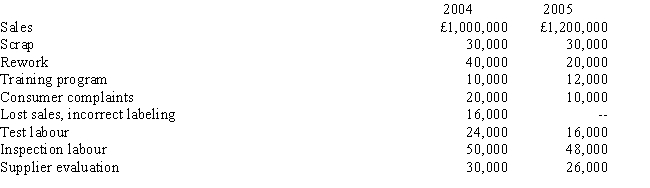 Required:
 a.
Prepare a long-range performance report that compares the quality costs incurred at the end of 2004 with the quality-cost structure expected at the end of 2009.
b.
Are the targeted costs in Year 2009 all value-added costs?
c.
What would be the increase in profits in 2009 if the 2.5 percent performance standard is met in that year?
Required:
a.
Prepare a long-range performance report that compares the quality costs incurred at the end of 2004 with the quality-cost structure expected at the end of 2009.
b.
Are the targeted costs in Year 2009 all value-added costs?
c.
What would be the increase in profits in 2009 if the 2.5 percent performance standard is met in that year? (Essay)
4.9/5 (69)
(69) For each activity listed below, determine the amount of value-added and nonvalue-added costs.

(Essay)
4.9/5 (86)
(86) Palms, SA., sells one of its products for £80 each. Sales volume averages 2,000 units per year. Recently, its main competitor reduced the price of its product to £56. Palms expects its sales to drop dramatically unless it matches the competitor's price. In addition, the current profit per unit must be maintained.
Information about the product (for production of 2,000) is as follows:
Required:
 a.
Calculate the target cost for maintaining current market share and profitability.
b.
Calculate the nonvalue-added cost per unit.
c.
If nonvalue-added costs can be reduced to zero, can the target cost be achieved?
a.
Calculate the target cost for maintaining current market share and profitability.
b.
Calculate the nonvalue-added cost per unit.
c.
If nonvalue-added costs can be reduced to zero, can the target cost be achieved? (Essay)
4.8/5 (81)
(81) Describe how activity-based management and activity-based costing systems differ.
(Essay)
4.9/5 (75)
(75) Which of the following process dimensions of the activity-based management model deals with "how well"?
(Multiple Choice)
4.9/5 (75)
(75) Define activity-based management. In your answer, present the activity-based management model in good form.
(Essay)
4.8/5 (77)
(77) As preventive and appraisal costs increase, internal and external failure costs are expected to
(Multiple Choice)
4.7/5 (84)
(84) Figure 1
At the beginning of this year, Sammie Company installed a JIT purchasing and manufacturing system. The following information has been gathered about one of the company's products:
-Refer to Figure 1 above. Sammie's defective units as a percentage of total units produced would be
(Multiple Choice)
4.8/5 (82)
(82) Larry Ltd.has developed ideal standards for four activities: labour, materials, inspection, and receiving. Information is as follows: The actual prices paid per unit of each activity driver were equal to the standard prices. The actual costs for receiving are

(Multiple Choice)
4.9/5 (90)
(90) 
Filters
- Essay(0)
- Multiple Choice(0)
- Short Answer(0)
- True False(0)
- Matching(0)