



 Chat with AI
Exam 13: Transfer Pricing in Divisionalized Companies

Exam 1: Introduction to Management Accounting78 Questions
Exam 2: An Introduction to Cost Terms and Concepts79 Questions
Exam 3: Cost-Volume-Profit Analysis121 Questions
Exam 4: Measuring Relevant Costs and Revenues for Decision-Making82 Questions
Exam 5: Pricing Decisions and Profitability Analysis62 Questions
Exam 6: Capital Investment Decisions110 Questions
Exam 7: Cost Assignment81 Questions
Exam 8: Activity-Based Costing108 Questions
Exam 9: The Budgeting Process120 Questions
Exam 10: Management Control Systems83 Questions
Exam 11: Standard Costing and Variance Analysis95 Questions
Exam 12: Divisional Financial Performance Measurement86 Questions
Exam 13: Transfer Pricing in Divisionalized Companies63 Questions
Exam 14: Cost Management156 Questions
Exam 15: Strategic Performance Management49 Questions
Select questions type


Bernie Manufacturing Company has two divisions, X and Y. Division X prepares the steel for processing. Division Y processes the steel into the final product. No inventories exist in either division at the beginning or end of 2004. During the year, Division X prepared 80,000 lbs. of steel at a cost of £800,000. All the steel was transferred to Division Y where additional operating costs of £5 per lb. were incurred. The final product was sold for £3,000,000.
Required:
a.
Determine the gross profit for each division and for the company as a whole if the transfer price is £8 per lb.
b.
Determine the gross profit for each division and for the company as a whole if the transfer price is £12 per lb.

Free
(Essay)
4.9/5  (80)
(80) Correct Answer: Verified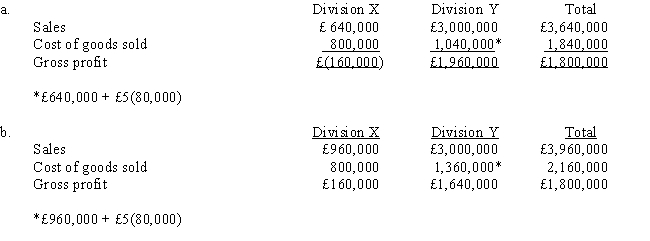
The Engine Division provides engines for the Tractor Division of a company. The standard unit costs for Engine Division are as follows: What is the best transfer price to avoid transfer price problems?

Free
(Multiple Choice)
4.9/5 (81)
(81) Correct Answer:Verified
VerifiedA
Figure 6
Callahan Industries is a decentralized company that evaluates its divisions based on ROI. The Jones Division has the capacity to make 5,000 units of a component. The Jones Division's variable costs are £200 per unit.
The Thomas Division can use the component in one of its products. The Thomas Division would incur £100 of variable costs to put the component in its own product that sells for £500.
-Refer to Figure 6 above. Assume the Jones Division can sell 4,000 units at £420. Any excess capacity will be unused unless the units are purchased by the Thomas Division, which could use up to 200 units. The minimum transfer price that the Jones Division would be willing to accept would be
Free
(Multiple Choice)
4.8/5 (84)
(84) Correct Answer:Verified
VerifiedB
Figure 2
Klaehn Industries is a decentralized company that evaluates its divisions based on ROI. The Fahl Division has the capacity to make 1,000 units of a component. The Fahl Division's variable costs are £40 per unit.
The Melton Division can use the component in one of its products. The Melton Division would incur £50 of variable costs to convert the component into its own product that sells for £160.
-Refer to Figure 2. Assume the Fahl Division can sell 800 units at £120 each. Any excess capacity will be unused unless the units are purchased by the Melton Division, which could use up to 100 units. The minimum transfer price that the Fahl Division would be willing to accept would be
(Multiple Choice)
4.8/5 (84)
(84) Figure 1
Universe Industries has two divisions: the Haley Division and the Comet Division. Information about a component that the Haley Division produces is as follows:
The Haley Division can produce up to 5,000 components per year. The Comet Division needs 200 units of the component for a product it manufactures.
-Refer to Figure 1 above. If the selling division did NOT have excess capacity, the minimum transfer price the selling division would be willing to accept is
(Multiple Choice)
4.9/5 (71)
(71) The Engine Division provides engines for the Tractor Division of a company. The standard unit costs for Engine Division are as follows: The engine department has excess capacity. What is the best transfer price to avoid transfer price problems?

(Multiple Choice)
4.9/5 (77)
(77) Conner Manufacturing has one plant located in Italy and another plant located in the United States. The Italian plant manufactures a component used in a finished product manufactured at the U.S. plant. Currently, the Italian plant is operating at 75 percent capacity. In Italy, the income tax rate is 32 percent; in the United States, the corporate income tax rate is 35 percent. The market price of the component is $240 and the Italian plant's costs to manufacture the component are as follows:
Which transfer price would be in the best interest of the overall company?

(Multiple Choice)
4.9/5 (91)
(91) Miggs Manufacturing has one plant located in Belgium and another plant located in the United States. The Belgium plant manufactures a component used in a finished product manufactured at the U.S. plant. Currently, the Belgium plant is operating at 70 percent capacity. In Belgium, the income tax rate is 42 percent; in the United States, the corporate income tax rate is 35 percent. The market price of the component is $200 and the Belgium plant's costs to manufacture the component are as follows:
What is the minimum transfer price that the Belgium division would be willing to accept?

(Multiple Choice)
4.7/5 (82)
(82) In most cases, _____ transfer prices achieve the optimal outcome for both the divisions and the company as a whole.
(Multiple Choice)
4.9/5 (74)
(74) Gregg Manufacturing has one plant located in Belgium and another plant located in the United States. The Belgium plant manufactures a component used in a finished product manufactured at the U.S. plant. Currently, the Belgium plant is operating at 70 percent capacity. In Belgium, the income tax rate is 30 percent; in the United States, the corporate income tax rate is 35 percent. The market price of the component is $280 and the Belgium plant's costs to manufacture the component are as follows:
What is the minimum transfer price that the Belgium division would be willing to accept?

(Multiple Choice)
4.9/5 (75)
(75) Miggs Manufacturing has one plant located in Belgium and another plant located in the United States. The Belgium plant manufactures a component used in a finished product manufactured at the U.S. plant. Currently, the Belgium plant is operating at 70 percent capacity. In Belgium, the income tax rate is 42 percent; in the United States, the corporate income tax rate is 35 percent. The market price of the component is $200 and the Belgium plant's costs to manufacture the component are as follows:
Which transfer price would be in the best interest of the overall company?

(Multiple Choice)
4.9/5 (80)
(80) The Engine Division provides engines for the Tractor Division of a company. The standard unit costs for Engine Division are as follows: What is the transfer price based on variable product costs plus a fixed fee of £210?

(Multiple Choice)
4.9/5 (71)
(71) A transfer pricing system should satisfy which of the following objectives?
(Multiple Choice)
4.8/5 (81)
(81) The optimal transfer price from the viewpoint of the company is
(Multiple Choice)
4.8/5 (82)
(82) Discuss the advantages of decentralization in a multinational company.
(Essay)
4.9/5 (65)
(65) Gregg Manufacturing has one plant located in Belgium and another plant located in the United States. The Belgium plant manufactures a component used in a finished product manufactured at the U.S. plant. Currently, the Belgium plant is operating at 70 percent capacity. In Belgium, the income tax rate is 30 percent; in the United States, the corporate income tax rate is 35 percent. The market price of the component is $280 and the Belgium plant's costs to manufacture the component are as follows:
What is the maximum transfer price that the U.S. division would be willing to pay?

(Multiple Choice)
4.8/5 (80)
(80) Explain why it is important for the multinational company to separate the evaluation of the manager of the division from the evaluation of the division.
(Essay)
4.9/5 (76)
(76) 
Filters
- Essay(0)
- Multiple Choice(0)
- Short Answer(0)
- True False(0)
- Matching(0)