



 Chat with AI
Exam 8: Activity-Based Costing

Exam 1: Introduction to Management Accounting78 Questions
Exam 2: An Introduction to Cost Terms and Concepts79 Questions
Exam 3: Cost-Volume-Profit Analysis121 Questions
Exam 4: Measuring Relevant Costs and Revenues for Decision-Making82 Questions
Exam 5: Pricing Decisions and Profitability Analysis62 Questions
Exam 6: Capital Investment Decisions110 Questions
Exam 7: Cost Assignment81 Questions
Exam 8: Activity-Based Costing108 Questions
Exam 9: The Budgeting Process120 Questions
Exam 10: Management Control Systems83 Questions
Exam 11: Standard Costing and Variance Analysis95 Questions
Exam 12: Divisional Financial Performance Measurement86 Questions
Exam 13: Transfer Pricing in Divisionalized Companies63 Questions
Exam 14: Cost Management156 Questions
Exam 15: Strategic Performance Management49 Questions
Select questions type


Flanigan Manufacturing uses an activity-based cost system. The company produces Product R and Product X. Information concerning the two products is as follows:
The following costs are reported:
 Required:
 a.
Classify the overhead activities as:
•
Unit-level activities
•
Batch-level activities
•
Product-sustaining activities
b.
Calculate the following:
•
The pool rate for power
•
The pool rate for setups
•
The pool rate for engineering
c.
Calculate the following:
•
Power costs assigned to Product X
•
Setup costs assigned to Product R
•
Engineering costs assigned to Product R
Required:
a.
Classify the overhead activities as:
•
Unit-level activities
•
Batch-level activities
•
Product-sustaining activities
b.
Calculate the following:
•
The pool rate for power
•
The pool rate for setups
•
The pool rate for engineering
c.
Calculate the following:
•
Power costs assigned to Product X
•
Setup costs assigned to Product R
•
Engineering costs assigned to Product R
Free
(Essay)
4.9/5  (76)
(76) Correct Answer: Verified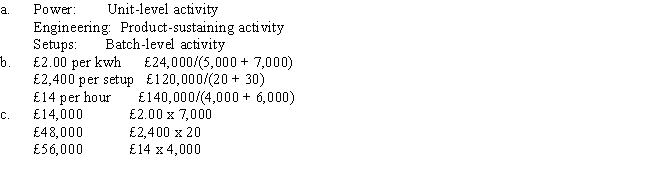
If activity-based costing is used, electricity usage would be an example of a
Free
(Multiple Choice)
4.8/5 (76)
(76) Correct Answer:Verified
VerifiedA
Owens Ltd. produces specially machined parts. The parts are produced in batches in one continuous manufacturing process. Each part is custom produced and requires special engineering design activity (based on customer specifications). Once the design is completed, the equipment can be set up for batch production. Once the batch is completed, a sample is taken and inspected to see if the parts are within the tolerances allowed. Thus, the manufacturing process has four activities: engineering, setups, machining, and inspecting. In addition, there is a sustaining process with two activities: providing utilities (plantwide) and providing space. Costs have been assigned to each activity using direct tracing and resource drivers: Activity cost drivers for each activity have been identified and their practical capacities listed:
 The costs of facility-level activities are assigned using machine hours.
What is the cost pool rate for the batch-level activities?

The costs of facility-level activities are assigned using machine hours.
What is the cost pool rate for the batch-level activities?
Free
(Multiple Choice)
5.0/5 (79)
(79) Correct Answer:Verified
VerifiedB
Which of the following quantities is an example of an activity driver in activity-based costing?
(Multiple Choice)
4.9/5 (83)
(83) If activity-based costing is used, modifications made by engineering to the product design of several products would be classified as a
(Multiple Choice)
4.8/5 (84)
(84) Batch-related costs are added to which of the following costs in break-even analysis?
(Multiple Choice)
5.0/5 (74)
(74) Owens Ltd. produces specially machined parts. The parts are produced in batches in one continuous manufacturing process. Each part is custom produced and requires special engineering design activity (based on customer specifications). Once the design is completed, the equipment can be set up for batch production. Once the batch is completed, a sample is taken and inspected to see if the parts are within the tolerances allowed. Thus, the manufacturing process has four activities: engineering, setups, machining, and inspecting. In addition, there is a sustaining process with two activities: providing utilities (plantwide) and providing space. Costs have been assigned to each activity using direct tracing and resource drivers: Activity cost drivers for each activity have been identified and their practical capacities listed:
 The costs of facility-level activities are assigned using machine hours.
What is(are) the product-level activity(ies)?

The costs of facility-level activities are assigned using machine hours.
What is(are) the product-level activity(ies)?
(Multiple Choice)
4.9/5 (87)
(87) Funk Manufacturing Company produces specially machined parts. The parts are produced in batches in one continuous manufacturing process. Each part is custom produced and requires special engineering design activity (based on customer specifications). Once the design is completed, the equipment can be set up for batch production. Once the batch is completed, a sample is taken and inspected to see if the parts are within the tolerances allowed. Thus, the manufacturing process has four activities: engineering, setups, machining, and inspecting. In addition, there is a sustaining process with two activities: providing utilities (plantwide) and providing space. Costs have been assigned to each activity using direct tracing and resource drivers:
Activity drivers for each activity have been identified and their practical capacities listed:
 The costs of facility-level activities are assigned using machine hours.
Required:
 a.
Identify the activities within each process as unit-level, batch-level, product-level, or facility-level.
b.
Create homogeneous cost pools. Identify the activities that belong to each pool and the activity driver that will be used for computing pool rates.
c.
Build an activity relational (i.e. cost) table.
d.
Compute the cost pool rates.
The costs of facility-level activities are assigned using machine hours.
Required:
a.
Identify the activities within each process as unit-level, batch-level, product-level, or facility-level.
b.
Create homogeneous cost pools. Identify the activities that belong to each pool and the activity driver that will be used for computing pool rates.
c.
Build an activity relational (i.e. cost) table.
d.
Compute the cost pool rates. (Essay)
4.8/5 (70)
(70) Figure 5
Peach, SA., has identified the following overhead costs and cost drivers for next year:
The following are two of the jobs completed during the year:
 The company's normal activity is 4,000 direct labour hours.
-Refer to Figure 5. If Peach, SA., used activity-based cost drivers to allocate overhead costs, the unit cost for Job 401 would be (round to two decimal places)
The company's normal activity is 4,000 direct labour hours.
-Refer to Figure 5. If Peach, SA., used activity-based cost drivers to allocate overhead costs, the unit cost for Job 401 would be (round to two decimal places) (Multiple Choice)
4.9/5 (80)
(80) Ubben Manufacturing uses an activity-based costing system. The company produces Model X and Model Y. Information relating to the two products is as follows: The following costs are reported:
 Machine-related overhead would be classified as a

Machine-related overhead would be classified as a
(Multiple Choice)
4.8/5 (82)
(82) Figure 2
The management of Chott Industries predicted that overhead cost would total £180,000 for the current year. Management further estimated that under absolutely perfect conditions they could produce 25,000 units. Under efficient conditions, they can produce 23,000 units. The product is expected to appeal to the public for approximately three years during which time Chott expects to sell a total of 60,000 units. Because poor economic conditions are forecast for the upcoming year, Chott plans to produce only 18,000 units.
-Refer to Figure 2. What will Chott's overhead application rate be if Chott uses practical capacity?
(Multiple Choice)
4.9/5 (82)
(82) Owens Ltd. produces specially machined parts. The parts are produced in batches in one continuous manufacturing process. Each part is custom produced and requires special engineering design activity (based on customer specifications). Once the design is completed, the equipment can be set up for batch production. Once the batch is completed, a sample is taken and inspected to see if the parts are within the tolerances allowed. Thus, the manufacturing process has four activities: engineering, setups, machining, and inspecting. In addition, there is a sustaining process with two activities: providing utilities (plantwide) and providing space. Costs have been assigned to each activity using direct tracing and resource drivers: Activity cost drivers for each activity have been identified and their practical capacities listed:
 The costs of facility-level activities are assigned using machine hours.
What is the cost pool rate for the product-level activities?

The costs of facility-level activities are assigned using machine hours.
What is the cost pool rate for the product-level activities?
(Multiple Choice)
4.9/5 (84)
(84) Product costs can be distorted if a unit-based activity driver is used and
(Multiple Choice)
4.9/5 (78)
(78) Zang Manufacturing Company manufactures two products (A and B). The overhead costs (£58,000) have been divided into three cost pools that use the following activity cost drivers: What is the allocation rate per order using ABC?

(Multiple Choice)
4.8/5 (84)
(84) More accurate product costing information is produced by assigning costs using
(Multiple Choice)
4.7/5 (76)
(76) Books Company manufactures and sells two products: Soft Cover (S) and Hard Cover (H). The firm's activities have been analyzed and placed into a hierarchy of activity costs. Presented is information on activity cost drivers and costs per unit of cost driver at each activity level.
During January 2004, Books Company produced 10,000 units of Soft Covers and 5,000 units of Hard Covers. Each batch of products includes 1,000 units of Soft Covers or 1,000 units of Hard Covers.
Required: Determine the total costs for each activity level and the total predicted costs for January.
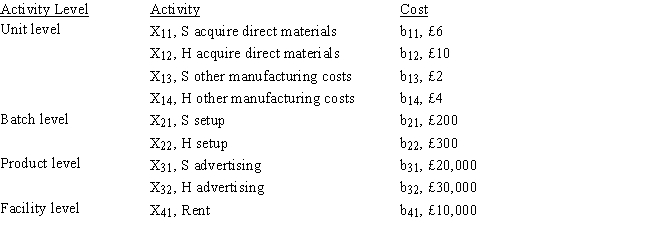
(Essay)
4.8/5 (86)
(86) Godwin Ltd. produces specially machined parts. The parts are produced in batches in one continuous manufacturing process. Each part is custom produced and requires special engineering design activity (based on customer specifications). Once the design is completed, the equipment can be set up for batch production. Once the batch is completed, a sample is taken and inspected to see if the parts are within the tolerances allowed. Thus, the manufacturing process has four activities: engineering, setups, machining, and inspecting. In addition, there is a sustaining process with two activities: providing utilities (plantwide) and providing space. Costs have been assigned to each activity using direct tracing and resource drivers:
Activity drivers for each activity have been identified and their practical capacities listed:
 The costs of facility-level activities are assigned using machine hours.
Required:
 a.
Identify the activities within each process as unit-level, batch-level, product-level, or facility-level.
b.
Create homogeneous cost pools. Identify the activities that belong to each pool and the activity driver that will be used for computing pool rates.
c.
Build an activity relational (i.e. cost) table.
d.
Compute the cost pool rates.
The costs of facility-level activities are assigned using machine hours.
Required:
a.
Identify the activities within each process as unit-level, batch-level, product-level, or facility-level.
b.
Create homogeneous cost pools. Identify the activities that belong to each pool and the activity driver that will be used for computing pool rates.
c.
Build an activity relational (i.e. cost) table.
d.
Compute the cost pool rates. (Essay)
4.9/5 (81)
(81) When selecting an activity driver, a company should consider
(Multiple Choice)
4.9/5 (80)
(80) 
Filters
- Essay(0)
- Multiple Choice(0)
- Short Answer(0)
- True False(0)
- Matching(0)