



 Chat with AI
Exam 8: Activity-Based Costing

Exam 1: Introduction to Management Accounting78 Questions
Exam 2: An Introduction to Cost Terms and Concepts79 Questions
Exam 3: Cost-Volume-Profit Analysis121 Questions
Exam 4: Measuring Relevant Costs and Revenues for Decision-Making82 Questions
Exam 5: Pricing Decisions and Profitability Analysis62 Questions
Exam 6: Capital Investment Decisions110 Questions
Exam 7: Cost Assignment81 Questions
Exam 8: Activity-Based Costing108 Questions
Exam 9: The Budgeting Process120 Questions
Exam 10: Management Control Systems83 Questions
Exam 11: Standard Costing and Variance Analysis95 Questions
Exam 12: Divisional Financial Performance Measurement86 Questions
Exam 13: Transfer Pricing in Divisionalized Companies63 Questions
Exam 14: Cost Management156 Questions
Exam 15: Strategic Performance Management49 Questions
Select questions type


Zipp Company manufactures two products (X and Y). The overhead costs (£84,000) have been divided into three cost pools that use the following activity cost drivers: What is the allocation rate per setup using activity-based costing?

(Multiple Choice)
4.8/5  (73)
(73) In an activity-based cost system, what types of drivers are used to describe cost behaviour?
(Multiple Choice)
4.8/5 (84)
(84) Maintenance of the production equipment would be classified as a
(Multiple Choice)
4.8/5 (77)
(77) Baker Manufacturing has four categories of overhead. The four categories and the expected overhead costs for each category for next year are as follows:
Currently, overhead is applied using a predetermined overhead rate based upon budgeted direct labour hours. For next year, 50,000 direct labour hours are budgeted.
The company has been asked to submit a bid for a proposed job. The plant manager feels that obtaining this job would result in new business in future years. Usually bids are based upon full manufacturing cost plus 30 percent.
Estimates for the proposed job are as follows:
 In the past, full manufacturing cost has been calculated by allocating overhead using a traditional volume-based cost driver system--direct labour hours. The plant manager has heard of a new way of applying overhead that uses cost pools and cost drivers.
Expected activity for the four activity-based cost drivers that would be used are as follows:
 Required:
 a.
Determine the amount of overhead that would be allocated to the proposed job if direct labour hours are used as the traditional volume-based cost driver.
Determine the total cost of the proposed job.
Determine the company's bid if the bid is based upon full manufacturing cost plus 30 percent.
b.
Determine the amount of overhead that would be applied to the proposed job if activity-based costing is used.
Determine the total cost of the proposed job if activity-based costing is used.
Determine the company's bid if activity-based costing is used and the bid is based upon full manufacturing cost plus 30 percent.
c.
Which product costing method produces the more competitive bid?
In the past, full manufacturing cost has been calculated by allocating overhead using a traditional volume-based cost driver system--direct labour hours. The plant manager has heard of a new way of applying overhead that uses cost pools and cost drivers.
Expected activity for the four activity-based cost drivers that would be used are as follows:
Required:
a.
Determine the amount of overhead that would be allocated to the proposed job if direct labour hours are used as the traditional volume-based cost driver.
Determine the total cost of the proposed job.
Determine the company's bid if the bid is based upon full manufacturing cost plus 30 percent.
b.
Determine the amount of overhead that would be applied to the proposed job if activity-based costing is used.
Determine the total cost of the proposed job if activity-based costing is used.
Determine the company's bid if activity-based costing is used and the bid is based upon full manufacturing cost plus 30 percent.
c.
Which product costing method produces the more competitive bid? (Essay)
4.8/5 (66)
(66) Hunter Company manufactures two products (XX and YY). The overhead costs have been divided into four cost pools that use the following activity drivers:
Required:
 a.
Compute the allocation rates for each of the activity drivers listed.
b.
Allocate the overhead costs to Products XX and YY using activity-based costing.
c.
Compute the overhead rate using labour hours under the traditional functional-based costing system.
d.
Allocate the overhead costs to Products XX and YY using the traditional functional-based costing system overhead rate calculated in part (c).
a.
Compute the allocation rates for each of the activity drivers listed.
b.
Allocate the overhead costs to Products XX and YY using activity-based costing.
c.
Compute the overhead rate using labour hours under the traditional functional-based costing system.
d.
Allocate the overhead costs to Products XX and YY using the traditional functional-based costing system overhead rate calculated in part (c). (Essay)
4.9/5 (83)
(83) Identify Cooper and Kaplan's four categories of activities and provide a brief description of each category.
(Essay)
4.9/5 (84)
(84) Figure 5
Peach, SA., has identified the following overhead costs and cost drivers for next year:
The following are two of the jobs completed during the year:
 The company's normal activity is 4,000 direct labour hours.
-Refer to Figure 5. If Peach, SA., used direct labour hours to assign overhead, the unit cost for Job 401 would be
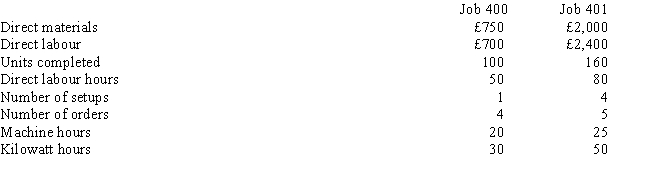
The company's normal activity is 4,000 direct labour hours.
-Refer to Figure 5. If Peach, SA., used direct labour hours to assign overhead, the unit cost for Job 401 would be (Multiple Choice)
4.9/5 (85)
(85) 
Filters
- Essay(0)
- Multiple Choice(0)
- Short Answer(0)
- True False(0)
- Matching(0)