



 Chat with AI
Exam 13: Transfer Pricing in Divisionalized Companies

Exam 1: Introduction to Management Accounting78 Questions
Exam 2: An Introduction to Cost Terms and Concepts79 Questions
Exam 3: Cost-Volume-Profit Analysis121 Questions
Exam 4: Measuring Relevant Costs and Revenues for Decision-Making82 Questions
Exam 5: Pricing Decisions and Profitability Analysis62 Questions
Exam 6: Capital Investment Decisions110 Questions
Exam 7: Cost Assignment81 Questions
Exam 8: Activity-Based Costing108 Questions
Exam 9: The Budgeting Process120 Questions
Exam 10: Management Control Systems83 Questions
Exam 11: Standard Costing and Variance Analysis95 Questions
Exam 12: Divisional Financial Performance Measurement86 Questions
Exam 13: Transfer Pricing in Divisionalized Companies63 Questions
Exam 14: Cost Management156 Questions
Exam 15: Strategic Performance Management49 Questions
Select questions type


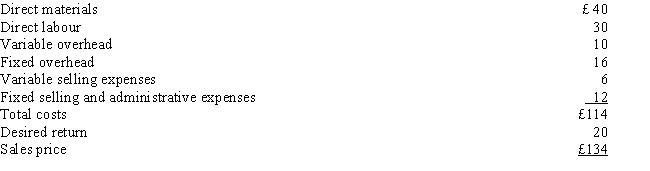
The Bat Division of Baseball Company has just revised its actual cost data for 2004. Bat Division transfers goods to the Sport Division. Sport Division can buy the same goods in the open market for £122 each. Bat's new cost data are as follows:
Current production is 200,000 units, and the Bat Division has a capacity of 300,000 units.
Required:
 a.
What is the lowest price the Bat Division should charge for the internal transfers of its goods?
b.
What is the highest price the Sport Division should pay for the units?
c.
Give the primary reason why the Bat Division should reduce its price.
a.
What is the lowest price the Bat Division should charge for the internal transfers of its goods?
b.
What is the highest price the Sport Division should pay for the units?
c.
Give the primary reason why the Bat Division should reduce its price. (Essay)
4.9/5  (91)
(91) When there is an outside market for an intermediate product which is perfectly competitive, the most equitable method of transfer pricing is
(Multiple Choice)
4.9/5 (80)
(80) The output of one division that can be used as input in another division is called a
(Multiple Choice)
4.8/5 (87)
(87) 
Filters
- Essay(0)
- Multiple Choice(0)
- Short Answer(0)
- True False(0)
- Matching(0)