



 Chat with AI
Exam 5: Corporations: Earnings Profits and Dividend Distributions

Exam 1: Understanding and Working With the Federal Tax Law74 Questions
Exam 2: Corporations: Introduction and Operating Rules113 Questions
Exam 3: Corporations: Special Situations109 Questions
Exam 4: Corporations: Organization and Capital Structure92 Questions
Exam 5: Corporations: Earnings Profits and Dividend Distributions130 Questions
Exam 6: Corporations: Redemptions and Liquidations115 Questions
Exam 7: Corporations: Reorganizations140 Questions
Exam 8: Consolidated Tax Returns175 Questions
Exam 9: Taxation of International Transactions177 Questions
Exam 10: Partnerships: Formation, Operation, and Basis135 Questions
Exam 11: Partnerships: Distributions, Transfer of Interests, and Terminations144 Questions
Exam 12: S: Corporations158 Questions
Exam 13: Comparative Forms of Doing Business170 Questions
Exam 14: Taxes on the Financial Statements87 Questions
Exam 15: Exempt Entities185 Questions
Exam 16: Multistate Corporate Taxation187 Questions
Exam 17: Tax Practice and Ethics174 Questions
Exam 18: The Federal Gift and Estate Taxes222 Questions
Exam 19: Family Tax Planning188 Questions
Exam 20: Income Taxation of Trusts and Estates183 Questions
Select questions type


In general, how are current and accumulated earnings and profits allocated to corporate distributions?
(Essay)
4.8/5  (80)
(80) Which of the following statements regarding constructive dividends is not correct?
(Multiple Choice)
4.8/5 (76)
(76) What is a constructive dividend? Provide several examples of the term.
(Essay)
4.8/5 (80)
(80) In June of the current year, Marigold Corporation declares a $4 dividend out of E & P on each share of common stock to shareholders of record on August 1. Ellen and Tim each purchase 100 shares of Marigold stock on July 1. On July 15, Ellen also purchases a short position in Marigold. Tim sells 50 of his shares on August 10 and continues to hold the remaining 50 shares through the end of the year. Ellen closes her short position in Marigold on October 15. With respect to the dividends, which of the following is correct?
(Multiple Choice)
4.8/5 (90)
(90) Rose Corporation (a calendar year taxpayer) has taxable income of $300,000, and its financial records reflect the following for the year. 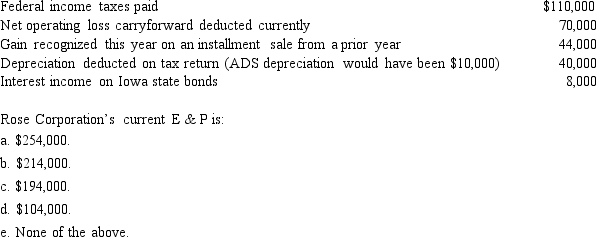
(Short Answer)
4.8/5 (66)
(66) If there is sufficient E & P, a distribution of nonconvertible preferred stock to common shareholders is taxable.
(True/False)
4.8/5 (76)
(76) How does the definition of accumulated E & P differ from the definition of current E & P?
(Essay)
4.9/5 (73)
(73) No E & P adjustment is required for regular tax gains under the installment method.
(True/False)
4.8/5 (92)
(92) On January 30, Juan receives a nontaxable distribution of stock rights from Platinum Corporation. Each right entitles the holder to purchase one share of stock for $40. One right is issued for every share of stock owned. Juan owns 100 shares of stock purchased two years ago for $4,000. At the date of distribution, the rights are worth $1,000 (100 rights at $10 per right) and Juan's stock in Platinum is worth $5,000 (or $50 per share). On December 1, Juan sells all 100 stock rights for $12 per right. How much gain does Juan recognize on the sale?
(Multiple Choice)
4.8/5 (73)
(73) Ten years ago, Carrie purchased 2,000 shares in Osprey Corporation for $20,000. In the current year, Carrie receives a nontaxable stock dividend of 20 shares of Osprey preferred. Values at the time of the dividend are: $8,000 for the preferred stock and $72,000 for the common. Based on this information, Carrie's basis in the stock is:
(Multiple Choice)
4.8/5 (78)
(78) Stephanie is the sole shareholder and president of Hawk Corporation. She feels that she can justify at least a $220,000 bonus this year because of her performance. However, rather than a bonus in the form of a salary, she plans to have Hawk pay her a $220,000 dividend. Because Stephanie's marginal tax rate is 35%, she prefers to receive a dividend taxed at 15%. Her accountant, however, suggests a $310,000 bonus in lieu of the $220,000 dividend since Hawk Corporation is in the 34% tax bracket. Should Stephanie take the $220,000 dividend or the $310,000 bonus? Support your answer by computing the after-tax cost of the two alternatives to Hawk and to Stephanie.
(Essay)
4.8/5 (84)
(84) Scarlet Corporation is an accrual basis, calendar year corporation. Scarlet distributes inventory (basis of $20,000; fair market value of $40,000) to Frank, its shareholder. Assuming that Scarlet has $500,000 of current E & P, what is the impact of the distribution on Scarlet Corporation and on Frank?
(Essay)
4.8/5 (86)
(86) Maria owns 75% and Christopher owns 25% of Cockatoo Corporation, a calendar year taxpayer. Cockatoo makes a $600,000 distribution to Maria on April 1 and a $200,000 distribution to Christopher on May 1. Cockatoo's current E & P is $120,000 and its accumulated E & P is $500,000. What are the tax implications of the distributions to Maria and Christopher?
(Essay)
4.9/5 (88)
(88) Which one of the following statements about property distributions is false?
(Multiple Choice)
4.8/5 (81)
(81) Purple Corporation makes a property distribution to its sole shareholder, Paul. The property distributed is a house (fair market value of $189,000; basis of $154,000) that is subject to a $245,000 mortgage that Paul assumes. Before considering the consequences of the distribution, Purple's current E & P is $35,000 and its accumulated E & P is $140,000. Purple makes no other distributions during the current year. What is Purple's taxable gain on the distribution of the house?
(Multiple Choice)
4.9/5 (93)
(93) Jen, the sole shareholder of Mahogany Corporation, sold her stock to Jason on July 1 for $90,000. Jen's stock basis at the beginning of the year was $60,000. Mahogany made a $30,000 cash distribution to Jen immediately before the sale, while Jason received a $60,000 cash distribution from Mahogany on November 1. As of the beginning of the current year, Mahogany had $16,000 in accumulated E & P, while current E & P (before distributions) is $30,000. What are the tax consequences of these transactions to Jen and Jason?
(Essay)
4.8/5 (75)
(75) Using the legend provided, classify each statement accordingly. In All cases, assume that taxable income is being adjusted to arrive at current E & P for 2014.
a. Increase
b. Decrease
c. No effect
-A decrease in the LIFO recapture amount during the year.
(Short Answer)
4.9/5 (72)
(72) A realized gain from an involuntary conversion under § 1033 that is not recognized for income tax purposes has no effect on E & P.
(True/False)
4.9/5 (74)
(74) Tracy and Lance, equal shareholders in Macaw Corporation, receive $600,000 each in distributions on December 31 of the current year. Macaw's current year taxable income is $1 million and it has no accumulated E & P. Last year, Macaw sold an appreciated asset for $1,200,000 (basis of $400,000). Payment for one-half of the sale of the asset was made this year. How much of Tracy's distribution will be taxed as a dividend?
(Multiple Choice)
4.8/5 (65)
(65) Puce Corporation, an accrual basis taxpayer, has struggled to survive since its formation, six years ago. As a result, it has a deficit in accumulated E & P at the beginning of the year of $340,000. This year, however, Puce earned a significant profit; taxable income was $240,000. Consequently, Puce made two cash distributions to Martha, its sole shareholder: $150,000 on July 1 and $200,000 December 31. The following information might be relevant to determining the tax treatment of the distributions.
-This year's taxable income included a net operating loss carryover of $50,000.
-The corporation's Federal income tax liability is $72,000 for the year.
-Puce paid nondeductible fines and kickbacks of $10,000. The company also paid nondeductible life insurance premiums of $22,000.
-The cash surrender value of the corporate-owned life insurance policies increased by $11,000 during the year.
-The company sold a piece of equipment during the year and reported a § 1231 gain of $105,000 and recapture income under § 1245 of $35,000. There were no other § 1231 transactions during the year, but the corporation did have a capital loss carryforward of $30,000.
-MACRS depreciation exceeds E & P depreciation by $14,000. In addition, an election under § 179 was made this year for $18,000 of assets.
a. Compute Puce's E & P for the year.
b. What are the tax consequences of the two distributions made during the year to Martha (her stock basis is $74,000)?
(Essay)
4.8/5 (86)
(86) 
Filters
- Essay(0)
- Multiple Choice(0)
- Short Answer(0)
- True False(0)
- Matching(0)