



 Chat with AI
Exam 23: Nutrition, Cancer, and Hiv Infection

Exam 1: Overview of Nutrition and Health78 Questions
Exam 2: Digestion and Absorption71 Questions
Exam 3: Carbohydrates74 Questions
Exam 4: Lipids82 Questions
Exam 5: Protein78 Questions
Exam 6: Energy Balance and Body Composition69 Questions
Exam 7: Weight Management70 Questions
Exam 8: The Vitamins85 Questions
Exam 9: Water and the Minerals80 Questions
Exam 10: Nutrition Through the Life Span: Pregnancy and Infancy95 Questions
Exam 11: Nutrition Through the Life Span: Childhood and Adolescence85 Questions
Exam 12: Nutrition Through the Life Span: Later Adulthood67 Questions
Exam 13: Nutrition Care and Assessment82 Questions
Exam 14: Nutrition Intervention and Diet-Drug Interactions89 Questions
Exam 15: Enteral and Parenteral Nutrition Support127 Questions
Exam 16: Nutrition in Metabolic and Respiratory Stress70 Questions
Exam 17: Nutrition and Upper Gastrointestinal Disorders83 Questions
Exam 18: Nutrition and Lower Gastrointestinal Disorders110 Questions
Exam 19: Nutrition and Liver Diseases95 Questions
Exam 20: Nutrition and Diabetes Mellitus108 Questions
Exam 21: Nutrition and Disorders of the Heart and Blood Vessels94 Questions
Exam 22: Nutrition and Renal Diseases95 Questions
Exam 23: Nutrition, Cancer, and Hiv Infection88 Questions
Select questions type


Factors contributing to anorexia in the person with cancer include all of the following except:
(Multiple Choice)
4.9/5  (76)
(76) Which of the following is a major contributor to wasting associated with cancer?
(Multiple Choice)
4.9/5 (77)
(77) Kaposi's sarcoma can contribute to wasting in cancer patients due to:
(Multiple Choice)
4.7/5 (81)
(81) There appears to be a link between the consumption of _____ and a decreased risk of prostate cancer.
(Multiple Choice)
4.8/5 (72)
(72) Discuss the use of enteral and parenteral nutrition in cancer patients.
(Essay)
4.9/5 (83)
(83) Herpes simplex is a fungal infection of the mouth and throat that often occurs in patients with HIV.
(True/False)
4.8/5 (73)
(73) An example of a patient who may require long-term tube feeding is a patient:
(Multiple Choice)
4.9/5 (76)
(76) The reason for the development of lipodystrophy in HIV treatment is:
(Multiple Choice)
4.9/5 (73)
(73) The nurse is working with a client admitted to the hospital with complaints of loss of appetite and weight loss.An assessment of the client also reveals depletion of lean body mass and serum protein.The nurse accurately recognizes these as characteristics of:
(Multiple Choice)
4.9/5 (83)
(83) Recurrent bacterial pneumonia is classified as an AIDS-defining illness.
(True/False)
4.8/5 (83)
(83) An individual who does not wish to receive CPR if she has a heart attack in the hospital should request a:
(Multiple Choice)
4.9/5 (77)
(77) Because of the symptoms Ms.Arther is experiencing, she is at risk for all of the following except:
(Multiple Choice)
4.7/5 (79)
(79) Which of the following legal documents allows a competent adult to clearly express directions regarding medical treatment in the event that the person is unable to make the necessary decisions at that time?
(Multiple Choice)
4.8/5 (69)
(69) An HIV patient develops metabolic complications resulting in insulin resistance and an abnormal lipid profile.The nurse recommends the following nutrition intervention:
(Multiple Choice)
4.9/5 (77)
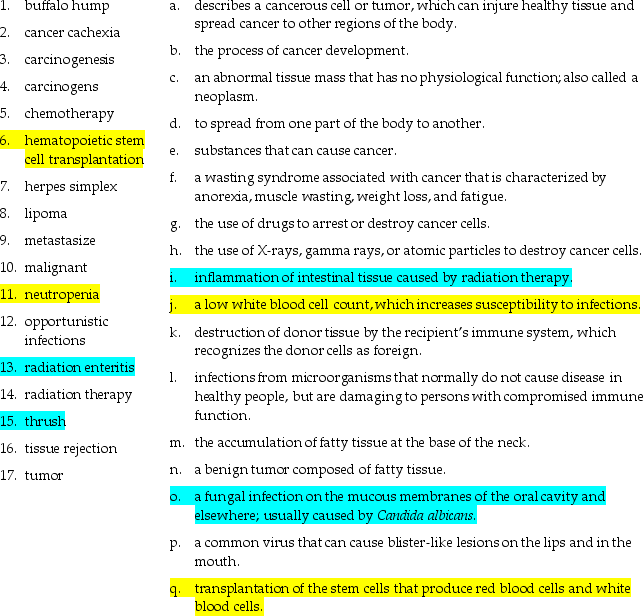
(77) 
A combination of three antiretroviral drugs are administered to slow the progression of cancer.
(True/False)
4.9/5 (74)
(74) Which of the following drugs, when combined with resistance training, has positive effects on lean tissue mass in HIV patients?
(Multiple Choice)
4.8/5 (80)
(80) Nutrition-related factors that may increase the risk of developing cancer include all of the following except:
(Multiple Choice)
4.8/5 (70)
(70) Cancer patients exhibit an increased rate of protein turnover.The nurse understands that this means patients:
(Multiple Choice)
4.7/5 (73)
(73) 
Filters
- Essay(0)
- Multiple Choice(0)
- Short Answer(0)
- True False(0)
- Matching(0)