



 Chat with AI
Exam 15: Enteral and Parenteral Nutrition Support

Exam 1: Overview of Nutrition and Health78 Questions
Exam 2: Digestion and Absorption71 Questions
Exam 3: Carbohydrates74 Questions
Exam 4: Lipids82 Questions
Exam 5: Protein78 Questions
Exam 6: Energy Balance and Body Composition69 Questions
Exam 7: Weight Management70 Questions
Exam 8: The Vitamins85 Questions
Exam 9: Water and the Minerals80 Questions
Exam 10: Nutrition Through the Life Span: Pregnancy and Infancy95 Questions
Exam 11: Nutrition Through the Life Span: Childhood and Adolescence85 Questions
Exam 12: Nutrition Through the Life Span: Later Adulthood67 Questions
Exam 13: Nutrition Care and Assessment82 Questions
Exam 14: Nutrition Intervention and Diet-Drug Interactions89 Questions
Exam 15: Enteral and Parenteral Nutrition Support127 Questions
Exam 16: Nutrition in Metabolic and Respiratory Stress70 Questions
Exam 17: Nutrition and Upper Gastrointestinal Disorders83 Questions
Exam 18: Nutrition and Lower Gastrointestinal Disorders110 Questions
Exam 19: Nutrition and Liver Diseases95 Questions
Exam 20: Nutrition and Diabetes Mellitus108 Questions
Exam 21: Nutrition and Disorders of the Heart and Blood Vessels94 Questions
Exam 22: Nutrition and Renal Diseases95 Questions
Exam 23: Nutrition, Cancer, and Hiv Infection88 Questions
Select questions type


All of the following conditions raise water requirements except:
(Multiple Choice)
4.8/5  (87)
(87) Candidates for peripheral parenteral nutrition include clients who:
(Multiple Choice)
4.9/5 (79)
(79) Describe the ways in which the transition from IV feeding to an oral diet can be accomplished.
(Essay)
4.8/5 (79)
(79) To prevent refeeding syndrome in a severely stressed individual you would:
(Multiple Choice)
4.8/5 (81)
(81) If a patient requires an intestinal feeding and gastric decompression, the nurse understands that the appropriate feeding tube is:
(Multiple Choice)
5.0/5 (84)
(84) An inborn error of metabolism results in the absence, deficiency, or malfunction of a:
(Multiple Choice)
5.0/5 (64)
(64) Which of the following statements regarding transitioning from tube feeding to an oral diet is correct?
(Multiple Choice)
4.9/5 (90)
(90) Name and discuss five metabolic complications that may result from parenteral feedings.
(Essay)
4.9/5 (89)
(89) Insertion of peripherally inserted catheters is less invasive and more easily performed than direct insertion of catheters into central veins.
(True/False)
4.9/5 (79)
(79) 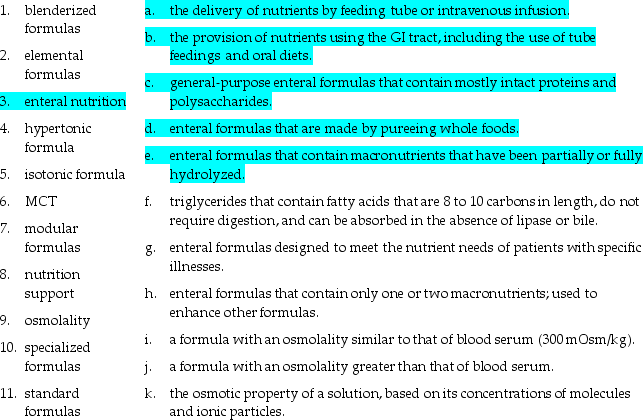
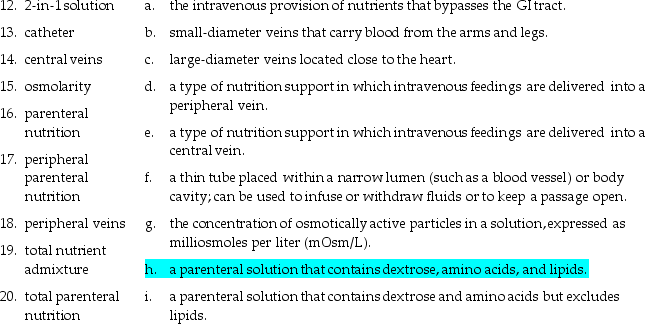
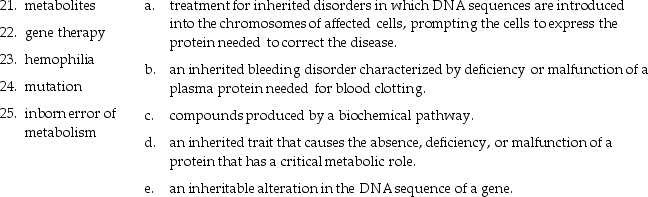
Which of the following medical conditions or treatments indicates the need for TPN?
(Multiple Choice)
4.7/5 (78)
(78) The appropriate method for administering TPN to a critically ill and malnourished patient is:
(Multiple Choice)
4.9/5 (79)
(79) If a client tolerates a formula after it is initiated, the rate of a continuous feeding should be increased by about 30 milliliters per hour every 8 to 10 hours.
(True/False)
4.8/5 (76)
(76) One method of making the transition from an intravenous feeding to an oral diet is to place the client on a tube feeding.
(True/False)
4.7/5 (74)
(74) A TPN solution provides 750 mL of a 10% amino acid solution.The nurse calculates that the patient is receiving _____ grams of protein.
(Multiple Choice)
4.8/5 (86)
(86) All of the following statements describe modular formulas except they:
(Multiple Choice)
4.8/5 (76)
(76) The nurse realizes that the venous access site selected for a client on PN is based on:
(Multiple Choice)
4.9/5 (71)
(71) In infants, _____ tube placement may be preferred because it aids breathing.
(Multiple Choice)
4.9/5 (88)
(88) The economic impact of home nutrition support programs is a concern for people on these programs.
(True/False)
4.8/5 (71)
(71) 
Filters
- Essay(0)
- Multiple Choice(0)
- Short Answer(0)
- True False(0)
- Matching(0)