



 Chat with AI
Exam 9: Thermodynamics: The Second and Third Laws

Exam 1: The Quantum World100 Questions
Exam 2: Quantum Mechanics in Action: Atoms100 Questions
Exam 3: Chemical Bonds83 Questions
Exam 4: Molecular Shape and Structure95 Questions
Exam 5: The Properties of Gases94 Questions
Exam 6: Liquids and Solids95 Questions
Exam 7: Inorganic Materials100 Questions
Exam 8: Thermodynamics: The First Law94 Questions
Exam 9: Thermodynamics: The Second and Third Laws95 Questions
Exam 10: Physical Equilibria94 Questions
Exam 11: Chemical Equilibria94 Questions
Exam 12: Acids and Bases94 Questions
Exam 13: Aqueous Equilibria94 Questions
Exam 14: Electrochemistry94 Questions
Exam 15: Chemical Kinetics93 Questions
Exam 16: The Elements: the Main Group Elements189 Questions
Exam 17: The Elements: The D Block94 Questions
Exam 18: Nuclear Chemistry95 Questions
Exam 19: Organic Chemistry I94 Questions
Exam 20: Organic Chemistry II95 Questions
Select questions type


The reaction
2Cu(s)+ CO2(g) 2CuO(s)+ C(s)
Is endothermic.Which of the following statements is true?
(Multiple Choice)
4.8/5  (86)
(86) The standard reaction free energy for the oxidation of glucose is -2879 kJ·mol-1.What is the maximum nonexpansion work obtainable from 125 g glucose,C6H12O6(s)?
(Short Answer)
4.9/5 (92)
(92) Consider the compounds
PCl5(g),HCN(g),CuO(s),NO(g),NH3(g),and SO2(g).
Which compound will have approximately the same stability with respect to its elements if the temperature is raised?
(Multiple Choice)
4.9/5 (74)
(74) Calculate the standard free energy of formation of mercury(II)oxide at 298 K,given
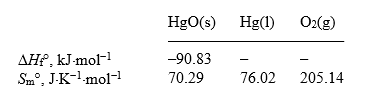
(Multiple Choice)
4.8/5 (85)
(85) Which of the following has the lowest standard molar entropy?
(Multiple Choice)
4.9/5 (77)
(77) The temperature of 2.00 mol Ne(g)is increased from 25 C to 200 C at constant pressure.Calculate the change in the entropy of neon (assume ideal behavior).
(Multiple Choice)
4.9/5 (72)
(72) Consider the following processes (treat all gases as ideal).
1.The pressure of 1 mol of oxygen gas is allowed to double isothermally.
2.Carbon dioxide is allowed to expand isothermally to 10 times its original volume.
3.The temperature of 1 mol of helium is increased 25°C at constant pressure.
4.Nitrogen gas is compressed isothermally to half its original volume.
5.A glass of water loses 100 J of energy reversibly at 30°C.
Which of these processes lead(s) to a decrease in entropy?
(Multiple Choice)
4.8/5 (90)
(90) Calculate the change in entropy of a large pail of water after 200 J of energy is reversibly transferred to the water at 20 C.
(Multiple Choice)
4.8/5 (79)
(79) The reaction 2C(s)+ 2H2(g) C2H4(g)is endothermic.This reaction will not be spontaneous at any temperature.
(True/False)
4.9/5 (80)
(80) All the following compounds become less stable with respect to their elements as the temperature is raised except
(Multiple Choice)
4.9/5 (76)
(76) When calculating the entropy of vaporization of water at 25 C,the dominant contribution is
(Multiple Choice)
4.9/5 (73)
(73) The enthalpy of fusion of H2O(s)at its normal melting point is 6.01 kJ.mol-1.The entropy change for freezing 1 mol of water at this temperature is
(Multiple Choice)
4.9/5 (78)
(78) Reactions with positive values of Sro always become spontaneous at low temperatures.
(True/False)
5.0/5 (88)
(88) Which of the following reactions has the smallest value of S ?
(Multiple Choice)
4.8/5 (83)
(83) Under what conditions (e.g.,constant P)are the following relations true?
(a) G = H - T S
(b)q = H
(Short Answer)
4.8/5 (86)
(86) Calculate Gr for the decomposition of mercury(II)oxide at 298 K.

(Multiple Choice)
4.8/5 (94)
(94) 
Filters
- Essay(0)
- Multiple Choice(0)
- Short Answer(0)
- True False(0)
- Matching(0)