



 Chat with AI
Exam 25: Work and Energy in Electrostatics

Exam 1: Foundations48 Questions
Exam 1: A: Foundations2 k Questions
Exam 2: Motion in One Dimension15 Questions
Exam 3: Acceleration48 Questions
Exam 4: Momentum7 Questions
Exam 5: Energy15 Questions
Exam 6: Principle of Relativity5 Questions
Exam 7: Interactions7 Questions
Exam 8: Force76 Questions
Exam 9: Work48 Questions
Exam 10: Motion in a Plane134 Questions
Exam 11: Motion in a Circle54 Questions
Exam 12: Torque68 Questions
Exam 13: Gravity44 Questions
Exam 14: Special Relativity49 Questions
Exam 15: Periodic Motion49 Questions
Exam 16: Waves in One Dimension23 Questions
Exam 17: Waves in Two and Three Dimensions44 Questions
Exam 18: Fluids54 Questions
Exam 19: Entropy27 Questions
Exam 20: Energy Transferred Thermally30 Questions
Exam 21: Degradation of Energy39 Questions
Exam 22: Electric Interactions20 Questions
Exam 23: The Electric Field34 Questions
Exam 24: Gausss Law46 Questions
Exam 25: Work and Energy in Electrostatics53 Questions
Exam 26: Charge Separation and Storage33 Questions
Exam 27: Magnetic Interactions37 Questions
Exam 28: Magnetic Fields of Charged Particles in Motion35 Questions
Exam 29: Changing Magnetic Fields38 Questions
Exam 30: Changing Electric Fields30 Questions
Exam 31: Electric Circuits68 Questions
Exam 32: Electronics46 Questions
Exam 33: Ray Optics65 Questions
Exam 34: Wave and Particle Optics100 Questions
Select questions type


A metallic sphere of radius 5 cm is charged such that the potential of its surface is 100 V (relative to infinity).Which of the following plots correctly shows the potential as a function of distance from the center of the sphere? 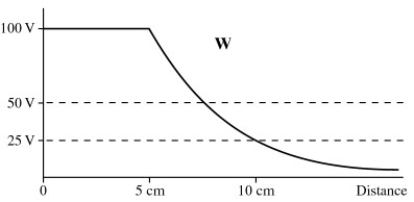
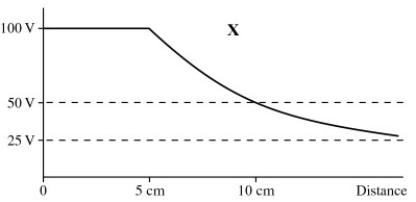
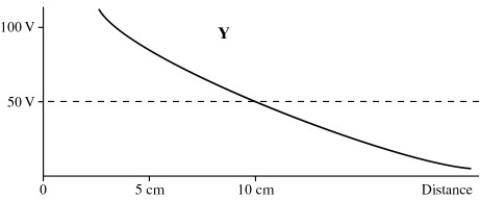
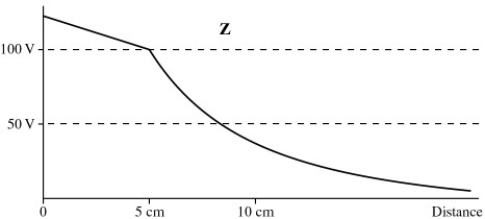
(Multiple Choice)
4.9/5  (92)
(92) Four point charges of magnitude 6.00 μC and of varying signs are placed at the corners of a square
2.00 m on each side,as shown in the figure.(k = 1/4πε0 = 8.99 × 10⁹ N • m2/C2)
(a)What is the electric potential (relative to infinity)at the center of this square due to these charges?
(b)What is the magnitude of the electric field due to these charges at the center of the square? 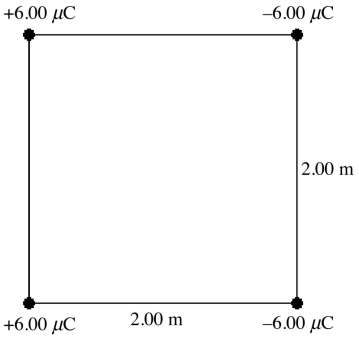
(Short Answer)
4.8/5 (83)
(83) Two equal point charges Q are separated by a distance d.One of the charges is released and moves away from the other due only to the electrical force between them.When the moving charge is a distance 3d from the other charge,what is its kinetic energy?
(Short Answer)
4.8/5 (80)
(80) If the electric potential in a region is given by V(x)= 6/x2,the x component of the electric field in that region is
(Multiple Choice)
4.8/5 (71)
(71) A very long nonconducting cylinder of diameter 10.0 cm carries charge distributed uniformly over its surface.Each meter of length carries +5.50 µC of charge.A proton is released from rest just outside the surface.How far will it be from the SURFACE of the cylinder when its speed has reached 2550 km/s?
(k = 1/4πε0 = 8.99 × 10⁹ N • m2/C2,e = 1.60 × 10⁻¹⁹ C,mproton = 1.67 × 10⁻²⁷ kg)
(Short Answer)
4.8/5 (77)
(77) Two long conducting cylindrical shells are coaxial and have radii of 20 mm and 80 mm.The electric potential of the inner conductor,with respect to the outer conductor,is +600 V.What is the maximum electric field magnitude between the cylinders? (k = 1/4πε0 = 8.99 × 10⁹ N • m2/C2)
(Multiple Choice)
4.9/5 (82)
(82) An extremely long thin wire carries a uniform linear charge density of 358 nC/m.Find the potential difference between points 5.0 m and 6.0 m from the wire,provided they are not near either end of the wire.(k = 1/4πε0 = 8.99 × 10⁹ N • m2/C2)
(Multiple Choice)
4.9/5 (74)
(74) A conducting sphere contains positive charge distributed uniformly over its surface.Which statements about the potential due to this sphere are true? All potentials are measured relative to infinity.(There may be more than one correct choice.)
(Multiple Choice)
4.9/5 (94)
(94) If an electron is accelerated from rest through a potential difference of 9.9 kV,what is its resulting speed? (e = 1.60 × 10⁻¹⁹ C,k = 1/4πε0 = 8.99 × 10⁹ N • m2/C2, mel = 9.11 × 10⁻³¹ kg)
(Multiple Choice)
4.9/5 (82)
(82) The graph in the figure shows the variation of the electric potential V (measured in volts)as a function of the radial direction r (measured in meters).For which range or value of r is the magnitude of the electric field the largest? 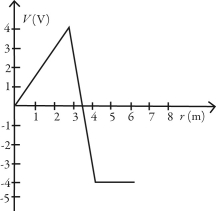
(Multiple Choice)
4.8/5 (81)
(81) Three point charges of -2.00 μC,+4.00 μC,and +6.00 μC are placed along the x-axis as shown in the figure.What is the electrical potential at point P (relative to infinity)due to these charges?
(k = 1/4πε0 = 8.99 × 10⁹ N • m2/C2) 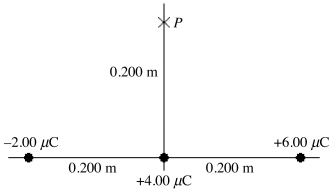
(Multiple Choice)
4.8/5 (77)
(77) When the electric field is zero at a point,the potential must also be zero there.
(True/False)
4.8/5 (91)
(91) Two +6.0-μC point charges are placed at the corners of the base of an equilateral triangle,as shown in the figure.(k = 1/4πε0 = 8.99 × 10⁹ N • m2/C2)At the vertex,P,of the triangle 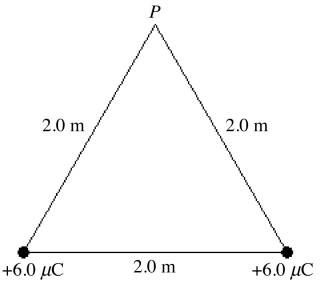 (a)what is the electric potential (relative to infinity)due to these charges?
(b)what is the magnitude of the electric field due to these charges?
(a)what is the electric potential (relative to infinity)due to these charges?
(b)what is the magnitude of the electric field due to these charges? (Short Answer)
4.9/5 (74)
(74) Suppose you have two negative point charges.As you move them farther and farther apart,the potential energy of this system relative to infinity
(Multiple Choice)
4.9/5 (87)
(87) A negative charge is moved from point A to point B along an equipotential surface.Which of the following statements must be true for this case?
(Multiple Choice)
4.9/5 (71)
(71) If the electric field is zero everywhere inside a region of space,the potential must also be zero in that region.
(True/False)
4.9/5 (81)
(81) An alpha particle is a nucleus of helium.It has twice the charge and four times the mass of the proton.When they were very far away from each other,but headed toward directly each other,a proton and an alpha particle each had an initial speed of 0.0030c,where c is the speed of light.What is their distance of closest approach? Hint: There are two conserved quantities.Make use of both of them.(c = 3.00 × 10⁸ m/s,k = 1/4πε0 = 8.99 × 10⁹ N • m2/C2,e = 1.60 × 10⁻¹⁹ C,mproton = 1.67 × 10⁻²⁷ • kg)
(Multiple Choice)
5.0/5 (77)
(77) A -7.0-μC point charge has a positively charged object in an elliptical orbit around it.If the mass of the positively charged object is 1.0 kg and the distance varies from 5.0 mm to 20.0 mm between the charges,what is the maximum electric potential difference through which the positive object moves?
(k = 1/4πε0 = 8.99 × 10⁹ N • m2/C2)
(Multiple Choice)
4.9/5 (86)
(86) The graph in the figure shows the variation of the electric potential V(x)(in arbitrary units)as a function of the position x (also in arbitrary units).Which of the choices below correctly describes the orientation of the x-component of the electric field along the x-axis? 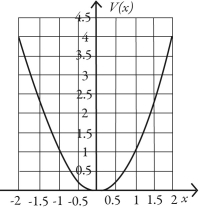
(Multiple Choice)
4.8/5 (89)
(89) Two parallel conducting plates are separated by 1.0 mm and carry equal but opposite surface charge densities.If the potential difference between them is 2.0 V.what is the magnitude of the surface charge density on each plate? (ε0 = 8.85 × 10⁻¹² C2/N • m2)
(Multiple Choice)
4.8/5 (87)
(87) 
Filters
- Essay(0)
- Multiple Choice(0)
- Short Answer(0)
- True False(0)
- Matching(0)