



 Chat with AI
Exam 22: Electric Interactions

Exam 1: Foundations48 Questions
Exam 1: A: Foundations2 k Questions
Exam 2: Motion in One Dimension15 Questions
Exam 3: Acceleration48 Questions
Exam 4: Momentum7 Questions
Exam 5: Energy15 Questions
Exam 6: Principle of Relativity5 Questions
Exam 7: Interactions7 Questions
Exam 8: Force76 Questions
Exam 9: Work48 Questions
Exam 10: Motion in a Plane134 Questions
Exam 11: Motion in a Circle54 Questions
Exam 12: Torque68 Questions
Exam 13: Gravity44 Questions
Exam 14: Special Relativity49 Questions
Exam 15: Periodic Motion49 Questions
Exam 16: Waves in One Dimension23 Questions
Exam 17: Waves in Two and Three Dimensions44 Questions
Exam 18: Fluids54 Questions
Exam 19: Entropy27 Questions
Exam 20: Energy Transferred Thermally30 Questions
Exam 21: Degradation of Energy39 Questions
Exam 22: Electric Interactions20 Questions
Exam 23: The Electric Field34 Questions
Exam 24: Gausss Law46 Questions
Exam 25: Work and Energy in Electrostatics53 Questions
Exam 26: Charge Separation and Storage33 Questions
Exam 27: Magnetic Interactions37 Questions
Exam 28: Magnetic Fields of Charged Particles in Motion35 Questions
Exam 29: Changing Magnetic Fields38 Questions
Exam 30: Changing Electric Fields30 Questions
Exam 31: Electric Circuits68 Questions
Exam 32: Electronics46 Questions
Exam 33: Ray Optics65 Questions
Exam 34: Wave and Particle Optics100 Questions
Select questions type


Charge Q1 = 6.0 nC is at (0.30 m,0),charge Q2 = -1.0 nC is at (0,0.10 m),and charge Q3 = 5.0 nC is at
(0,0). What are the magnitude and direction of the net electrostatic force on the 5.0-nC charge due to the other charges? (k = 1/4πε0 = 8.99 × 10⁹ N • m2/C2)

Free
(Essay)
4.7/5  (76)
(76) Correct Answer: Verified
5.4 × 10⁻⁶ N
,56° above -x-axis
A positive point charge Q is fixed on a very large horizontal frictionless tabletop.A second positive point charge q is released from rest near the stationary charge and is free to move.Which statement best describes the motion of q after it is released?
Free
(Multiple Choice)
4.8/5 (77)
(77) Correct Answer:Verified
VerifiedE
When two point charges are a distance d part,the electric force that each one feels from the other has magnitude F.In order to make this force twice as strong,the distance would have to be changed to
Free
(Multiple Choice)
4.8/5 (88)
(88) Correct Answer:Verified
VerifiedC
In the figure,all the charges are point charges and the charge in the middle is Q = -3.1 nC.For what charge q1 will charge q2 be in static equilibrium? 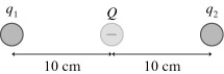
(Multiple Choice)
4.8/5 (83)
(83) The point charge at the bottom of the figure is Q = +17 nC,and the curve is a circular arc.What is the magnitude of the force on the charge Q due to the other point charges shown?
(k = 1/4πε0 = 8.99 × 10⁹ N • m2/C2) 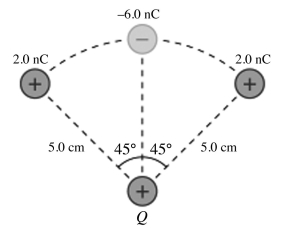
(Multiple Choice)
4.8/5 (77)
(77) Two identical small charged spheres are a certain distance apart,and each one initially experiences an electrostatic force of magnitude F due to the other.With time,charge gradually leaks off of both spheres.When each of the spheres has lost half its initial charge,the magnitude of the electrostatic force will be
(Multiple Choice)
5.0/5 (90)
(90) Two identical small conducting spheres are separated by 0.60 m.The spheres carry different amounts of charge and each sphere experiences an attractive electric force of 10.8N.The total charge on the two spheres is -24 μC.The two spheres are now connected by a slender conducting wire,which is then removed.The electric force on each sphere is closest to
(Multiple Choice)
4.8/5 (73)
(73) In the figure,charge q1 = 3.1 × 10⁻⁶ C is placed at the origin and charge q2 = -8.7 × 10⁻⁶ C is placed on the x-axis,at x = -0.20 m.Where along the x-axis can a third charge Q = -8.3 µC be placed such that the resultant force on this third charge is zero? 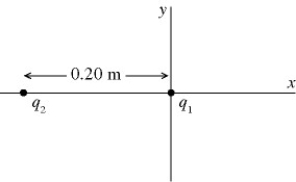
(Short Answer)
4.9/5 (81)
(81) A point charge Q is located a short distance from a point charge 3Q,and no other charges are present.If the electrical force on Q is F,what is the electrical force on 3Q?
(Multiple Choice)
4.8/5 (93)
(93) X and Y are two uncharged metal spheres on insulating stands,and are in contact with each other.A positively charged rod R is brought close to X as shown in Figure (a). 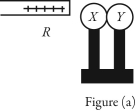 Sphere Y is now moved away from X,as in Figure (b).
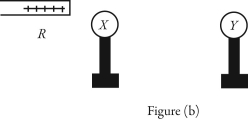 What are the final charge states of X and Y?
Sphere Y is now moved away from X,as in Figure (b).
What are the final charge states of X and Y? (Multiple Choice)
4.8/5 (81)
(81) One very small uniformly charged plastic ball is located directly above another such charge in a test tube as shown in the figure.The balls are in equilibrium a distance d apart.If the charge on each ball is doubled,the distance between the balls in the test tube would become 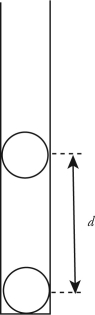
(Multiple Choice)
4.7/5 (73)
(73) In the figure Q = 5.8 nC and all other quantities are accurate to 2 significant figures.What is the magnitude of the force on the charge Q? (k = 1/4πε0 = 8.99 × 10⁹ N • m2/C2) 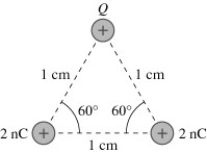
(Multiple Choice)
4.7/5 (80)
(80) Two small insulating spheres are attached to silk threads and aligned vertically as shown in the figure.These spheres have equal masses of 40 g,and carry charges q1 and q2 of equal magnitude 2.0 μC but opposite sign. The spheres are brought into the positions shown in the figure,with a vertical separation of 15 cm between them.Note that you cannot neglect gravity.(k = 1/4πε0 = 8.99 × 10⁹ N • m2/C2)The tension in the lower thread is closest to 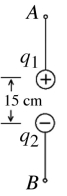
(Multiple Choice)
4.9/5 (78)
(78) A piece of plastic has a net charge of +2.00 μC. How many more protons than electrons does this piece of plastic have? (e = 1.60 × 10⁻¹⁹C)
(Multiple Choice)
4.9/5 (89)
(89) The figure shows two tiny 5.0-g spheres suspended from two very thin 1.0-m-long threads.The spheres repel each other after being charged to +91 nC and hang at rest as shown.What is the angle θ?
(k = 1/4πε0 = 8.99 × 10⁹ N • m2/C2) 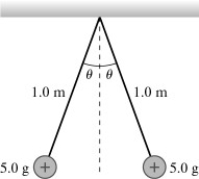
(Multiple Choice)
4.8/5 (90)
(90) A 1.0-C point charge is 15 m from a second point charge,and the electric force on one of them due to the other is 1.0 N. What is the magnitude of the second charge? (k = 1/4πε0 = 8.99 × 10⁹ N • m2/C2)
(Multiple Choice)
4.8/5 (78)
(78) In the figure,a small spherical insulator of mass 6.00 × 10⁻² kg and charge +0.400 μC is hung by a thin wire of negligible mass.A charge of -0.220 μC is held 0.290 m away from the sphere and directly to the right of it,so the wire makes an angle θ with the vertical,as shown.What is the angle θ?
(k = 1/4πε0 = 8.99 × 10⁹ N • m2/C2) 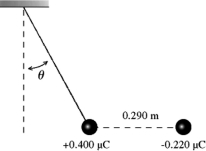
(Multiple Choice)
5.0/5 (80)
(80) When two point charges are 2.0 cm apart,each one experiences a 1.0-N electric force due to the other charge. If they are moved to a new separation of 8.0 cm,the electric force on each of them is closest to
(Multiple Choice)
4.8/5 (73)
(73) Three point charges are placed on the x-axis.A charge of +2.0 μC is placed at the origin,-2.0 μC to the right at x = 50 cm,and +4.0 μC at the 100 cm mark. What are the magnitude and direction of the electrostatic force that acts on the charge at the origin? (k = 1/4πε0 = 8.99 × 10⁹ N • m2/C2)
(Short Answer)
4.9/5 (78)
(78) A +7.00 μC point charge and -9.00 μC point charge are placed along the x-axis at x = 0.000 cm and
X = 40.0 cm,respectively.Where must a third charge,q,be placed along the x-axis so that it does not experience any net electric force due to the other two charges?
(Multiple Choice)
4.9/5 (84)
(84) 
Filters
- Essay(0)
- Multiple Choice(0)
- Short Answer(0)
- True False(0)
- Matching(0)