



 Chat with AI
Exam 5: Energy

Exam 1: Foundations48 Questions
Exam 1: A: Foundations2 k Questions
Exam 2: Motion in One Dimension15 Questions
Exam 3: Acceleration48 Questions
Exam 4: Momentum7 Questions
Exam 5: Energy15 Questions
Exam 6: Principle of Relativity5 Questions
Exam 7: Interactions7 Questions
Exam 8: Force76 Questions
Exam 9: Work48 Questions
Exam 10: Motion in a Plane134 Questions
Exam 11: Motion in a Circle54 Questions
Exam 12: Torque68 Questions
Exam 13: Gravity44 Questions
Exam 14: Special Relativity49 Questions
Exam 15: Periodic Motion49 Questions
Exam 16: Waves in One Dimension23 Questions
Exam 17: Waves in Two and Three Dimensions44 Questions
Exam 18: Fluids54 Questions
Exam 19: Entropy27 Questions
Exam 20: Energy Transferred Thermally30 Questions
Exam 21: Degradation of Energy39 Questions
Exam 22: Electric Interactions20 Questions
Exam 23: The Electric Field34 Questions
Exam 24: Gausss Law46 Questions
Exam 25: Work and Energy in Electrostatics53 Questions
Exam 26: Charge Separation and Storage33 Questions
Exam 27: Magnetic Interactions37 Questions
Exam 28: Magnetic Fields of Charged Particles in Motion35 Questions
Exam 29: Changing Magnetic Fields38 Questions
Exam 30: Changing Electric Fields30 Questions
Exam 31: Electric Circuits68 Questions
Exam 32: Electronics46 Questions
Exam 33: Ray Optics65 Questions
Exam 34: Wave and Particle Optics100 Questions
Select questions type


A 620-g object traveling at 2.1 m/s collides head-on with a 320-g object traveling in the opposite direction at 3.8 m/s.If the collision is perfectly elastic,what is the change in the kinetic energy of the 620-g object?

Free
(Multiple Choice)
4.7/5  (92)
(92) Correct Answer: Verified
A
A 1000.0 kg car is moving at 15 km/h.If a 2000.0 kg truck has 18 times the kinetic energy of the car,how fast is the truck moving?
Free
(Multiple Choice)
4.9/5 (88)
(88) Correct Answer:Verified
VerifiedA
In a perfectly ELASTIC collision between two perfectly rigid objects
Free
(Multiple Choice)
4.7/5 (80)
(80) Correct Answer:Verified
VerifiedD
The coefficient of the restitution of an object is defined as the ratio of its outgoing to incoming speed when the object collides with a rigid surface.For an object with a coefficient of 0.78,what fraction of the object's kinetic energy is lost during a single collision?
(Multiple Choice)
4.7/5 (84)
(84) A 2.3-kg object traveling at 6.1 m/s collides head-on with a 3.5-kg object traveling in the opposite direction at 4.8 m/s.If the collision is perfectly elastic,what is the final speed of the 2.3-kg object?
(Multiple Choice)
4.9/5 (92)
(92) How much energy is needed to change the speed of a 1600 kg sport utility vehicle from 15.0 m/s to 40.0 m/s?
(Multiple Choice)
4.8/5 (84)
(84) A shell explodes into two fragments,one fragment 25 times heavier than the other.If any gas from the explosion has negligible mass,then
(Multiple Choice)
5.0/5 (75)
(75) A 1.0-kg block and a 2.0-kg block are pressed together on a horizontal frictionless surface with a compressed very light spring between them.They are not attached to the spring.After they are released and have both moved free of the spring
(Multiple Choice)
4.9/5 (73)
(73) Jacques and George meet in the middle of a lake while paddling in their canoes.They come to a complete stop and talk for a while.When they are ready to leave,Jacques pushes George's canoe with a force  to separate the two canoes.What is correct to say about the final momentum and kinetic energy of the system if we can neglect any resistance due to the water?
 (Multiple Choice)
4.9/5 (75)
(75) In the figure,determine the character of the collision.The masses of the blocks,and the velocities before and after are given,and no other unbalanced forces act on these blocks.The collision is 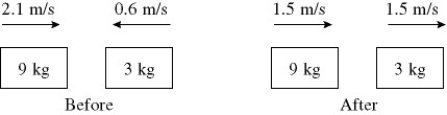
(Multiple Choice)
4.8/5 (84)
(84) A 10.0-kg shell is traveling horizontally to the right at 25.0 m/s relative to the ground when it explodes into two fragments,one of mass 3.00 kg and the other of mass 7.00 kg.The lighter fragment goes directly forward,and the explosion releases 1.50 × 10³ J of mechanical energy to the fragments.Find the magnitude and direction of the velocity of the heavier fragment relative to the ground just after the explosion.Ignore the effect of any ejected gases.
(Short Answer)
4.8/5 (74)
(74) A car of mass 1689 kg collides head-on with a parked truck of mass 2000 kg. Spring mounted bumpers ensure that the collision is essentially elastic.If the velocity of the truck is 17 km/h (in the same direction as the car's initial velocity)after the collision,what was the initial speed of the car?
(Multiple Choice)
5.0/5 (84)
(84) On a frictionless horizontal table,two blocks (A of mass 2.00 kg and B of mass 3.00 kg)are pressed together against an ideal massless spring that stores 75.0 J of elastic potential energy.The blocks are not attached to the spring and are free to move free of it once they are released from rest.The maximum speed achieved by each block is closest to:
(Multiple Choice)
4.7/5 (77)
(77) In the figure,determine the character of the collision.The masses of the blocks,and the velocities before and after are given.The collision is 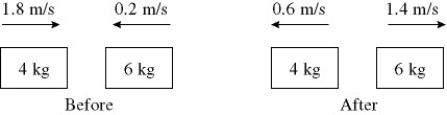
(Multiple Choice)
4.9/5 (84)
(84) 
Filters
- Essay(0)
- Multiple Choice(0)
- Short Answer(0)
- True False(0)
- Matching(0)