



 Chat with AI
Exam 3: Acceleration

Exam 1: Foundations48 Questions
Exam 1: A: Foundations2 k Questions
Exam 2: Motion in One Dimension15 Questions
Exam 3: Acceleration48 Questions
Exam 4: Momentum7 Questions
Exam 5: Energy15 Questions
Exam 6: Principle of Relativity5 Questions
Exam 7: Interactions7 Questions
Exam 8: Force76 Questions
Exam 9: Work48 Questions
Exam 10: Motion in a Plane134 Questions
Exam 11: Motion in a Circle54 Questions
Exam 12: Torque68 Questions
Exam 13: Gravity44 Questions
Exam 14: Special Relativity49 Questions
Exam 15: Periodic Motion49 Questions
Exam 16: Waves in One Dimension23 Questions
Exam 17: Waves in Two and Three Dimensions44 Questions
Exam 18: Fluids54 Questions
Exam 19: Entropy27 Questions
Exam 20: Energy Transferred Thermally30 Questions
Exam 21: Degradation of Energy39 Questions
Exam 22: Electric Interactions20 Questions
Exam 23: The Electric Field34 Questions
Exam 24: Gausss Law46 Questions
Exam 25: Work and Energy in Electrostatics53 Questions
Exam 26: Charge Separation and Storage33 Questions
Exam 27: Magnetic Interactions37 Questions
Exam 28: Magnetic Fields of Charged Particles in Motion35 Questions
Exam 29: Changing Magnetic Fields38 Questions
Exam 30: Changing Electric Fields30 Questions
Exam 31: Electric Circuits68 Questions
Exam 32: Electronics46 Questions
Exam 33: Ray Optics65 Questions
Exam 34: Wave and Particle Optics100 Questions
Select questions type


Suppose that an object is moving with constant nonzero acceleration.Which of the following is an accurate statement concerning its motion?
(Multiple Choice)
4.8/5  (79)
(79) A car is 200 m from a stop sign and traveling toward the sign at 40.0 m/s.At this time,the driver suddenly realizes that she must stop the car.If it takes 0.200 s for the driver to apply the brakes,what must be the magnitude of the constant acceleration of the car after the brakes are applied so that the car will come to rest at the stop sign?
(Multiple Choice)
4.9/5 (70)
(70) When can we be certain that the average velocity of an object is always equal to its instantaneous velocity?
(Multiple Choice)
4.7/5 (83)
(83) The figure represents the velocity of a particle as it travels along the x-axis.At what value (or values)of t is the instantaneous acceleration equal to zero? 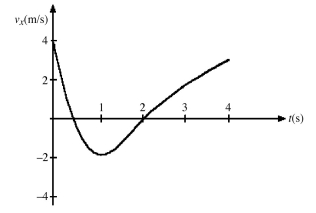
(Multiple Choice)
4.9/5 (72)
(72) An object is moving in a straight line along the x-axis.A plot of its velocity in the x direction as a function of time is shown in the figure.Which graph represents its acceleration in the x direction as a function of time? 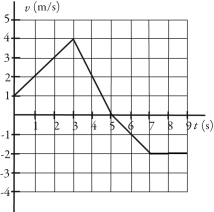
(Multiple Choice)
4.9/5 (81)
(81) Two objects have masses m and 5m,respectively.They both are placed side by side on a frictionless inclined plane and allowed to slide down from rest.
(Multiple Choice)
4.7/5 (83)
(83) A test rocket is fired straight up from rest with a net acceleration of 20.0 m/s2.After 4.00 seconds the motor turns off,but the rocket continues to coast upward with no appreciable air resistance.What maximum elevation does the rocket reach?
(Multiple Choice)
4.9/5 (65)
(65) The position of an object is given by x = at3 - bt2 + ct,where a = 4.1 m/s3,b = 2.2 m/s2,c = 1.7 m/s,and x and t are in SI units.What is the instantaneous acceleration of the object when t = 0.7 s?
(Multiple Choice)
4.9/5 (72)
(72) 
Filters
- Essay(0)
- Multiple Choice(0)
- Short Answer(0)
- True False(0)
- Matching(0)