



 Chat with AI
Exam 8: Monopoly Markets

Exam 1: Economics: Foundations and Models142 Questions
Exam 2: Choices and Trade-Offs in the Market192 Questions
Exam 3: Where Prices Come From: the Interaction of Demand and Supply241 Questions
Exam 4: Elasticity: The Responsiveness of Demand and Supply224 Questions
Exam 5: Economic Efficiency,government Price Setting and Taxes169 Questions
Exam 6: Technology,production and Costs255 Questions
Exam 7: Firms in Perfectly Competitive Markets269 Questions
Exam 8: Monopoly Markets187 Questions
Exam 9: Monopolistic Competition and Oligopoly350 Questions
Exam 10: The Markets for Labour and Other Factors of Production250 Questions
Exam 11: Government Intervention in the Market325 Questions
Exam 12: Social Policy and Inequality125 Questions
Exam 13: Gdp: Measuring Total Production, income and Economic Growth202 Questions
Exam 14: Unemployment and Inflation230 Questions
Exam 15: Aggregate Demand and Aggregate Supply Analysis166 Questions
Exam 16: Money,banks and the Reserve Bank of Australia110 Questions
Exam 17: Monetary Policy111 Questions
Exam 18: Fiscal Policy138 Questions
Exam 19: Comparative Advantage and the Gains From International Trade131 Questions
Exam 20: Macroeconomics in an Open Economy276 Questions
Select questions type


Figure 8.4  Figure 8.4 shows the demand and cost curves for a monopolist.
-Refer to Figure 8.4.The amount of the monopoly's total revenue is -.
Figure 8.4 shows the demand and cost curves for a monopolist.
-Refer to Figure 8.4.The amount of the monopoly's total revenue is -. (Multiple Choice)
4.9/5  (73)
(73) A snack shop inside a hotel in a busy city has a monopoly on food sales if it is the only food vendor in the hotel that is open 24 hours a day.
(True/False)
4.8/5 (75)
(75) Figure 8.1  -Refer to Figure 8.1.Which of the following statements about the firm depicted in the diagram is true?
 (Multiple Choice)
4.8/5 (75)
(75) For which of the following firms is patent protection of vital importance?
(Multiple Choice)
4.9/5 (83)
(83) To maximise profit,a monopolist will produce and sell a quantity such that for the last unit sold,marginal revenue equals marginal cost,and will charge a price given by the demand curve at that output level.
(True/False)
4.8/5 (81)
(81) Figure 8.10  -Refer to Figure 8.10.What is the area that represents the deadweight loss?
 (Multiple Choice)
4.9/5 (80)
(80) The ability of a firm to charge a price greater than marginal cost is called
(Multiple Choice)
4.9/5 (92)
(92) What is the relationship between marginal revenue and average revenue for a monopolist and is it the same for a perfect competitor?
__________________________________________________________________________________________________________________________________________________________________________________________
(Essay)
4.7/5 (91)
(91) When the government wants to give an exclusive right to one firm to produce a product,it
(Multiple Choice)
4.9/5 (76)
(76) How do the price and quantity of a monopoly compare to that of a perfectly competitive industry?
__________________________________________________________________________________________________________________________________________________________________________________________
(Essay)
4.9/5 (94)
(94) a.What is the defining characteristic of a natural monopoly?
b.Should the government break up a natural monopoly into two or more firms to make the industry more competitive?
c.Suppose the government wants to ensure that some of the benefits of declining average total cost are passed on to consumers.To achieve this goal,it requires that the natural monopoly set its price equal to marginal cost.Is this a feasible goal? Explain.
d.What is an alternative to marginal cost pricing that ensures that consumers reap some of the benefits of declining average total cost?
__________________________________________________________________________________________________________________________________________________________________________________________
(Essay)
4.9/5 (86)
(86) Figure 8.7 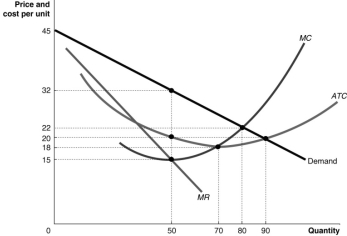 -Refer to Figure 8.7.Use the figure above to answer the following questions.
a.What is the profit-maximising quantity and what price will the monopolist charge?
b.What is the total revenue at the profit-maximising output level?
c.What is the total cost at the profit-maximising output level?
d.What is the profit?
e.What is the profit per unit (average profit)at the profit-maximising output level?
f.If this industry was organised as a perfectly competitive industry,what would be the profit-maximising price and quantity?
__________________________________________________________________________________________________________________________________________________________________________________________
-Refer to Figure 8.7.Use the figure above to answer the following questions.
a.What is the profit-maximising quantity and what price will the monopolist charge?
b.What is the total revenue at the profit-maximising output level?
c.What is the total cost at the profit-maximising output level?
d.What is the profit?
e.What is the profit per unit (average profit)at the profit-maximising output level?
f.If this industry was organised as a perfectly competitive industry,what would be the profit-maximising price and quantity?
__________________________________________________________________________________________________________________________________________________________________________________________ (Essay)
4.8/5 (86)
(86) Network externalities refer to the situation where the usefulness of a product increases with the number of consumers who use it.
(True/False)
4.9/5 (81)
(81) For a natural monopoly,the marginal cost of producing an additional unit of its product is relatively small.
(True/False)
5.0/5 (86)
(86) A local electricity-generating company has a monopoly that is protected by an entry barrier that takes the form of
(Multiple Choice)
4.7/5 (88)
(88) Figure 8.10
-Refer to Figure 8.10.The area that represents consumer surplus under a monopoly is -.
-Refer to Figure 8.10.The area that represents consumer surplus under a monopoly is -. (Multiple Choice)
4.8/5 (73)
(73) 
Filters
- Essay(0)
- Multiple Choice(0)
- Short Answer(0)
- True False(0)
- Matching(0)