



 Chat with AI
Exam 12: Social Policy and Inequality

Exam 1: Economics: Foundations and Models142 Questions
Exam 2: Choices and Trade-Offs in the Market192 Questions
Exam 3: Where Prices Come From: the Interaction of Demand and Supply241 Questions
Exam 4: Elasticity: The Responsiveness of Demand and Supply224 Questions
Exam 5: Economic Efficiency,government Price Setting and Taxes169 Questions
Exam 6: Technology,production and Costs255 Questions
Exam 7: Firms in Perfectly Competitive Markets269 Questions
Exam 8: Monopoly Markets187 Questions
Exam 9: Monopolistic Competition and Oligopoly350 Questions
Exam 10: The Markets for Labour and Other Factors of Production250 Questions
Exam 11: Government Intervention in the Market325 Questions
Exam 12: Social Policy and Inequality125 Questions
Exam 13: Gdp: Measuring Total Production, income and Economic Growth202 Questions
Exam 14: Unemployment and Inflation230 Questions
Exam 15: Aggregate Demand and Aggregate Supply Analysis166 Questions
Exam 16: Money,banks and the Reserve Bank of Australia110 Questions
Exam 17: Monetary Policy111 Questions
Exam 18: Fiscal Policy138 Questions
Exam 19: Comparative Advantage and the Gains From International Trade131 Questions
Exam 20: Macroeconomics in an Open Economy276 Questions
Select questions type


If the government wants to minimise the welfare loss of a tax,it should tax goods with more inelastic demands or supplies.

Free
(True/False)
4.9/5  (64)
(64) Correct Answer: Verified
True
The horizontal-equity principle of taxation is not easy to use in practice because
Free
(Multiple Choice)
4.7/5 (82)
(82) Correct Answer:Verified
VerifiedD
Consider a public good such as fire protection services.Rich people may benefit more than the poor from such a service because rich people stand to lose more from a fire that destroys property.In this case,
(Multiple Choice)
4.8/5 (81)
(81) Figure 12.2 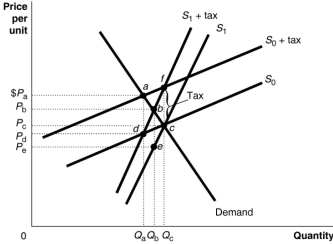 Figure 12.2 shows a demand curve and two sets of supply curves, one set more elastic than the other.
-Refer to Figure 12.2.If the government imposes an excise tax of $1.00 on every unit sold,
Figure 12.2 shows a demand curve and two sets of supply curves, one set more elastic than the other.
-Refer to Figure 12.2.If the government imposes an excise tax of $1.00 on every unit sold, (Multiple Choice)
4.8/5 (78)
(78) What happens when the demand for a product is more elastic than the supply?
(Multiple Choice)
4.9/5 (76)
(76) A Lorenz curve summarises the information provided by a Gini coefficient.
(True/False)
4.7/5 (85)
(85) Petrol taxes that are typically used for highway construction and maintenance are consistent with which of the following principles of taxation?
(Multiple Choice)
4.9/5 (77)
(77) Figure 12.2 Figure 12.2 shows a demand curve and two sets of supply curves, one set more elastic than the other.
-Refer to Figure 12.2.If the government imposes an excise tax of $1.00 on every unit sold,the producer's burden of the tax
Figure 12.2 shows a demand curve and two sets of supply curves, one set more elastic than the other.
-Refer to Figure 12.2.If the government imposes an excise tax of $1.00 on every unit sold,the producer's burden of the tax (Multiple Choice)
4.9/5 (81)
(81) The idea that two taxpayers in the same economic circumstances should pay the same level of taxes is known as the -.
(Multiple Choice)
4.8/5 (78)
(78) What happens as the value of the Gini coefficient approaches one?
(Multiple Choice)
4.8/5 (70)
(70) Holding all other factors constant,income earned from capital is more unequally distributed than income earned from labour.
(True/False)
4.8/5 (85)
(85) If,as your taxable income decreases,you pay a smaller percentage of your taxable income in taxes,then the tax is -.
(Multiple Choice)
4.9/5 (69)
(69) If you pay $14 000 in taxes on an income of $125 000,and $17 400 in taxes on an income of $144 000,what is your marginal tax rate? Show your work.
--------------------------------------------------------------------------------------------------------------------------------------------
--------------------------------------------------------------------------------------------------------------------------------------------
(Essay)
4.8/5 (85)
(85) Figure 12.1 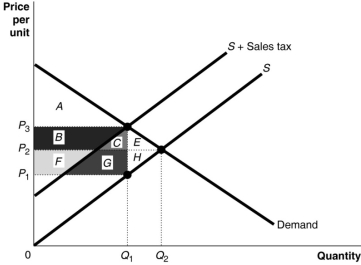 -Refer to Figure 12.1.Of the tax revenue collected by the government,the portion borne by producers is represented by the area -.
 (Multiple Choice)
4.8/5 (76)
(76) Figure 12.6  Figure 12.6 shows the Lorenz curves for Islandia and Syldavia.
-Refer to Figure 12.6.If area X = 2060,area Y = 240,and area Z= 2700,calculate the Gini coefficient for Syldavia.
Figure 12.6 shows the Lorenz curves for Islandia and Syldavia.
-Refer to Figure 12.6.If area X = 2060,area Y = 240,and area Z= 2700,calculate the Gini coefficient for Syldavia. (Multiple Choice)
4.9/5 (87)
(87) 
Filters
- Essay(0)
- Multiple Choice(0)
- Short Answer(0)
- True False(0)
- Matching(0)