



 Chat with AI
Exam 18: Fiscal Policy

Exam 1: Economics: Foundations and Models142 Questions
Exam 2: Choices and Trade-Offs in the Market192 Questions
Exam 3: Where Prices Come From: the Interaction of Demand and Supply241 Questions
Exam 4: Elasticity: The Responsiveness of Demand and Supply224 Questions
Exam 5: Economic Efficiency,government Price Setting and Taxes169 Questions
Exam 6: Technology,production and Costs255 Questions
Exam 7: Firms in Perfectly Competitive Markets269 Questions
Exam 8: Monopoly Markets187 Questions
Exam 9: Monopolistic Competition and Oligopoly350 Questions
Exam 10: The Markets for Labour and Other Factors of Production250 Questions
Exam 11: Government Intervention in the Market325 Questions
Exam 12: Social Policy and Inequality125 Questions
Exam 13: Gdp: Measuring Total Production, income and Economic Growth202 Questions
Exam 14: Unemployment and Inflation230 Questions
Exam 15: Aggregate Demand and Aggregate Supply Analysis166 Questions
Exam 16: Money,banks and the Reserve Bank of Australia110 Questions
Exam 17: Monetary Policy111 Questions
Exam 18: Fiscal Policy138 Questions
Exam 19: Comparative Advantage and the Gains From International Trade131 Questions
Exam 20: Macroeconomics in an Open Economy276 Questions
Select questions type


By decreasing government spending and aggregate demand,the policy ________ the price level and ________ equilibrium real GDP,ceteris paribus.

Free
(Multiple Choice)
4.8/5  (85)
(85) Correct Answer: Verified
D
An appropriate fiscal policy response when aggregate demand is growing at a faster rate than aggregate supply is to increase interest rates.
Free
(True/False)
4.8/5 (81)
(81) Correct Answer:Verified
VerifiedFalse
Outline the differences between the government 'purchases multiplier' and the 'tax multiplier'.
_____________________________________________________________________________________________
_____________________________________________________________________________________________
Free
(Essay)
4.9/5 (80)
(80) Correct Answer:Verified
VerifiedFirst,changes in government purchases affect GDP in the opposite direction as changes in taxes.As a result,the government purchases multiplier is positive,and the tax multiplier is negative.Secondly,the government purchases multiplier is larger in magnitude than the tax multiplier.This means that a dollar change in government purchases will have a larger effect on GDP as compared to a dollar change in the taxes.
The ________ the tax wedge,the smaller the difference between pre-tax and post-tax returns for an economic activity,the ________ of that activity will occur.
(Multiple Choice)
4.9/5 (85)
(85) Borrowing to pay for long-term capital expenditures makes sense as the benefits are received _________.
(Multiple Choice)
5.0/5 (83)
(83) If the economy were in a recession,we would expect government expenditure to be _________.
(Multiple Choice)
4.9/5 (74)
(74) A deliberate policy change in taxes and government spending to influence the level of aggregate demand is called __________.
(Multiple Choice)
4.7/5 (85)
(85) Identify each of the following as (i)part of an expansionary fiscal policy; (ii)part of a contractionary fiscal policy; or (iii)not part of fiscal policy.
a.The personal income tax rate is lowered.
b.The government increases spending on defence due to a change in spending priorities.
c.The company income tax rate is lowered.
d.The State of New South Wales builds a new tollway in an attempt to expand employment and ease traffic congestion.
_____________________________________________________________________________________________
_____________________________________________________________________________________________
(Essay)
4.7/5 (81)
(81) Increases in government spending will lower the long-term growth rate of GDP if it lowers ________ and the government purchases ________ goods and not ________ goods.
(Multiple Choice)
5.0/5 (66)
(66) Consider the hypothetical information in the following table for potential GDP,real GDP,and the price level in 2016 and in 2017 if the government does not use fiscal policy. Year Potential GDP Real GDP Price Level 2016 \ 1.5 trillion \ 1.5 trillion 150 2017 \ 1.7 trillion \ 1.8 trillion 154 If the government wants control inflation while keeping real GDP at its potential level in 2017,it should ________.
(Multiple Choice)
4.9/5 (79)
(79) Refer to Figure 18.6 for the following questions.
Figure 18.6  -Suppose the federal government reduces income taxes.Assume that the movement from A to B in Figure 18.6 represents normal growth in the economy before the tax change.Also assume that aggregate demand does not change.If the tax change is effective and labour supply and savings increase because of the tax change,then the tax change will __________.
 (Multiple Choice)
4.7/5 (76)
(76) Refer to Figure 18.2 for the following question.
Figure 18.2  -If policy makers are concerned that the economy is in danger of rising inflation because aggregate demand is increasing faster than aggregate supply,the appropriate fiscal policy response is to _________.
 (Multiple Choice)
4.8/5 (83)
(83) Induced taxes and transfer payments reduce the multiplier effects.
(True/False)
4.8/5 (75)
(75) In 2015/2016,the largest share of Australian federal government welfare payments went to __________.
(Multiple Choice)
4.8/5 (75)
(75) Suppose the economy is in the state described by the following table.
Year Potential GDP Real GDP Price Level 1 \ 1100 billion \ 1100 billion 100 2 \ 1150 billion \ 1170 billion 109 What problem will occur in the economy if no policy is pursued? What fiscal policy tools could be used to combat the problem? Draw a dynamic aggregate demand and supply graph to illustrate the appropriate fiscal policy to use in this situation. 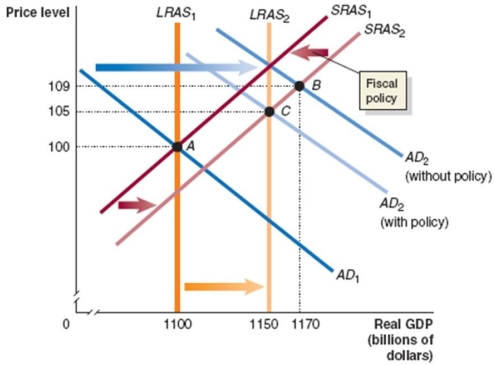 _____________________________________________________________________________________________
_____________________________________________________________________________________________
_____________________________________________________________________________________________ (Essay)
4.8/5 (76)
(76) Refer to Figure 18.1 for the following questions.
Figure 18.1  -In Figure 18.1,if fiscal policy successfully moves the economy from point B to equilibrium at potential GDP,this will _______.
 (Multiple Choice)
4.8/5 (83)
(83) During which decade was government expenditure in Australia the highest as a proportion of GDP?
(Multiple Choice)
4.8/5 (83)
(83) An increase in government spending lowers interest rates and increases the rate of investment in new capital.
(True/False)
4.9/5 (74)
(74) 
Filters
- Essay(0)
- Multiple Choice(0)
- Short Answer(0)
- True False(0)
- Matching(0)