



 Chat with AI
Exam 18: Fiscal Policy

Exam 1: Economics: Foundations and Models142 Questions
Exam 2: Choices and Trade-Offs in the Market192 Questions
Exam 3: Where Prices Come From: the Interaction of Demand and Supply241 Questions
Exam 4: Elasticity: The Responsiveness of Demand and Supply224 Questions
Exam 5: Economic Efficiency,government Price Setting and Taxes169 Questions
Exam 6: Technology,production and Costs255 Questions
Exam 7: Firms in Perfectly Competitive Markets269 Questions
Exam 8: Monopoly Markets187 Questions
Exam 9: Monopolistic Competition and Oligopoly350 Questions
Exam 10: The Markets for Labour and Other Factors of Production250 Questions
Exam 11: Government Intervention in the Market325 Questions
Exam 12: Social Policy and Inequality125 Questions
Exam 13: Gdp: Measuring Total Production, income and Economic Growth202 Questions
Exam 14: Unemployment and Inflation230 Questions
Exam 15: Aggregate Demand and Aggregate Supply Analysis166 Questions
Exam 16: Money,banks and the Reserve Bank of Australia110 Questions
Exam 17: Monetary Policy111 Questions
Exam 18: Fiscal Policy138 Questions
Exam 19: Comparative Advantage and the Gains From International Trade131 Questions
Exam 20: Macroeconomics in an Open Economy276 Questions
Select questions type


To counteract the effect of automatic stabilisers during a recession and keep the budget balanced,the federal government would need to ________ government spending,or ________ taxes,which would ________ aggregate demand.
(Multiple Choice)
4.9/5  (79)
(79) AACSB: Able to translate knowledge of business and management into practice
Refer to Figure 18.5 for the following question.
Figure 18.5 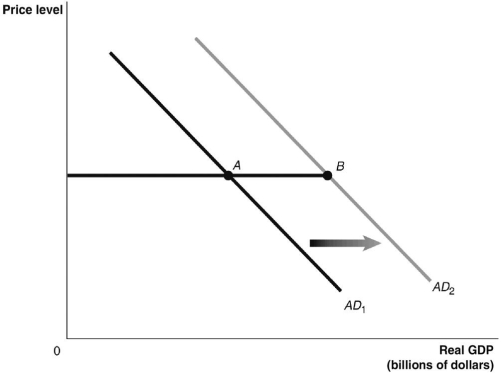 -Refer to Figure 18.5.If government purchases increase by $100 billion and lead to an ultimate increase in aggregate demand as shown in the graph,the difference in real GDP between point A and point B will be ________.
 (Multiple Choice)
4.9/5 (85)
(85) If tax reduction and simplification are effective,then __________.
(Multiple Choice)
4.8/5 (69)
(69) What is the structural budget deficit or surplus?
_____________________________________________________________________________________________
_____________________________________________________________________________________________
(Essay)
4.7/5 (83)
(83) Government net debt in Australia was highest in which of the following time periods?
(Multiple Choice)
4.9/5 (89)
(89) Tax reduction and simplification should ________ long-run aggregate supply and ________ aggregate demand.
(Multiple Choice)
4.8/5 (75)
(75) Reducing the marginal tax rate on individual income will ________.
(Multiple Choice)
4.9/5 (79)
(79) 'Contractionary fiscal policy' aims to reduce the rate of increase in aggregate demand.
(True/False)
4.8/5 (72)
(72) An increase in government spending may expedite recovery from a recession in the short run,but in the long run,this policy may __________.
(Multiple Choice)
4.9/5 (85)
(85) Refer to Figure 18.2 for the following question.
Figure 18.2  -In Figure 18.2,suppose the economy in Year 1 is at point A and expected in Year 2 to be at point B.Which of the following policies could the government use to move the economy to point C?
 (Multiple Choice)
4.8/5 (61)
(61) Suppose that the federal budget is balanced when GDP is at potential GDP.If equilibrium GDP falls below potential,_________.
(Multiple Choice)
4.7/5 (92)
(92) If the federal government's expenditures are less than its tax revenues,then __________.
(Multiple Choice)
4.9/5 (60)
(60) An equal decrease in government purchases and taxes will cause __________.
(Multiple Choice)
4.8/5 (97)
(97) Give examples of 'automatic stabilisers'.Explain how automatic stabilisers work when there is an economic boom.
_____________________________________________________________________________________________
_____________________________________________________________________________________________
(Essay)
4.9/5 (84)
(84) Suppose that the government allocates $2 billion for new roads.It also raises taxes by $2 billion to keep the deficit from growing.If the marginal propensity to consume = 0.8,what is the effect on equilibrium GDP?
(Multiple Choice)
4.9/5 (71)
(71) Government purchases and transfer payments are included in the measure of government expenditures.
(True/False)
4.9/5 (82)
(82) A cut in tax rates affects equilibrium real GDP through two channels: ________ disposable income and consumer spending,and ________ the size of the multiplier effect.
(Multiple Choice)
4.8/5 (78)
(78) Government expenditure in Australia as a percentage of GDP has consistently trended upward since the 1960s.
(True/False)
4.8/5 (79)
(79) 
Filters
- Essay(0)
- Multiple Choice(0)
- Short Answer(0)
- True False(0)
- Matching(0)