



 Chat with AI
Exam 8: Monopoly Markets

Exam 1: Economics: Foundations and Models142 Questions
Exam 2: Choices and Trade-Offs in the Market192 Questions
Exam 3: Where Prices Come From: the Interaction of Demand and Supply241 Questions
Exam 4: Elasticity: The Responsiveness of Demand and Supply224 Questions
Exam 5: Economic Efficiency,government Price Setting and Taxes169 Questions
Exam 6: Technology,production and Costs255 Questions
Exam 7: Firms in Perfectly Competitive Markets269 Questions
Exam 8: Monopoly Markets187 Questions
Exam 9: Monopolistic Competition and Oligopoly350 Questions
Exam 10: The Markets for Labour and Other Factors of Production250 Questions
Exam 11: Government Intervention in the Market325 Questions
Exam 12: Social Policy and Inequality125 Questions
Exam 13: Gdp: Measuring Total Production, income and Economic Growth202 Questions
Exam 14: Unemployment and Inflation230 Questions
Exam 15: Aggregate Demand and Aggregate Supply Analysis166 Questions
Exam 16: Money,banks and the Reserve Bank of Australia110 Questions
Exam 17: Monetary Policy111 Questions
Exam 18: Fiscal Policy138 Questions
Exam 19: Comparative Advantage and the Gains From International Trade131 Questions
Exam 20: Macroeconomics in an Open Economy276 Questions
Select questions type


Figure 8.13  Figure 8.13 shows the market demand and cost curves facing a natural monopoly.
-Refer to Figure 8.13.If the regulators of the natural monopoly allow the owners of the firm to break even on their investment,the firm will produce an output of ________ and charge a price of ________.
Figure 8.13 shows the market demand and cost curves facing a natural monopoly.
-Refer to Figure 8.13.If the regulators of the natural monopoly allow the owners of the firm to break even on their investment,the firm will produce an output of ________ and charge a price of ________. (Multiple Choice)
4.8/5  (79)
(79) Figure 8.13 Figure 8.13 shows the market demand and cost curves facing a natural monopoly.
-Refer to Figure 8.13.Suppose the government regulates this industry in order to remove the inefficiency implied by the behaviour of the profit-maximising owners.If regulators require that the firm produce the economically efficient output level,what is this level and what price will be charged?
Figure 8.13 shows the market demand and cost curves facing a natural monopoly.
-Refer to Figure 8.13.Suppose the government regulates this industry in order to remove the inefficiency implied by the behaviour of the profit-maximising owners.If regulators require that the firm produce the economically efficient output level,what is this level and what price will be charged? (Multiple Choice)
4.7/5 (85)
(85) A monopoly firm is the only seller of a good or service that
(Multiple Choice)
4.9/5 (66)
(66) Figure 8.14 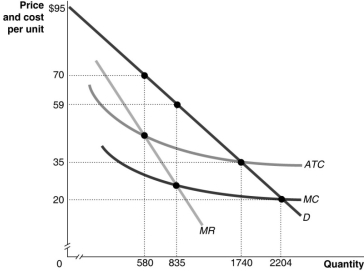 -Refer to Figure 8.14 to answer the following questions:
a.What quantity will this monopoly produce and what price will it charge?
b.Suppose the monopoly is regulated.If the regulatory agency wants to achieve economic efficiency,what price should it require the monopoly to charge?
c.To achieve economic efficiency,what quantity will the regulated monopoly produce?
d.Will the regulated monopoly make a profit if it charges the price that will achieve economic efficiency?
e.Suppose the government decides to regulate the monopoly by imposing a price ceiling of $35.What quantity will the monopoly produce and what price will the monopoly charge?
f.With the price ceiling of $35,what profit will the monopoly earn?
__________________________________________________________________________________________________________________________________________________________________________________________
-Refer to Figure 8.14 to answer the following questions:
a.What quantity will this monopoly produce and what price will it charge?
b.Suppose the monopoly is regulated.If the regulatory agency wants to achieve economic efficiency,what price should it require the monopoly to charge?
c.To achieve economic efficiency,what quantity will the regulated monopoly produce?
d.Will the regulated monopoly make a profit if it charges the price that will achieve economic efficiency?
e.Suppose the government decides to regulate the monopoly by imposing a price ceiling of $35.What quantity will the monopoly produce and what price will the monopoly charge?
f.With the price ceiling of $35,what profit will the monopoly earn?
__________________________________________________________________________________________________________________________________________________________________________________________ (Essay)
4.8/5 (80)
(80) A narrow definition of monopoly is that a firm is a monopoly if it can ignore
(Multiple Choice)
5.0/5 (73)
(73) If we use a narrow definition of monopoly,then a monopoly is defined as a firm
(Multiple Choice)
4.9/5 (79)
(79) Which of the following is not a characteristic of a monopoly?
(Multiple Choice)
4.8/5 (75)
(75) A vertical merger is one that takes place between two companies producing different goods or services for one specific finished product.
(True/False)
4.8/5 (63)
(63) Firms do not have market power in which of the following market structures?
(Multiple Choice)
4.9/5 (76)
(76) Figure 8.12  Figure 8.12 shows the cost and demand curves for the ETSA.
-Refer to Figure 8.12.ETSA Power is a natural monopoly because
Figure 8.12 shows the cost and demand curves for the ETSA.
-Refer to Figure 8.12.ETSA Power is a natural monopoly because (Multiple Choice)
4.7/5 (82)
(82) Figure 8.13 Figure 8.13 shows the market demand and cost curves facing a natural monopoly.
-Refer to figure 8.13.In the absence of any government regulation,the profit-maximising owners of this firm will produce ________ units and charge a price of ________.
Figure 8.13 shows the market demand and cost curves facing a natural monopoly.
-Refer to figure 8.13.In the absence of any government regulation,the profit-maximising owners of this firm will produce ________ units and charge a price of ________. (Multiple Choice)
4.8/5 (83)
(83) Figure 8.4  Figure 8.4 shows the demand and cost curves for a monopolist.
-Refer to Figure 8.4.What is likely to happen to this monopoly in the long run?
Figure 8.4 shows the demand and cost curves for a monopolist.
-Refer to Figure 8.4.What is likely to happen to this monopoly in the long run? (Multiple Choice)
4.7/5 (88)
(88) Economic efficiency requires that a natural monopoly's price be
(Multiple Choice)
4.8/5 (81)
(81) Whenever a firm can charge a price greater than marginal cost
(Multiple Choice)
4.9/5 (72)
(72) In a natural monopoly,throughout the range of market demand
(Multiple Choice)
4.8/5 (90)
(90) 
Filters
- Essay(0)
- Multiple Choice(0)
- Short Answer(0)
- True False(0)
- Matching(0)