



 Chat with AI
Exam 14: Oscillations

Exam 1: Overview64 Questions
Exam 2: Motion in a Straight Line81 Questions
Exam 3: Motion in Two and Three Dimensions73 Questions
Exam 4: Force86 Questions
Exam 5: Kinetic Energy, work, and Power70 Questions
Exam 6: Potential Energy and Energy Conservation79 Questions
Exam 7: Momentum and Collisions82 Questions
Exam 8: Systems of Particles and Extended Objects62 Questions
Exam 9: Circular Motion78 Questions
Exam 10: Rotation78 Questions
Exam 11: Static Equilibrium60 Questions
Exam 12: Gravitation73 Questions
Exam 13: Solids and Fluids81 Questions
Exam 14: Oscillations66 Questions
Exam 15: Waves61 Questions
Exam 16: Sound60 Questions
Exam 17: Temperature61 Questions
Exam 18: Heat and the First Law of Thermodynamics67 Questions
Exam 19: Ideal Gases82 Questions
Exam 20: The Second Law of Thermodynamics64 Questions
Exam 21: Electrostatics70 Questions
Exam 22: Electric Fields and Gausss Law74 Questions
Exam 23: Electric Potential75 Questions
Exam 24: Capacitors78 Questions
Exam 25: Current and Resistance80 Questions
Exam 26: Direct Current Circuits63 Questions
Exam 27: Magnetism72 Questions
Exam 28: Magnetic Fields of Moving Charges58 Questions
Exam 29: Electromagnetic Induction85 Questions
Exam 30: Alternating Current Circuits78 Questions
Exam 31: Electromagnetic Waves74 Questions
Exam 32: Geometric Optics63 Questions
Exam 33: Lenses and Optical Instruments77 Questions
Exam 34: Wave Optics76 Questions
Exam 35: Relativity61 Questions
Exam 36: Quantum Physics68 Questions
Exam 37: Quantum Mechanics67 Questions
Exam 38: Atomic Physics72 Questions
Exam 39: Elementary Particle Physics59 Questions
Exam 40: Nuclear Physics77 Questions
Select questions type


A 3.0-kg mass is attached to a spring with a spring constant of 7.0 N/m and set into simple harmonic motion with an amplitude of 5.0 cm.When the mass has 36% of its maximum kinetic energy,how far away is it from its equilibrium position?
(Multiple Choice)
4.9/5  (87)
(87) A particle in simple harmonic motion has an angular frequency of 24 rad/s.Its maximum acceleration is 400 m/s2.What is its maximum velocity?
(Multiple Choice)
4.8/5 (70)
(70) A particle in simple harmonic motion has an angular frequency of 24 rad/s.Its maximum velocity is 25 m/s.What is the amplitude of its oscillation?
(Multiple Choice)
4.8/5 (73)
(73) Two objects oscillate on springs in simple harmonic motion.Object 1 has mass M1,amplitude A1,and a spring with a spring constant k1.Object 2 has M2 = 5 M1,A2 = 2 A1,and k2 = 1.5 k1.How do the total energies of these two systems compare?
(Multiple Choice)
5.0/5 (83)
(83) A mass m1 = 7.0 kg is at rest on a frictionless horizontal surface and connected to a wall by an ideal spring with a spring constant of k = 50 N/m as shown in the figure.A second mass m2 = 7.0 kg is moving to the left at vO = 8.0 m/s.The two masses then collide elastically.What is the maximum compression of the spring? 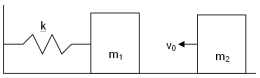
(Multiple Choice)
4.8/5 (77)
(77) A mass of 1.35 kg rests on a frictionless floor and is attached to a wall with a 25.0-cm long spring with spring constant 1250 N/m.The mass is pulled back away from the wall to stretch the spring to a length of 34.5 cm.The mass is then released.The speed of the block when the spring returns to its original (unstretched)length is
(Multiple Choice)
4.8/5 (64)
(64) A mass M = 2.54 kg is attached to a wall with a spring with spring constant k = 375 N/m.The mass slides on a frictionless floor.The spring and mass are immersed in a fluid with damping coefficient 8.25 kg/s.An external sinusoidal horizontal force F(t)= Fdcos( dt),where Fd = 75.4 N,is applied to the mass,causing the mass to oscillate back and forth.You may neglect the mass of the spring.What is the largest amplitude response in the mass's oscillation this driving force can produce?
(Multiple Choice)
4.8/5 (84)
(84) A vertical spring with a spring constant of 4.00 N/m,has a 1.00-kg mass attached to it,and moves in a medium with a damping constant 0.025 kg/s.The mass is released from rest at a position of 3.0 cm from equilibrium position.How long will it take for the amplitude to decrease to 1.0 cm?
(Multiple Choice)
4.9/5 (94)
(94) A 2.0-kg mass is connected to a 5.0-kg mass by a massless rod 32 cm long,as shown in the figure.A hole is then drilled in the rod 11 cm away from the 2.0-kg mass and the rod and masses are free to rotate about this pivot point P.What is the period of rotational oscillations for the masses if they are displaced slightly from equilibrium? 
(Multiple Choice)
4.9/5 (79)
(79) An oscillator has a Q factor of 150.In one period its energy is decreased by
(Multiple Choice)
4.9/5 (77)
(77) A mass m1 = 7.0 kg is at rest on a frictionless horizontal surface and connected to a wall by an ideal spring with a spring constant of k = 50 N/m as shown in the figure.A second mass m2 = 7.0 kg is moving to the left at vO.The two masses then collide elastically.If the maximum compression of the spring is 1.2 m,what was the initial velocity of the second mass (vO)? 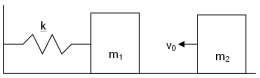
(Multiple Choice)
4.7/5 (79)
(79) Consider the two pendulums shown in the figure.The one on the left has a 2.0-kg mass attached to a 3.0-m long string,while the one on the right has two 1.0-kg masses that are separated by a 2.0-m long string and then hung from another 2.0-m string.Which pendulum will have a shorter period? 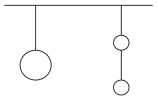
(Multiple Choice)
4.8/5 (70)
(70) A mass of 0.404 kg is attached to a spring with spring constant 204.9 N/m.Its oscillation is damped with a damping constant of b = 15.7 kg/s.What is the angular oscillation frequency of this damped oscillation? (in rad/s)
(Multiple Choice)
4.7/5 (72)
(72) Imagine you are an astronaut who has landed on another planet and you want to determine the free fall acceleration on that planet.In one of the experiments you decided to conduct,you use a pendulum 0.50 m long and find that the period of oscillation for this pendulum is 2.15 s.What is the acceleration of gravity on that planet?
(Multiple Choice)
4.9/5 (82)
(82) A 7.2-kg mass oscillates on a horizontal spring.The position of the object is given by the relation  (all units in MKS).The system is then submerged into a vat of oil with a damping constant of 1.42 kg/s.How long will it take before the amplitude of oscillations becomes 0.314 m?
 (Multiple Choice)
4.9/5 (79)
(79) The position of a particle moving along x-axis is given by x = 0.05 sin (15(rad/s)t + 0.5 rad)m.Its acceleration at t = 0.5 sec is
(Multiple Choice)
4.7/5 (76)
(76) An object connected to a spring oscillates with simple harmonic motion.The amplitude of the motion is A,the equilibrium position is x = 0,the angular frequency is  .What is the speed of the object when it is located at x = A/2? Ignore friction and air resistance.
 (Multiple Choice)
4.7/5 (74)
(74) A 2.0-kg mass is connected to a 5.0-kg mass by a massless rod 32 cm long,as shown in the figure.A hole is then drilled in the rod 11 cm away from the 2.0-kg mass and the rod and masses are free to rotate about this pivot point P.What is the angular frequency of rotational oscillations for the masses if they are displaced slightly from equilibrium? 
(Multiple Choice)
4.9/5 (92)
(92) A mass that can oscillate without friction on a horizontal surface is attached to a horizontal spring and is pulled to the right and is released from rest.The period of the oscillation is 5.60 s.The speed of the mass is  m/s at t = 0.50 s.What is the amplitude of the oscillation?
 (Multiple Choice)
4.8/5 (84)
(84) A vertical spring with a spring constant of 4.00 N/m,has a 1.00-kg mass attached to it,and moves in a medium with a damping constant 0.025 kg/s.The mass is released from rest at a position of 3.00 cm from equilibrium position.What is the amplitude of the oscillation after 20 seconds have elapsed?
(Multiple Choice)
4.9/5 (83)
(83) 
Filters
- Essay(0)
- Multiple Choice(0)
- Short Answer(0)
- True False(0)
- Matching(0)