



 Chat with AI
Exam 14: Oscillations

Exam 1: Overview64 Questions
Exam 2: Motion in a Straight Line81 Questions
Exam 3: Motion in Two and Three Dimensions73 Questions
Exam 4: Force86 Questions
Exam 5: Kinetic Energy, work, and Power70 Questions
Exam 6: Potential Energy and Energy Conservation79 Questions
Exam 7: Momentum and Collisions82 Questions
Exam 8: Systems of Particles and Extended Objects62 Questions
Exam 9: Circular Motion78 Questions
Exam 10: Rotation78 Questions
Exam 11: Static Equilibrium60 Questions
Exam 12: Gravitation73 Questions
Exam 13: Solids and Fluids81 Questions
Exam 14: Oscillations66 Questions
Exam 15: Waves61 Questions
Exam 16: Sound60 Questions
Exam 17: Temperature61 Questions
Exam 18: Heat and the First Law of Thermodynamics67 Questions
Exam 19: Ideal Gases82 Questions
Exam 20: The Second Law of Thermodynamics64 Questions
Exam 21: Electrostatics70 Questions
Exam 22: Electric Fields and Gausss Law74 Questions
Exam 23: Electric Potential75 Questions
Exam 24: Capacitors78 Questions
Exam 25: Current and Resistance80 Questions
Exam 26: Direct Current Circuits63 Questions
Exam 27: Magnetism72 Questions
Exam 28: Magnetic Fields of Moving Charges58 Questions
Exam 29: Electromagnetic Induction85 Questions
Exam 30: Alternating Current Circuits78 Questions
Exam 31: Electromagnetic Waves74 Questions
Exam 32: Geometric Optics63 Questions
Exam 33: Lenses and Optical Instruments77 Questions
Exam 34: Wave Optics76 Questions
Exam 35: Relativity61 Questions
Exam 36: Quantum Physics68 Questions
Exam 37: Quantum Mechanics67 Questions
Exam 38: Atomic Physics72 Questions
Exam 39: Elementary Particle Physics59 Questions
Exam 40: Nuclear Physics77 Questions
Select questions type


The figure shows mass m1 resting on top of mass m2 which is attached to a spring with spring constant 10 N/m,where m1 = m2 = 20 g.The coefficient of static friction between the two masses is 0.6.The masses are oscillating with SMH on a frictionless surface.What is the maximum amplitude of oscillation without m1 slipping off m2? 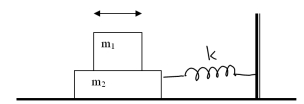

Free
(Multiple Choice)
4.9/5  (75)
(75) Correct Answer: Verified
B
A vertical spring with a spring constant of 4.00 N/m and has a 1.00-kg mass attached to it.The mass is released from rest at a position of 3.00 cm from equilibrium position.If after 100 seconds,the amplitude has decreased to 1.5 cm,what is the damping constant?
Free
(Multiple Choice)
4.7/5 (81)
(81) Correct Answer:Verified
VerifiedE
A vertical spring is hanging from the ceiling with a mass attached to it.The mass is set to oscillate with SHM by pulling on it.Which of the following would increase the frequency of oscillation?
Free
(Multiple Choice)
4.8/5 (79)
(79) Correct Answer:Verified
VerifiedD
An object is undergoing simple harmonic motion.The equation of motion of the object is y = Asin( t+ ).The equation for the acceleration as a function of time is
(Multiple Choice)
4.8/5 (78)
(78) Simple harmonic motion requires that the magnitude of the net restoring force is proportional to the magnitude of which quantity?
(Multiple Choice)
4.9/5 (84)
(84) Water fills a length of 25 cm of a U tube.Water is slightly displaced and allowed to move freely inside the tube. 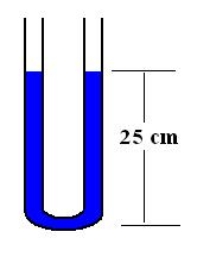 Assuming the amount of water in the curved section of the U-tube is negligible,what is the period of its motion?
 (Multiple Choice)
4.9/5 (67)
(67) In the small angle approximation,the angle must be measured in
(Multiple Choice)
4.8/5 (71)
(71) A spring of with a constant k is attached to a mass M.In order to double the frequency of oscillation of this system,I should
(Multiple Choice)
4.9/5 (75)
(75) The period of a 1.30-m long simple pendulum in an elevator that is 2.52 s.The elevator is accelerating uniformly.What is the acceleration of the elevator?
(Multiple Choice)
4.9/5 (75)
(75) A 250-g metal cube connected to a light spring of constant 25 N/m oscillates on a horizontal,frictionless surface.The amplitude of its motion is 4 cm.The maximum velocity is
(Multiple Choice)
4.9/5 (83)
(83) A 5-kg block is attached to a horizontal spring of constant 500 N/m.It is pulled 20 cm from its equilibrium position and released.What is its angular frequency?
(Multiple Choice)
4.9/5 (77)
(77) A spring is suspended from the ceiling.When a mass of m kg is attached to the spring,it stretches d1 m.The mass is then pulled down an additional d2 m and released.Which one of the following statements is true concerning the equation of motion of the mass? 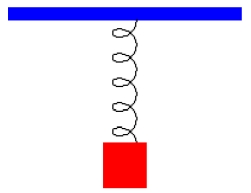
(Multiple Choice)
4.9/5 (73)
(73) When the displacement of a mass on a spring is one half of the amplitude of its oscillation,what fraction of the total energy is potential energy?
(Multiple Choice)
4.8/5 (80)
(80) A particle in simple harmonic motion has an angular frequency of 24 rad/s.Its maximum velocity is 25 m/s.What is its maximum acceleration?
(Multiple Choice)
4.8/5 (79)
(79) A grandfather clock oscillates both on Earth and on the Moon.Where is the period of oscillation the greatest?
(Multiple Choice)
4.8/5 (95)
(95) What is the total energy of a 15-kg mass attached to a spring oscillating horizontally with an amplitude of 20 cm and an angular frequency of 32 rad/s?
(Multiple Choice)
4.8/5 (94)
(94) A 2.0-kg mass attached to a spring is displaced 8.0 cm from equilibrium position.It is released and it oscillates with a frequency of 4.0 Hz.What is the speed of the block when it is 6.5 cm from equilibrium? Assume that the surface is frictionless.
(Multiple Choice)
4.9/5 (62)
(62) A mass m1 = 7.0 kg is at rest on a frictionless horizontal surface and connected to a wall by an ideal spring with a spring constant of k = 50 N/m as shown in the figure.A second mass m2 = 5.0 kg is moving to the left at vO.The two masses then collide and stick together.If the maximum compression of the spring is 1.2 m,what was the initial velocity of the second mass (vO)? 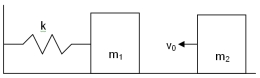
(Multiple Choice)
4.8/5 (78)
(78) A mass M = 2.54 kg is attached to a wall with a spring with spring constant k = 375 N/m.The mass slides on a frictionless floor.The spring and mass are immersed in a fluid with damping coefficient 8.25 kg/s.An external sinusoidal horizontal force F(t)= Fdcos( dt),where Fd = 75.4 N,is applied to the mass,causing the mass to oscillate back and forth.You may neglect the mass of the spring.The driving frequency d that will produce the largest amplitude response in the mass's oscillation is
(Multiple Choice)
4.8/5 (81)
(81) A mass m1 = 7.0 kg is at rest on a frictionless horizontal surface and connected to a wall by an ideal spring with a spring constant of k = 50 N/m as shown in the figure.A second mass m2 = 3.0 kg is moving to the left at vO = 8.0 m/s.The two masses then collide and stick together.What is the maximum compression of the spring? 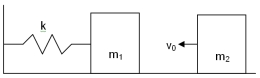
(Multiple Choice)
4.9/5 (92)
(92) 
Filters
- Essay(0)
- Multiple Choice(0)
- Short Answer(0)
- True False(0)
- Matching(0)