



 Chat with AI
Exam 24: Capacitors

Exam 1: Overview64 Questions
Exam 2: Motion in a Straight Line81 Questions
Exam 3: Motion in Two and Three Dimensions73 Questions
Exam 4: Force86 Questions
Exam 5: Kinetic Energy, work, and Power70 Questions
Exam 6: Potential Energy and Energy Conservation79 Questions
Exam 7: Momentum and Collisions82 Questions
Exam 8: Systems of Particles and Extended Objects62 Questions
Exam 9: Circular Motion78 Questions
Exam 10: Rotation78 Questions
Exam 11: Static Equilibrium60 Questions
Exam 12: Gravitation73 Questions
Exam 13: Solids and Fluids81 Questions
Exam 14: Oscillations66 Questions
Exam 15: Waves61 Questions
Exam 16: Sound60 Questions
Exam 17: Temperature61 Questions
Exam 18: Heat and the First Law of Thermodynamics67 Questions
Exam 19: Ideal Gases82 Questions
Exam 20: The Second Law of Thermodynamics64 Questions
Exam 21: Electrostatics70 Questions
Exam 22: Electric Fields and Gausss Law74 Questions
Exam 23: Electric Potential75 Questions
Exam 24: Capacitors78 Questions
Exam 25: Current and Resistance80 Questions
Exam 26: Direct Current Circuits63 Questions
Exam 27: Magnetism72 Questions
Exam 28: Magnetic Fields of Moving Charges58 Questions
Exam 29: Electromagnetic Induction85 Questions
Exam 30: Alternating Current Circuits78 Questions
Exam 31: Electromagnetic Waves74 Questions
Exam 32: Geometric Optics63 Questions
Exam 33: Lenses and Optical Instruments77 Questions
Exam 34: Wave Optics76 Questions
Exam 35: Relativity61 Questions
Exam 36: Quantum Physics68 Questions
Exam 37: Quantum Mechanics67 Questions
Exam 38: Atomic Physics72 Questions
Exam 39: Elementary Particle Physics59 Questions
Exam 40: Nuclear Physics77 Questions
Select questions type


Capacitors connected in series always have the same

Free
(Multiple Choice)
4.8/5  (73)
(73) Correct Answer: Verified
B
Suppose we have two capacitors connected in parallel with a 10 V battery.What is the energy stored in the circuit if the capacitance of one is C1 = 50 mF and the other is C2 = 100 mF?
Free
(Multiple Choice)
4.8/5 (97)
(97) Correct Answer:Verified
VerifiedE
Which of the following capacitors have the smallest charge?
Free
(Multiple Choice)
4.7/5 (84)
(84) Correct Answer:Verified
VerifiedC
A proton traveling at speed of 1.0 * 106 m/s enters the gap between the plates of a 2.0-cm-wide parallel-plate capacitor along x-axis.The surface charge densities on the plates are = 1.0 * 10-6 C/m2.How far has the proton been deflected sideways ( y)when it reaches the far edge of the capacitor? Assume the electric field is uniform inside the capacitor and zero outside. 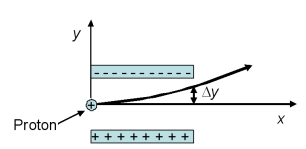
(Multiple Choice)
4.7/5 (82)
(82) Consider the assembly of capacitors shown here.Let C1 = C2 = C3 = C4 = 20 mF.What is the equivalent capacitance of this circuit? 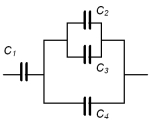
(Multiple Choice)
4.8/5 (79)
(79) What is the radius of a steel sphere having a capacitance of radius 1.5 pF?
(Multiple Choice)
4.8/5 (77)
(77) An uncharged parallel plate capacitor with an air gap is connected to a 6.0-V battery.After charging,the energy stored in the capacitor is 40 nJ.If each of the plates has an area of 10 cm2,what is the magnitude of the electric field between the plates?
(Multiple Choice)
5.0/5 (94)
(94) A 10-nF is connected in series with a 20-nF capacitor.This combination is then placed in parallel with a 30-nF capacitor.This combination is then placed parallel to a 9.0-V battery.What is the charge on the 20-nF capacitor.
(Multiple Choice)
4.9/5 (81)
(81) A spherical shell capacitor is 1 cm in radius with the outside shell 1 mm beyond this.What is the capacitance of this combination?
(Multiple Choice)
4.7/5 (85)
(85) A 1.50-µF capacitor charged to 40.0 V and a 2.40-µF capacitor charged to 15.0 V are connected to each other,with the positive plate of each connected to the negative plate of the other.What is the final electric potential across the 1.50-µF capacitor?
(Multiple Choice)
4.8/5 (85)
(85) What is the capacitance of two parallel plates 0.9 mm apart with an area of 12 cm2 if the space between the plates is filled with a material with dielectric constant of 3.7?
(Multiple Choice)
4.9/5 (83)
(83) In circuit shown,calculate the charge on C3,where = 10 V,C1 = C2 = 6 F and C3 = 3 F. 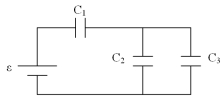
(Multiple Choice)
4.9/5 (68)
(68) A 1.50-µF capacitor charged to 40.0 V and a 2.40-µF capacitor charged to 15.0 V are connected to each other,with the positive plate of each connected to the negative plate of the other.What is the final charge on the 2.4-µF capacitor?
(Multiple Choice)
4.8/5 (81)
(81) A parallel plate capacitor connected to a 2-V battery consists of two 1-cm square plates separated by 1 mm of air.How much work is done in inserting a sheet with a dielectric constant of 1.5 between the plates (in units of 10-13 J)?
(Multiple Choice)
4.9/5 (90)
(90) Two capacitors C1 = 2.5 mF and C2 = 5.0 mF are connected in parallel.If a voltage of V = 120 volts is applied across the capacitors,what is the energy stored in the capacitors?
(Multiple Choice)
4.8/5 (74)
(74) Three capacitors of capacity 4,6,and 8 µF are connected in series with a battery of 13 V.The potential difference across the 6-µF capacitance is
(Multiple Choice)
5.0/5 (77)
(77) A 3.0-nF parallel plate capacitor with a sheet of mylar (k = 3.1)filling the space between the plates is connected to a 150-V battery.While it is still connected to the battery,the sheet of mylar is completely removed from the space between the two plates.Determine the change in energy stored in the capacitor?
(Multiple Choice)
4.8/5 (70)
(70) A 1.50-µF capacitor charged to 40.0 V and a 2.40-µF capacitor charged to 15.0 V are connected to each other,with the positive plate of each connected to the negative plate of the other.What is the final charge on the 1.50-µF capacitor?
(Multiple Choice)
4.9/5 (82)
(82) Consider a capacitor that consists of two parallel plates,one of which can move relative to the other.Air fills the space between the plates,the capacitance is 25.0 pF when the separation between plates is d = 0.450 cm.A battery with potential difference V=11.1 V is connected to the plates.What is the charge density on the left plate?
(Multiple Choice)
4.8/5 (89)
(89) 
Filters
- Essay(0)
- Multiple Choice(0)
- Short Answer(0)
- True False(0)
- Matching(0)