



 Chat with AI
Exam 12: Gravitation

Exam 1: Overview64 Questions
Exam 2: Motion in a Straight Line81 Questions
Exam 3: Motion in Two and Three Dimensions73 Questions
Exam 4: Force86 Questions
Exam 5: Kinetic Energy, work, and Power70 Questions
Exam 6: Potential Energy and Energy Conservation79 Questions
Exam 7: Momentum and Collisions82 Questions
Exam 8: Systems of Particles and Extended Objects62 Questions
Exam 9: Circular Motion78 Questions
Exam 10: Rotation78 Questions
Exam 11: Static Equilibrium60 Questions
Exam 12: Gravitation73 Questions
Exam 13: Solids and Fluids81 Questions
Exam 14: Oscillations66 Questions
Exam 15: Waves61 Questions
Exam 16: Sound60 Questions
Exam 17: Temperature61 Questions
Exam 18: Heat and the First Law of Thermodynamics67 Questions
Exam 19: Ideal Gases82 Questions
Exam 20: The Second Law of Thermodynamics64 Questions
Exam 21: Electrostatics70 Questions
Exam 22: Electric Fields and Gausss Law74 Questions
Exam 23: Electric Potential75 Questions
Exam 24: Capacitors78 Questions
Exam 25: Current and Resistance80 Questions
Exam 26: Direct Current Circuits63 Questions
Exam 27: Magnetism72 Questions
Exam 28: Magnetic Fields of Moving Charges58 Questions
Exam 29: Electromagnetic Induction85 Questions
Exam 30: Alternating Current Circuits78 Questions
Exam 31: Electromagnetic Waves74 Questions
Exam 32: Geometric Optics63 Questions
Exam 33: Lenses and Optical Instruments77 Questions
Exam 34: Wave Optics76 Questions
Exam 35: Relativity61 Questions
Exam 36: Quantum Physics68 Questions
Exam 37: Quantum Mechanics67 Questions
Exam 38: Atomic Physics72 Questions
Exam 39: Elementary Particle Physics59 Questions
Exam 40: Nuclear Physics77 Questions
Select questions type


An astronaut on the surface of a strange planet observes that the acceleration of gravity is 7 m/s2.What could be an explanation of this phenomenon?

Free
(Multiple Choice)
4.8/5  (80)
(80) Correct Answer: Verified
E
Four identical subatomic particles,each of mass m,are initially at rest and located on the four corners of a square,one at each corner.The length of each side of the square is L.There aren't any other forces on the particles besides the gravitational force.What is the magnitude of their initial accelerations?
Free
(Multiple Choice)
4.8/5 (64)
(64) Correct Answer:Verified
VerifiedD
What is the escape speed from a spherical asteroid of radius 15 km,whose mass density is approximately half that of the Earth,or 2.8 g/cm3?
Free
(Multiple Choice)
4.9/5 (81)
(81) Correct Answer:Verified
VerifiedC
A spherical planet has twice the mass and twice the radius of the Earth.If a man weighs 810 N on Earth,what would his weight be on the surface of that planet?
(Multiple Choice)
4.9/5 (91)
(91) The escape velocity of a rocket launched from position A,the center of the three planet system depicted in the figure is 12.6 km/s.Each planet has the same mass and radius R = 106 m,and the center-to-center distance between any two planets is 10 R.What is the mass of one of the three planets? 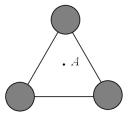
(Multiple Choice)
4.9/5 (71)
(71) What is the difference in the acceleration due to gravity between your head and your feet.Assume your height is 1.80 m. Mass of the Earth: 5.98 * 1024 kg
Radius of the Earth: 6.38 * 106 m
(Multiple Choice)
4.9/5 (86)
(86) A particle of mass m is located at a distance r from the center of a sphere of mass M and radius R.The force on the particle as a function of distance r,inside the sphere is given by
(Multiple Choice)
4.8/5 (77)
(77) Two stars,S1 and S2,attract each other gravitationally with a force of magnitude
(Multiple Choice)
4.7/5 (86)
(86) The figure shows a system of three masses.What is the direction of the gravitational force on the 10-kg mass? The center-to-center distances between masses are shown in the diagram. 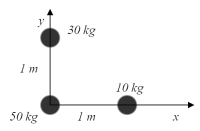
(Multiple Choice)
4.8/5 (80)
(80) For two identical satellites in circular motions around the Earth which statement is true?
(Multiple Choice)
4.8/5 (73)
(73) The escape velocity of a rocket launched from position A,the center of the three planet system depicted in the figure is 12.6 km/s.Each planet has mass M = 1024 kg,radius R ,and the center-to-center distance between any two planets is 10 R.What is the radius of one of the three planets? 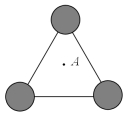
(Multiple Choice)
4.8/5 (83)
(83) How much energy does it take to move a 300-kg satellite from an orbit 300 km above the Earth's surface to an orbit 600 km above the Earth's surface?
(Multiple Choice)
4.9/5 (84)
(84) The free fall acceleration at the altitude h is 9.00 m/s2.If R is the radius of the Earth,then the altitude h is
(Multiple Choice)
4.9/5 (79)
(79) The figure shows a system of three masses.If the 30-kg mass is released,what is the magnitude of its initial acceleration? The center-to-center distances between masses are shown in the diagram. 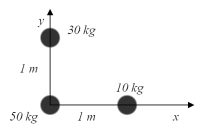
(Multiple Choice)
4.8/5 (98)
(98) You wish to place a geo-stationary satellite to study Jupiter's Great Red Spot,how high above the surface must it be placed? Possibly useful information:
Mass of Jupiter: 1.90 * 1027 kg
Radius of Jupiter: 7.15 * 107 m
Rotational Period: 9.925 h
(Multiple Choice)
4.8/5 (84)
(84) A spaceship is fired from the Earth's surface with a speed of v.The radius of the Earth is R,the mass of the Earth is M,and the universal gravitational constant is
(Multiple Choice)
4.8/5 (74)
(74) What is the orbital velocity of a 100-kg satellite orbiting at an altitude of 1000 km above the surface of the Earth?
(Multiple Choice)
5.0/5 (73)
(73) A 51-kg satellite is put into orbit 37,000 km above the Earth's surface.What is its kinetic energy?
(Multiple Choice)
4.8/5 (78)
(78) The mass of Jupiter is 1.9 * 1027 kg and its radius 7.14 * 107 m.The gravitational field strength at its surface is
(Multiple Choice)
4.9/5 (72)
(72) A satellite is put into orbit 37,000 km above the Earth's surface and has a kinetic energy of 105 MJ.What is the mass of the satellite?
(Multiple Choice)
4.8/5 (72)
(72) 
Filters
- Essay(0)
- Multiple Choice(0)
- Short Answer(0)
- True False(0)
- Matching(0)