



 Chat with AI
Exam 21: Electrostatics

Exam 1: Overview64 Questions
Exam 2: Motion in a Straight Line81 Questions
Exam 3: Motion in Two and Three Dimensions73 Questions
Exam 4: Force86 Questions
Exam 5: Kinetic Energy, work, and Power70 Questions
Exam 6: Potential Energy and Energy Conservation79 Questions
Exam 7: Momentum and Collisions82 Questions
Exam 8: Systems of Particles and Extended Objects62 Questions
Exam 9: Circular Motion78 Questions
Exam 10: Rotation78 Questions
Exam 11: Static Equilibrium60 Questions
Exam 12: Gravitation73 Questions
Exam 13: Solids and Fluids81 Questions
Exam 14: Oscillations66 Questions
Exam 15: Waves61 Questions
Exam 16: Sound60 Questions
Exam 17: Temperature61 Questions
Exam 18: Heat and the First Law of Thermodynamics67 Questions
Exam 19: Ideal Gases82 Questions
Exam 20: The Second Law of Thermodynamics64 Questions
Exam 21: Electrostatics70 Questions
Exam 22: Electric Fields and Gausss Law74 Questions
Exam 23: Electric Potential75 Questions
Exam 24: Capacitors78 Questions
Exam 25: Current and Resistance80 Questions
Exam 26: Direct Current Circuits63 Questions
Exam 27: Magnetism72 Questions
Exam 28: Magnetic Fields of Moving Charges58 Questions
Exam 29: Electromagnetic Induction85 Questions
Exam 30: Alternating Current Circuits78 Questions
Exam 31: Electromagnetic Waves74 Questions
Exam 32: Geometric Optics63 Questions
Exam 33: Lenses and Optical Instruments77 Questions
Exam 34: Wave Optics76 Questions
Exam 35: Relativity61 Questions
Exam 36: Quantum Physics68 Questions
Exam 37: Quantum Mechanics67 Questions
Exam 38: Atomic Physics72 Questions
Exam 39: Elementary Particle Physics59 Questions
Exam 40: Nuclear Physics77 Questions
Select questions type


According to the Bohr model of the atom,an electron orbits the nucleus in a circular orbit.Find the linear speed of an electron in a circular orbit around a proton.Ignore any relativistic or quantum effects. Mass of the electron: 9.11 * 10-31 kg
Mass of the proton: 1.67 *10-27 kg
Radius of orbit: 5.29 *10-11 m
(Multiple Choice)
4.9/5  (92)
(92) Identical point charges Q are placed at each of the four corners of a 1.0 m * 2.0 m rectangle.If Q = 35 µC,what is the magnitude of the electrostatic force on any one of the charges?
(Multiple Choice)
4.9/5 (74)
(74) According to the Bohr model of the atom,an electron orbits the nucleus in a circular orbit.Find the acceleration of an electron in a circular orbit around a proton.Ignore any relativistic or quantum effects. Mass of the electron: 9.11 * 10-31 kg
Mass of the proton: 1.67 * 10-27 kg
Radius of orbit: 5.29* 10-11 m
(Multiple Choice)
5.0/5 (95)
(95) When two charges are separated by a distance d,the magnitude of the electrostatic force between them is F. What would be the magnitude of the electrostatic force between them if the separation distance was d/2?
(Multiple Choice)
4.9/5 (78)
(78) In Bohr's model of the hydrogen atom an electron revolves in a circular orbit of radius 0.053 nm around a proton.The number of revolutions made by the electron in one second is
(Multiple Choice)
4.9/5 (94)
(94) Two spheres carry electric charge,and a third charged sphere is now placed somewhere on the line that runs through the two spheres' centers.If the result of the placement of the third charge is that there is no net electrostatic force on each of the two original spheres,what can be said?
(Multiple Choice)
4.8/5 (83)
(83) Three charges of equal magnitude Q are held in the configuration shown.If a small positive charge,q,is placed at the origin what will be the magnitude and direction of the force it experiences? (Note: Pay attention to the sign on each of the three charges.) 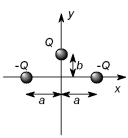
(Multiple Choice)
4.9/5 (85)
(85) Three point charges are placed on the x-axis as shown.Assume that Q1 = 2.40 C,Q2 = -Q1,and Q3 = Q1.The coordinates of the point charges are x1 = -0.100 m,x2 = 0.120 m,x3 = 0.300 m.What is the force (in N)on Q2? 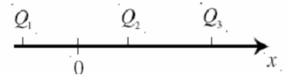
(Multiple Choice)
4.9/5 (79)
(79) Two initially uncharged identical metal spheres 1 and 2 are connected by an insulating spring (unstretched length of 0.68 m).Charge +6.2 C is placed on the first sphere and -6.2 C on the second sphere,causing the spring to contract to a length of 0.43 m.If someone coats the spring with metal to make it conducting,what is the new length of the spring? Recall that the force exerted by a spring is k x,where x is the change in the spring's length from its unstretched/uncompressed length.
(Multiple Choice)
4.8/5 (87)
(87) For a hydrogen atom of radius 10-10 m how does the ratio of the gravitational force between the electron and the proton to the electrostatic force Fg/Fe change if the atomic radius is doubled?
(Multiple Choice)
4.9/5 (64)
(64) 
Filters
- Essay(0)
- Multiple Choice(0)
- Short Answer(0)
- True False(0)
- Matching(0)