



 Chat with AI
Exam 33: Lenses and Optical Instruments

Exam 1: Overview64 Questions
Exam 2: Motion in a Straight Line81 Questions
Exam 3: Motion in Two and Three Dimensions73 Questions
Exam 4: Force86 Questions
Exam 5: Kinetic Energy, work, and Power70 Questions
Exam 6: Potential Energy and Energy Conservation79 Questions
Exam 7: Momentum and Collisions82 Questions
Exam 8: Systems of Particles and Extended Objects62 Questions
Exam 9: Circular Motion78 Questions
Exam 10: Rotation78 Questions
Exam 11: Static Equilibrium60 Questions
Exam 12: Gravitation73 Questions
Exam 13: Solids and Fluids81 Questions
Exam 14: Oscillations66 Questions
Exam 15: Waves61 Questions
Exam 16: Sound60 Questions
Exam 17: Temperature61 Questions
Exam 18: Heat and the First Law of Thermodynamics67 Questions
Exam 19: Ideal Gases82 Questions
Exam 20: The Second Law of Thermodynamics64 Questions
Exam 21: Electrostatics70 Questions
Exam 22: Electric Fields and Gausss Law74 Questions
Exam 23: Electric Potential75 Questions
Exam 24: Capacitors78 Questions
Exam 25: Current and Resistance80 Questions
Exam 26: Direct Current Circuits63 Questions
Exam 27: Magnetism72 Questions
Exam 28: Magnetic Fields of Moving Charges58 Questions
Exam 29: Electromagnetic Induction85 Questions
Exam 30: Alternating Current Circuits78 Questions
Exam 31: Electromagnetic Waves74 Questions
Exam 32: Geometric Optics63 Questions
Exam 33: Lenses and Optical Instruments77 Questions
Exam 34: Wave Optics76 Questions
Exam 35: Relativity61 Questions
Exam 36: Quantum Physics68 Questions
Exam 37: Quantum Mechanics67 Questions
Exam 38: Atomic Physics72 Questions
Exam 39: Elementary Particle Physics59 Questions
Exam 40: Nuclear Physics77 Questions
Select questions type


A diverging lens is fabricated from a piece of glass with an index of refraction of 1.5.It is ground such that one surface of the lens is convex and the other surface is concave.The convex surface is part of a sphere with a radius of 45 cm and the concave surface is part of a sphere with a radius of 20 cm.What is the power of this lens in diopters?
(Multiple Choice)
4.8/5  (81)
(81) A physics student epoxies two converging lenses to the opposite ends of a 20-cm long tube.One lens has a focal length of f1 = 4.0 cm and the other has a focal length of f2 = 2.0 cm.She wants to use this device as a microscope.What is the magnification of this homemade microscope?
(Multiple Choice)
4.9/5 (84)
(84) A thin spherical lens is fabricated from glass with an index of refraction of 1.5.The lens is fabricated so that it bulges outwards in the middle on both sides,and has been ground so that the surfaces are part of a sphere with a radius of 20 cm on one side and a radius of 50 cm on the other.What is the power of this lens in diopters?
(Multiple Choice)
4.9/5 (82)
(82) Suppose a reflecting telescope consists of a convex spherical mirror with a radius of curvature R =15.0 m and an eyepiece lens of focal length fe = 30.0 cm.What is the magnitude of the magnification of this telescope?
(Multiple Choice)
4.9/5 (70)
(70) A bracken fern spore produces an image that is 7.5 cm tall when placed before a converging lens of focal length 5.0 cm.If the spore's true height is 1.5 mm,how far from the lens was it placed?
(Multiple Choice)
4.9/5 (81)
(81) The greatest distance a person can see an object in focus is 35.0 cm in front of his eyes.What power of eyeglasses should he wear in order to see distant objects clearly? His eyeglasses sit 2.0 cm in front of his eyes.
(Multiple Choice)
4.7/5 (84)
(84) A person wears bifocal glasses and is reading a newspaper a distance of 20.0 cm away.The lower part of the lens is converging for reading and has a focal length of 70.0 cm.The upper part of the lens is diverging for seeing at distances far away and has a focal length of 50.0 cm.What is the uncorrected far point for the person?
(Multiple Choice)
4.9/5 (61)
(61) A system of two converging lenses 7.5 cm apart from each other is used to examine a leaf from a distance (to the first lens)of 25 cm.If the focal lengths of the two lenses are 12 cm and 17 cm,respectively,what is the magnification of the image?
(Multiple Choice)
4.8/5 (79)
(79) A real image is formed with a converging lens.Which of the following actions will move the image point farther from the lens?
(Multiple Choice)
4.8/5 (76)
(76) A diver with 20/20 vision removes his mask underwater.What can be said about how the diver sees without his mask underwater? The index of refraction of water is 1.3 and the index of refraction for a human lens is 1.4.
(Multiple Choice)
5.0/5 (79)
(79) Two lenses are used to create an image of a 15.0-cm tall source that is located 43.0 cm to the left of the first lens,which is a biconcave thin polycarbonate lens (index of refraction n = 1.67)and has a radius of curvature of 25.0 cm for both front and back surfaces.The second lens is 36.0 cm to the right of the first lens.The second lens is a converging lens with a focal length magnitude of 25.0 cm.At what position relative to the object does the image get formed?
(Multiple Choice)
4.8/5 (64)
(64) A lens with an unknown focal length forms an image of an object that is 12 cm away from the lens,inverted,and a factor of 3.0 larger in size than the object.Where is the object located?
(Multiple Choice)
4.9/5 (84)
(84) A physics student epoxies two converging lenses to the opposite ends of a 20-cm long tube.One lens has a focal length of f1 = 4.0 cm.She wants to use this device as a microscope.If the desired magnification of this homemade microscope is 80,what focal length should the student use for the the second lens?
(Multiple Choice)
4.8/5 (69)
(69) A convex lens with index of refraction n = 1.60 has two spherical surfaces as shown in the diagram.The radius of curvature of the left face is r1 = 1.50 m.The radius of curvature of the right face is r2 = 1.70 m.What is the focal length (in m)of this lens? 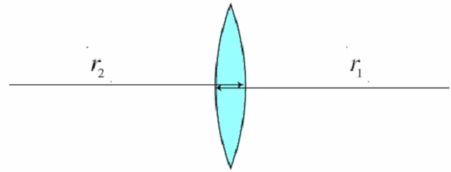
(Multiple Choice)
4.9/5 (71)
(71) The objective lens in a laboratory microscope has a focal length 4.00 cm and provides an overall magnification of 250.What is the focal length of the eyepiece if the distance between the two lenses is 32.0 cm?
(Multiple Choice)
4.9/5 (80)
(80) The focal length of the lens of a camera is 38.0 mm.How far must the lens be moved to change focus from a person 50.0 m away to one that is 5.0 m away?
(Multiple Choice)
4.9/5 (71)
(71) Laser-Assisted in Situ Keratomileusis (LASIK)surgery uses a laser to modify the
(Multiple Choice)
4.8/5 (81)
(81) Three converging lenses of focal length 5 cm are arranged with a spacing of 20 cm between them,and are used to image an insect 20 cm away from the first lens.Where is the image with respect to the third lens?
(Multiple Choice)
4.8/5 (79)
(79) A person wears bifocal glasses and is reading a newspaper a distance of 20.0 cm away.The lower part of the lens is converging for reading and has a focal length of 70.0 cm.The upper part of the lens is diverging for seeing at distances far away and has a focal length of 50.0 cm.What is the uncorrected near point for the person?
(Multiple Choice)
4.9/5 (80)
(80) An object is moved from a distance of 30 cm to a distance of 10 cm in front of a converging lens of focal length 20 cm.What happens to the image?
(Multiple Choice)
4.9/5 (74)
(74) 
Filters
- Essay(0)
- Multiple Choice(0)
- Short Answer(0)
- True False(0)
- Matching(0)